
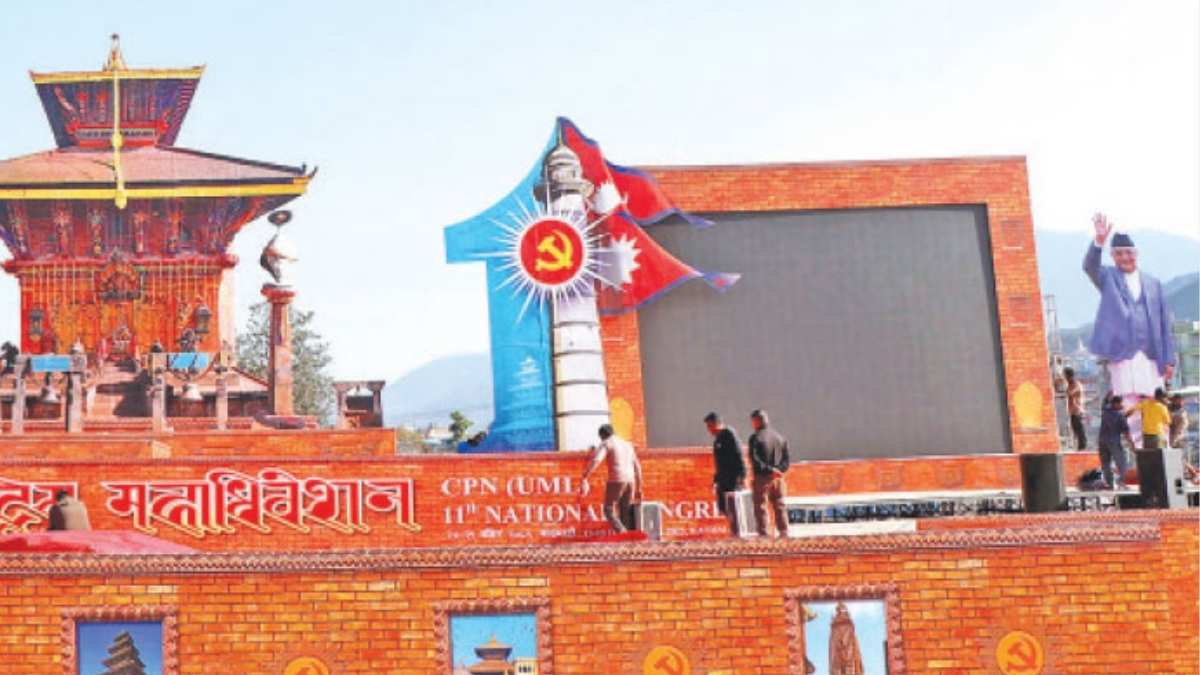
Image via Facebook
Ask Nepal’s disgraced communists and they’ll tell you their three-day general convention that started on December 13th is a robust exercise in inner-party democracy. Look past the staged spectacle of thousands of cadres and the heavy police presence, however, and you’ll see an institution in a panic. The Communist Party of Nepal (Unified Marxist-Leninist), or UML, is holding this gathering a year early for one reason: it’s trying to figure out how to survive.
Three months ago the party’s ageing chairman, KP Sharma Oli, was forced to resign as prime minister after a youth-led uprising that saw dozens of protesters killed by police. The UML, long the country’s dominant political machine, was shaken to its core. Public rage focused squarely on its out-of-touch leadership. This convention, which concludes with leadership elections on December 15th, is the party’s first attempt to process that shock. Its response will define not just the UML’s future, but Nepal’s fragile democratic trajectory.
The party’s problem is a common one for entrenched political elites everywhere, but it’s particularly acute in Kathmandu. A younger generation, wearied by corruption and economic stagnation, has utterly lost patience with the old guard. The UML’s initial reaction to September’s protests was denial and deflection. Mr Oli has dismissed the legitimacy of the interim government that replaced his and questioned the motives of the young protesters. He treats the crisis as a public-relations problem rather than an existential warning.
That’s why the challenge from within is so significant. Recently Ishwar Pokhrel, the UML’s senior vice-chairman, did the unthinkable by announcing he would contest Mr Oli for the top job. Mr Pokhrel is no liberal reformer: he’s a party stalwart in his seventies. But his critique is scathing. He says internal debate has withered, that the leadership is too centralised and that the party catastrophically misread the public mood. His candidacy is a vehicle for the unease of many senior figures. It’s a plea for adaptation from within the castle walls.
Mr Oli, predictably, is resisting. His camp’s pre-convention manoeuvring was revealing: they tried to expand the number of senior party posts, a blatant bid to buy loyalty and smother dissent. Mr Pokhrel’s faction blocked the move. That a challenger could stymie the chairman is a small sign of life in a rigid system. But let’s not get carried away. This isn’t a generational shift. It is a power struggle between grey-haired factions. The real test isn’t who wins, but whether the victor understands the scale of the disconnect between the party and the country.
A resounding victory for Mr Oli would signal continuity. It would mean a return to confrontational politics and a stubborn refusal to engage with the demands for accountability and renewal that fuelled September’s fires. A narrow win, or a strong showing for Mr Pokhrel’s slate, would at least force a conversation about renewal. It might begin to crack the door for a long-overdue rejuvenation of Nepal’s politics.
The UML’s dilemma is one example of a global phenomenon. Established parties everywhere are struggling to channel the energy and anger of younger citizens. They can either find ways to admit new ideas and new faces, or they can double down on the old ways and watch their relevance slowly ebb away. For Nepal the stakes are high. The country needs a stable, responsive political system to tackle its deep economic and social challenges. The UML, as the dominant force, has a responsibility to lead that renewal.
This week in the closed-door meetings in Kathmandu, the party’s delegates aren’t just voting for a chairman. They can anoint a leader who sees the September protests as an inconvenience, or they can empower those who see them as an urgent alarm. The correct choice is obvious. A party that can’t change when the world around it is shouting for change is a party with a death wish. ■




