
Image: Mahmut Yılmaz
For a brief, heady period at the turn of the millennium, the path to prosperity for the world’s poorer nations seemed obvious. Global capital, seeking yield and fresh markets, would flow downhill from rich economies to emerging ones. Factories would spring up in Vietnam’s industrial parks or Ethiopia’s burgeoning manufacturing zones. Workers would move from farm to assembly line. And the gap between the West and the rest would narrow. For a time, it worked. In 2008 foreign direct investment (FDI) into emerging market and developing economies (EMDEs) was a torrent, amounting to roughly 5% of their combined GDP (see chart below).
Today that torrent has slowed to a trickle. By 2023 the ratio of FDI to GDP in the median developing economy had collapsed to just over 2%, less than half its peak. This is not just a cyclical dip caused by high interest rates or a post-pandemic hangover. It looks increasingly like a lasting change. The retreating tide of global capital is exposing a rocky shoreline of geopolitical fragmentation and economic vulnerability, leaving the world’s most desperate citizens stranded.
Also read: Foreign capital is changing. So is its power to transform poor nations
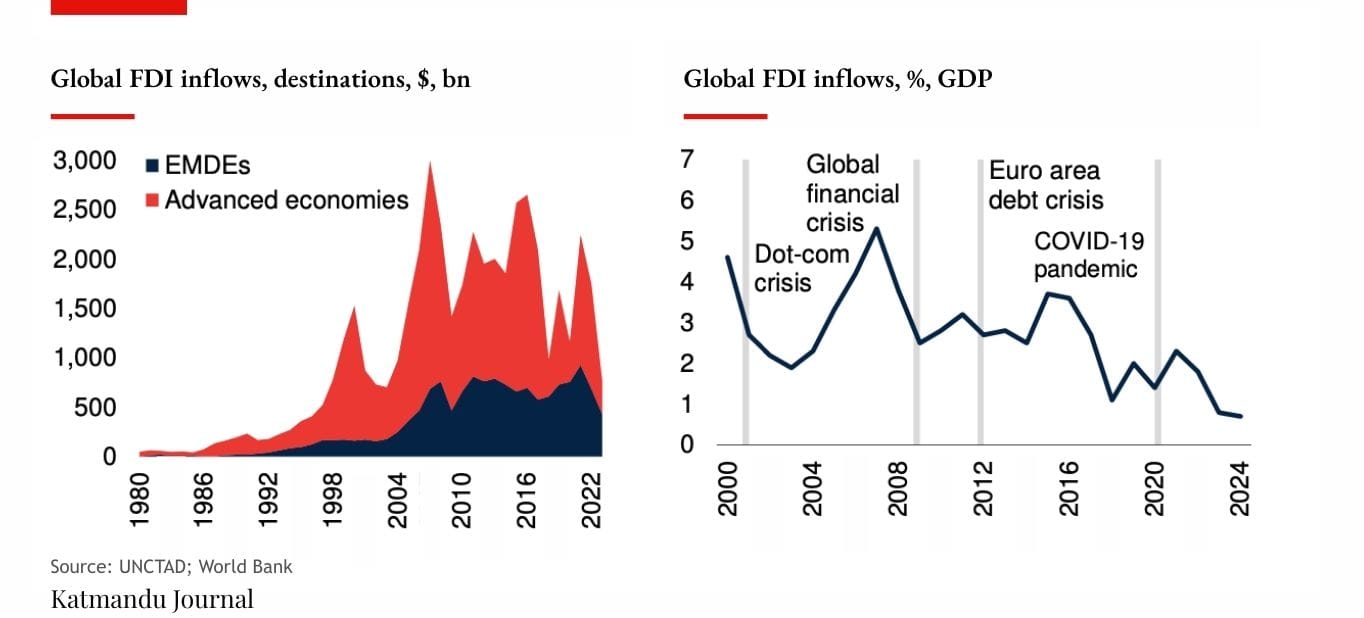
The plunge is as uneven as it is steep. Although the headline figures are grim, the pain is concentrated in the poorest places. Low-income countries, a group that includes much of sub-Saharan Africa, now fight over crumbs, receiving less than 1% of global FDI. Meanwhile, the lions’ share of what little investment remains is being devoured by a few giants. Between 2012 and 2023, China absorbed nearly a third of all inflows to the developing world, with Brazil and India swallowing another sixth. For the remaining 150-odd nations, the competition for capital has become a zero-sum game played with loaded dice.
The nature of the money is changing, too, in ways that make traditional development harder. The classic image of FDI—a car plant or a textile mill—is becoming outdated. In the early 2000s, services made up less than half of foreign investment; recently they have accounted for nearly two-thirds. This pivot towards “servitization” favours countries with reliable electricity, as well as high-speed internet and skilled workforces. A software hub in Bangalore or a fintech center in São Paulo creates value, certainly, but it does not absorb unskilled labour or drive mass industrialization the way a factory does. The ladder of development is not just missing rungs; it is being pulled up, too.
This capital drought could not have come at a worse time. Developing nations are facing a formidable list of bills, ranging from the infrastructure deficits of the last decade and soaring debts to the astronomical costs of the climate transition. The green transition requires a massive injection of capital into the very regions where the sun shines brightest and the wind blows hardest. Yet despite a rise in investment in environmental technologies, the money is not flowing to where it would do the most good. Investors are wary of the “pollution haven” effect—where lax rules attract dirty industry—but they are equally spooked by regulatory uncertainty in green sectors.
The culprit for this retreat is a toxic cocktail of domestic weakness and global anxiety. Domestically, many emerging markets have failed to tend their gardens. Political instability, corruption and a lack of clear property rights act as potent repellents to capital that is already jittery. But the bigger chill comes from abroad. The era of efficiency-seeking globalization, where companies built wherever costs were lowest, is giving way to an era of security-seeking fragmentation thanks to Donald Trump’s mafia-style diplomacy.
Geopolitical tensions, particularly the grinding friction between America and China, have forced multinational executives to become amateur diplomats. Investment decisions are now about supply chain resilience and “friend-shoring”. This has created a new class of winners: “connector” economies like Vietnam, Mexico and Poland, which sit strategically between rival blocs. These nations are prospering by acting as bridges. Those that fall outside these geopolitical circles—or those too small to matter—are simply being bypassed.
The implications for the world’s poor are ugly and far-reaching. FDI is not just cash; it is a bundle of technology and management know-how, as well as market access. When it dries up, innovation stalls and productivity stagnates. The divergence between the “haves” of the emerging world and the “have-nots” is set to widen. The dream of convergence, where poor countries naturally catch up to rich ones through the magic of compound growth, is fading.
Reversing this means more than just waiting for America’s Federal Reserve to cut interest rates. Developing nations must undertake the unglamorous work of structural reforms, which are among others fixing courts, simplifying customs and educating workers, to make themselves attractive again. They must create “pollution halos”, where foreign firms are wooed by the promise of clean energy and green supply chains.
However, the onus also falls on the architects of the global order. If the rich world is serious about climate change and global stability, it cannot let the developing world starve for capital. Development banks and multilateral institutions need to be more creative in de-risking investments to crowd in private money.
The golden age of easy globalization is over. The capital that once flowed like water now moves with the viscosity of treacle, sticking only where conditions are perfect. Finance ministers in the developing world should heed this ugly warning: the world does not owe you a living and the rent is overdue. ■





