
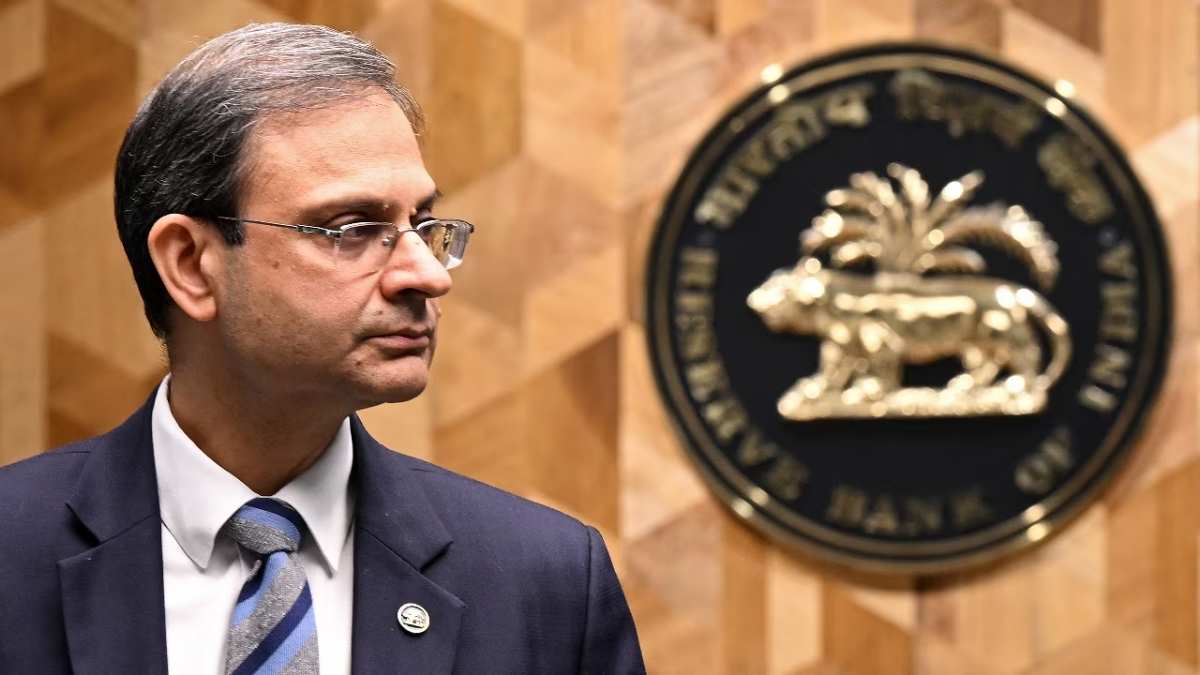
MUMBAI | Image via Money Control
BY THE END of March 2026, if current trajectories hold, India will have performed a feat of economic acrobatics. It is expected to overtake Japan to become the world’s fourth-largest economy, leaving Germany as the final obstacle before it reaches the global top three (see chart below). For a country that was once synonymous with the “Hindu rate of growth”, a polite term for stagnation, the current pace is dizzying. In the third quarter of this year GDP expanded by 8.2% year on year. Whereas much of the world is fretting over anaemic productivity or the threat of recession, India is enjoying a moment of rare, sun-drenched optimism.
At the centre of that brightness is Sanjay Malhotra (pictured above), who took the helm of the Reserve Bank of India (RBI), the central bank, in late 2024. His tenure has so far been defined by a major change in tone. After five years of holding the line, the RBI has cut benchmark interest rates by 1.25 percentage points over the last year. The latest reduction, a quarter-point trim, leaves the repo rate at 5.25%. Mr Malhotra describes this as a “Goldilocks period”: growth is brisk, and inflation for the time being is behaving itself.
The numbers on the dashboard are certainly eye-catching. Retail inflation sat at a mere 0.25% in October, with the headline figure for November at 0.71%. This is well below the bank’s lower target of 2%. Such low readings have provided the RBI with the “firepower”, to use a favoured term in Mumbai’s financial district, to support growth without fear of overheating. Yet the central bank is not declaring mission accomplished. It expects inflation to climb back towards 2.9% by early 2026. The porridge, it seems, may soon start to simmer.
The engine of this growth is surprisingly domestic. Manufacturing leapt by 9.1% in the third quarter and services by more than 10%. Meanwhile consumer spending, the bedrock of the Indian economy, yanked up by nearly 8%. This internal demand has shielded India from some of the chillier winds blowing from Donald Trump’s America. When the American government imposed 50% tariffs on Indian exports in August, over India’s continued purchase of Russian oil, the impact was less than many feared. India’s export share to America is small enough that the blow was more of a bruise than a fracture.
Still, the external environment is becoming trickier. The rupee has slid past 90 to the dollar, making it the worst-performing major Asian currency this year. Rather than burning through reserves to defend a specific level, the RBI has allowed a “crawl-like” flexibility. This has been a boon for exporters but a headache for anyone paying for foreign education or imported machinery. Foreign portfolio investors have noticed the shift, pulling out $4.1bn in the first half of this fiscal year, a sharp reversal from the $20.8bn that flowed in during the same period a year earlier.
To keep the momentum the government is betting on structural overhauls that were once considered politically impossible. The key change is a consolidation of 29 tangled, often colonial-era labour laws into four simpler codes. These reforms lessen the compliance burden from 1,400 rules to a more manageable 350. Crucially, they allow firms with up to 300 workers to lay off staff without prior government approval, a three-fold increase from the previous threshold.
Although trade unions decry this as a “deceptive fraud” that weakens worker protections, the government argues it will finally encourage small firms to grow into big ones. The reforms also attempt to formalise the gig economy, which now counts some 10m workers. By promising social security and minimum wages to delivery drivers and platform workers, the state is trying to bring the shadow economy into the light. Most states have signed on, though Kerala, ever the contrarian, is hesitant.
Under the headline success, however, the situation is more complicated. For all the talk of becoming a global titan, India is a country of profound contrasts. Its GDP per capita, adjusted for local purchasing power, is roughly $12,000, ranking it 126th in the world. Millions still live on less than $4.20 a day. The “discrepancy” category in official GDP data—a statistical catch-all that has grown unusually large—leads some economists to wonder if the 8.2% figure is quite as solid as it looks.
The IMF has already begun to trim its sails, revising India’s 2026 forecast down to 6.2% in anticipation of further trade friction. Narendra Modi, the prime minister, has set a target of “developed country” status by 2047. To reach that goal, India must maintain an 8% growth rate for two decades, a feat few nations have ever managed. For now the RBI’s strategy of low rates and regulatory easing—such as removing extra provisioning requirements for big corporate loans—is providing the necessary lubricant.
The challenge for Mr Malhotra will be handling the transition from this “Goldilocks” phase to a more turbulent 2026. As inflation begins to creep up and global trade tensions harden, the RBI’s promise to keep rates low for a “long period” may be tested. For the moment, India is the world’s fastest-growing major economy and is about to claim another scalp in the global rankings. But as any mountaineer knows, the air gets much thinner the higher you climb. ■





