

Image: Tomertu/Shutterstock
The prospect of an ageing population has long been treated by economists with the sort of grim fatalism usually reserved for approaching asteroid strikes. The “demographic time bomb” was a terrifying metaphor: as birth rates cratered and the post-war generation moved into its dotage, a shrinking pool of workers would be crushed under the weight of a geriatric continent. Japan was the perennial canary in the coal mine, a society destined to be followed into the twilight by Europe and eventually the rest of the world.
Yet the explosion has been curiously quiet. While the populations of rich countries are indeed older than ever, the predicted economic collapse has not arrived. Instead a more optimistic reality is coming into view. The assumption that ageing is a one-way street to stagnation comes from an outdated view of how people live. It turns out that when the horizon of life recedes, people do not just sit in the departure lounge for longer. They stay at the party.
Research from Goldman Sachs, an investment bank, suggests the risks of ageing have been greatly overstated. The traditional “dependency ratio”—the number of elderly people relative to those of working age—is a crude metric that ignores a fundamental shift in human behaviour. Since the turn of the millennium, life expectancy has climbed, but so has the length of time people spend in the office. In developed economies, the effective working life has increased by about 12% since 2000. People are now working, on average, four years longer than they did two decades ago. The share of a person’s life spent in employment has actually leapt, from 44% to 47%.
This is not merely a matter of people being forced to toil into their twilight years by parsimonious governments. Much of the shift is voluntary and driven by a revolution in health. A 70-year-old today is, in biological and cognitive terms, remarkably different from a 70-year-old in the mid-twentieth century. By the yardsticks of cognitive function and physical capacity, a 70-year-old in 2025 looks much like a 53-year-old did in 2000. As the nature of work has shifted from the physical to the cerebral, the barrier to remaining productive has tanked. A lawyer or a coder can stay effective long after a coal miner would have been forced to hang up his lamp.
The outcome is the opposite of what confounds the doomsayers. In many countries where the working-age population (traditionally defined as those aged 15 to 64) has shrunk, the total share of the population in employment has actually yanked up. This resilience is bolstered by the soaring participation of women in the workforce and the fact that having fewer children has, in the short term, lessened the “youth dependency” burden more than the “elderly dependency” burden has grown. The net result is that many rich societies have more hands on deck than they did when they were younger.
Even in places where the demographic shift is most acute, the sky has stayed put. Japan is the most instructive case. Its population is shrinking and its median age is the highest in the world; yet its living standards continue to soar. Innovation has not withered; rather, the scarcity of labour has acted as a catalyst for automation and the adoption of technology. The lesson is that the wealth of a nation depends on the productivity of those it has rather than on the sheer number of its citizens. If AI and robotics can fill the gaps left by missing workers, a smaller population might even enjoy a “longevity dividend”, that is, a wealthier and more spacious society.
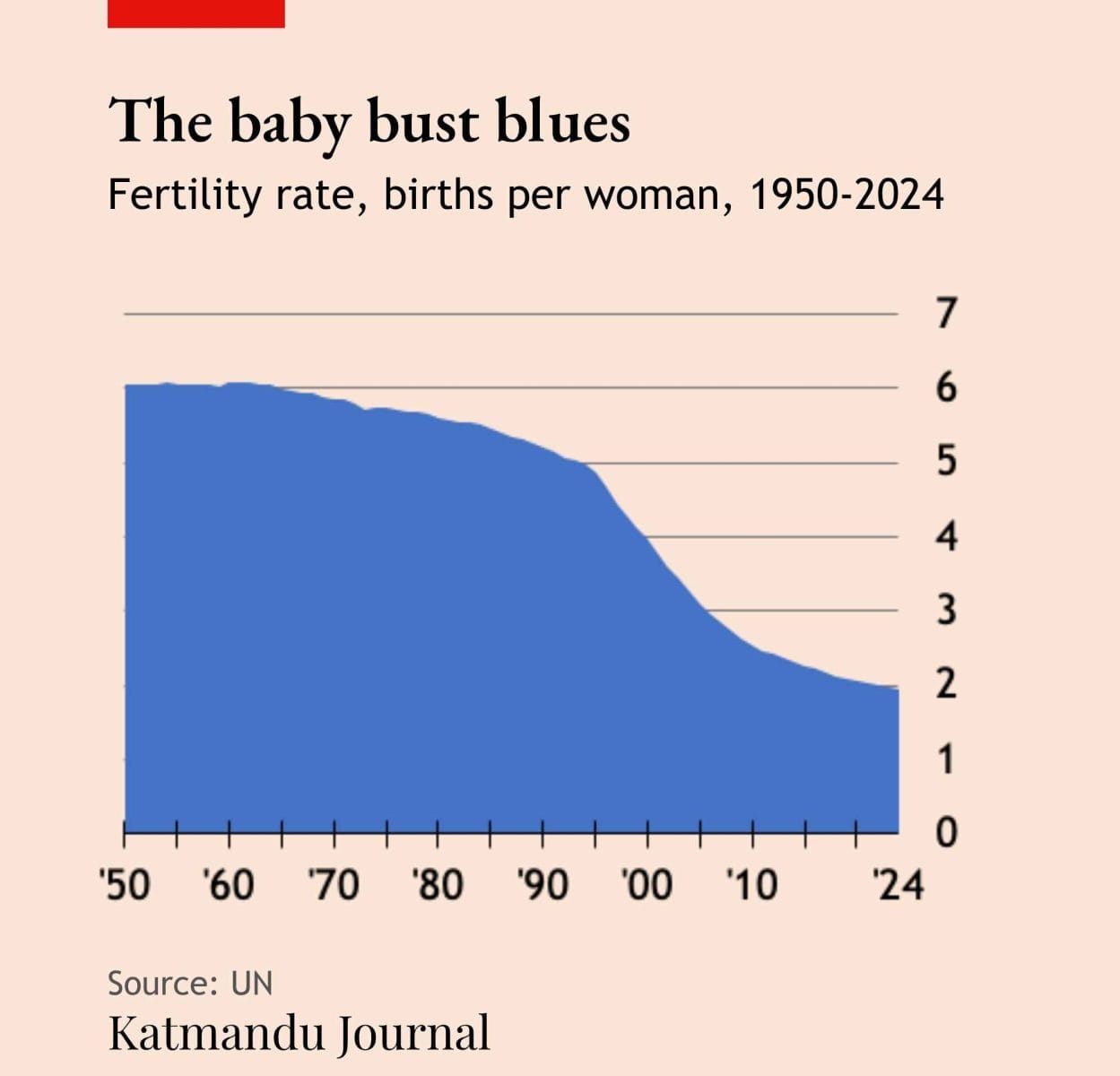
This is not to say the transition will be easy everywhere. The speed of the change matters more than the change itself. Take Nepal, which is currently hurtling through a demographic transition at breakneck speed. In a matter of decades, fertility here has plummeted from six children per woman to 1.9 (see chart below), falling below the replacement level of 2.1. Nepal lacks the deep pockets of a Japan or a Germany to fund the transition. Its trouble is a “second-order” effect: as its domestic labour pool thins, the remittances from young Nepalis working abroad (a vital pillar of the economy) may eventually dry up as global competition for workers intensifies.
For governments, the impulse to “buy babies” through pro-natalist subsidies tends to be irresistible but usually futile. Hungary spends roughly 6% of its GDP on policies designed to coax its citizens into having bigger families; yet its fertility rate is stubbornly below the level needed to keep the population stable. Such schemes are expensive and generally fail because they attempt to reverse a voluntary shift in human preferences towards smaller families and delayed marriage.
The more sensible path is to stop fighting the numbers and start managing the transition. This means reforming pensions to reflect the reality of longer, healthier lives and investing heavily in the human capital of the workers who remain. Education and health are the best hedges against a shrinking headcount. If each worker is more skilled as well as healthier and supported by better technology, the total economic pie can keep growing even as the number of people sharing it diminishes.
The demographic time bomb was always a misnomer. It implied a sudden and catastrophic end. What the world is actually experiencing is a slow and manageable adjustment to a new era of human history. The planet is becoming a world of fewer, older, but more capable people. Provided it adapts its institutions to match its new-found longevity, a graying world need not be a poorer one. The future may be older but it is far from finished. ■





