IMAGE: AFP PHOTO/PROJECT POSSIBLE
AT THE BASE of Mount Everest, things can feel oddly serene. Tents sit in neat clusters on grey moraine, like a pop-up town dropped from the sky. Solar panels blink in the Himalayan sun. Climbers shuffle past in down suits that look better suited to fashion week than frostbite. Above them, the mountain’s summit, 8,848 metres up, seems impossibly far away. And yet people are willing to pay eye-watering sums to get closer to it: $30,000 for the bare-bones version, well over $100,000 for the deluxe. The puzzle is not just why Everest costs so much. It is what, exactly, that money buys.
Start with the people who keep you alive. Guides swallow the largest share of any Everest budget. Nepal requires at least one certified guide per climber, a rule written in blood. Everest is unforgiving: avalanches, crevasses, storms and frostbite are part of the daily routine. And the so-called Death Zone above 8,000 metres does not forgive mistakes. More than 330 people have died on the mountain over the past century. Roughly a third of them were guides. These are not cheerleaders: they are paid to make snap, life-or-death calls when oxygen is low and judgement thinner still. A seasoned, internationally certified guide can command around $10,000 for a single expedition. Less experienced ones earn closer to $4,000–$4,400. Some agencies throw in a summit bonus—$1,500 if you make it to the top.
Then there are the Sherpas, without whom Everest would be unclimbable at anything like today’s scale. Indigenous to the region, they are adapted—physically and culturally—to altitude in ways outsiders are not. They carry heavy loads through terrain that looks actively hostile to human movement. Nowhere is their role clearer than in the Khumbu Icefall, a shifting maze of ice towers and open crevasses, stitched together with ladders and rope. Their skill saves lives. It also costs money. Sherpas typically work only during the short spring season, so earnings have to be squeezed into a few frantic weeks. Their equipment is expensive, too. A full climbing kit can run to $7,000. A purpose-built Everest down suit can surpass $22,000. None of it lasts forever.
Getting people and gear up the mountain is another bill altogether. The Icefall Doctors—an elite team tasked with fixing ladders, ropes and routes through the most dangerous sections—charge each climber about $600. Training and acclimatisation climbs add days, staff and supervision. Porters haul tonnes of supplies along trails where roads are impossible. Yaks and donkeys fill the gaps, but they are not cheap to maintain. Daily wages may look modest, around $11–$15, yet that covers feed, repairs and survival in an environment that grinds both animals and humans down.
Safety is not optional, and it is never cheap. Medical teams often set up at Base Camp. Supplemental oxygen, essential above 8,000 metres, costs roughly $600 a cylinder. Better packages include high-flow systems that make breathing easier when the air all but disappears. Rescue is not a hypothetical. In May 2023 a team spent six hours carrying a climber down from the Death Zone. Expeditions have to plan for things going wrong, because on Everest they eventually do.
Even eating and sleeping come at altitude-adjusted prices. Base Camp tents are robust structures with cots, heating and communal dining areas. Chefs prepare dense, calorie-heavy meals to fuel bodies under strain. Higher up, tea houses and lodges depend on supply chains that defy common sense. A sack of rice can cost $60. A gallon of fuel, $113. A cup of milk tea may be ten times more expensive than in the valley below. Everything must be built to withstand wind, snow and thin air, pushing costs higher still.
Everest also has a waste problem, and cleaning it up is part of the bill. Forty to fifty metric tons of rubbish are scattered across the mountain. Nepal now requires climbers to lodge a $4,000 deposit, refundable only if they bring down at least eight kilograms of trash. Oxygen bottles carry similar rules. Government and army clean-up operations cost around $7.5m a year. Private schemes, such as “Carry Me Back”, add further charges, which climbers ultimately foot.
Then come the permits. Nepal has raised climbing fees sharply, charging up to $115,000 a climber, from just $11,000 in earlier years. The money supports administration and local development, and is meant to restrain numbers on an increasingly crowded peak. Permits are limited, demand is fierce and scarcity, as ever, yanks up prices.
Commercialisation has done the rest. When fully guided expeditions emerged in the early 1990s, Everest was still niche. Today it is an industry: in 2023 a record 478 permits were issued. Agencies sell the climb as a once-in-a-lifetime experience and price it accordingly: $30,000 at the low end, six figures at the top. Everest is both an adventure and status symbol. Neither comes cheap.
Beneath it all sit stubborn structural realities. Everest is dangerous, remote and seasonal. Guides can work only a few weeks a year. Every kilo of food, fuel and gear has to be carried by people or pack animals. There are no roads to exploit and certainly no economies of scale to tap. Skilled Sherpas are finite; demand keeps rising and environmental rules add extra work. None of this is negotiable.
To outsiders, much of this stays invisible. A $70,000 expedition bundles together guides, insurance, oxygen, food, tents, porters, permits, waste management and emergency cover. That is only the starting point. Add private tents, personal chefs, extra oxygen or constant satellite contact and the bill can shoot past $100,000. The market neatly stratifies itself: standard packages, premium ascents and bespoke experiences for those who want Everest without inconvenience.
Margins for operators are slimmer than they look. One bad storm, one serious accident or one broken supply chain can wipe out a season’s profits. For Sherpas, a successful climb can fund a family for a year—but only if the mountain cooperates.
Everest also matters beyond the climbers. Tourism accounts for about 7% of Nepal’s GDP. High fees support wages, villages and infrastructure along trekking routes. But they also shut most of the world out, intensifying the tension between local benefit and elite access.
The mountain’s commercial history charts a shift from national pride to market logic. What began as exploration became a packaged product. Climbers now buy not just a route to the summit but a medically supported, environmentally regulated experience, too.
That experience is getting costlier as the climate changes. Melting ice exposes decades of abandoned gear and waste, complicating clean-ups and driving tighter rules. Climbers increasingly pay to enter a managed ecosystem rather than just a mountain.
Insurance adds another surcharge. High-altitude evacuations can require helicopters, doctors as well as specialist equipment. Premiums can top $10,000 for a single climb, and they are usually folded into the final price.
Oxygen logistics demonstrate how granular the cost structure is. A climber may burn through four or five cylinders above 8,000 metres. Each costs about $600. Premium trips stash tanks at multiple camps, carried up by Sherpas through lethal terrain. Oxygen keeps people alive but it also weighs heavily on logistics.
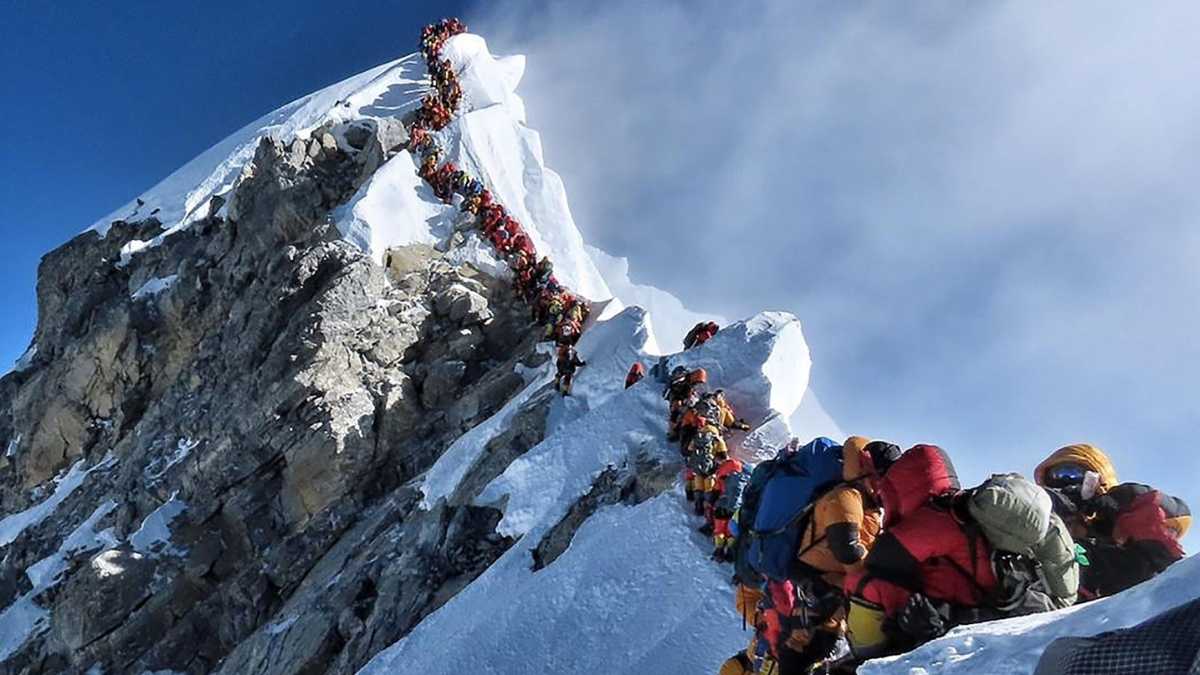
Crowding has its own price. A surge of climbers from China, India and the West has created choke points. In 2019 a queue at the Hillary Step went viral. Waiting burns oxygen, food and time. Agencies charge for that risk in advance.
Nothing on Everest is trivial. Fuel, reinforced tents, satellite phones, portable toilets: all add up. A month on the mountain can consume hundreds of litres of fuel. Helicopter flights to Base Camp can cost tens of thousands of dollars each. Everest does not move, but the costs around it never sit still.
Part of the appeal is social. Standing on the summit confers bragging rights—a photograph, a story, a badge. Agencies turn ambition into a priced product, wrapping desire in risk management. The stakes are existential, and so is the bill.
None of this buys safety. Crowds, inexperience and volatile weather keep the death toll ticking. Money purchases expertise and preparation not guarantees. In the end Everest charges what it does because it stays indifferent. Survival is uncertain. Preparation is not cheap. ■