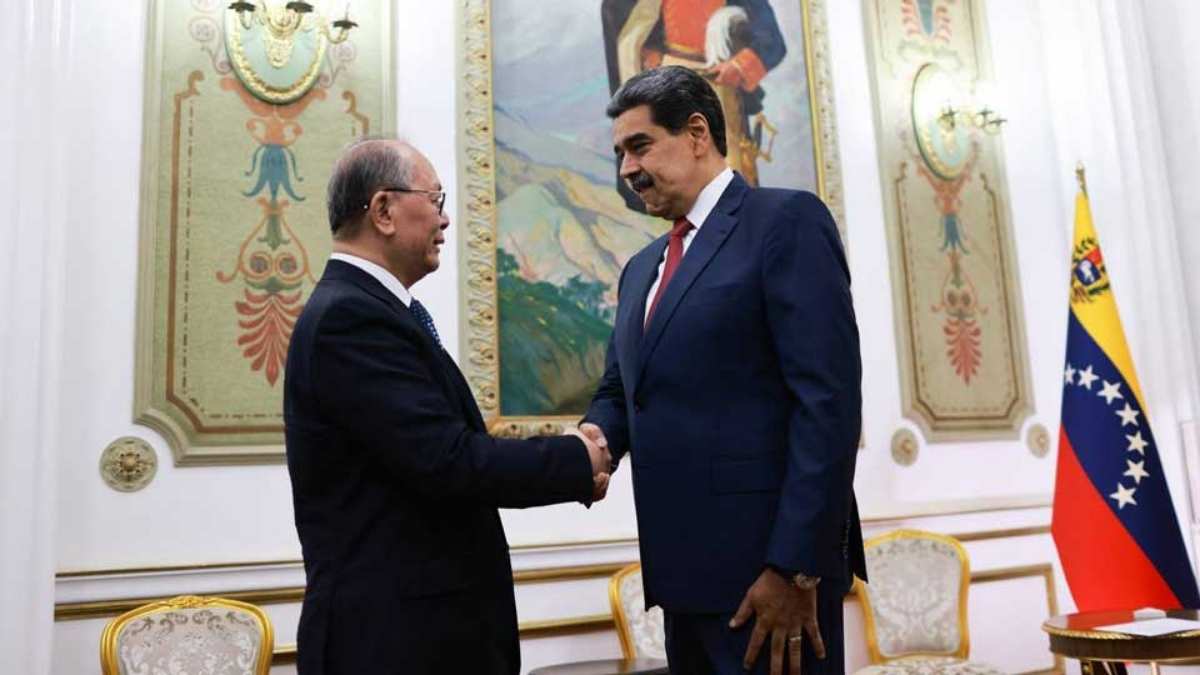
Image via the Chinese Ministry of Foreign Affairs
WHEN Qiu Xiaoqi, Beijing’s special envoy for Latin American affairs, sat down with Nicolás Maduro in Caracas, Venezuela’s capital, last week, the mood was festive. They were there to toast an “all-weather strategic partnership” and sign another stack of agreements on energy and logistics. Yet hours later the weather turned. True, the lightning raid by American forces that snatched Mr Maduro from his palace decapitated the Venezuelan state. But it provided a bracing cold shower for China’s ambitions in the western hemisphere, too.
For two decades, Venezuela was the vanguard of China’s attempt to erode American dominance in its own backyard. Beijing viewed Caracas as a loyal client that could endorse Chinese governance norms and provide a steady flow of heavy crude oil. In exchange, China became the regime’s banker of last resort. Estimates from AidData, a research lab, suggest cumulative credit topped $100bn since the early 2000s. But as the smoke clears from the American operation, the limits of this “all-weather” friendship have been exposed. China has discovered that while it can buy a seat at the table, it cannot always protect the host from the bailiffs.
The relationship was always more transactional than ideological. The “oil-for-loans” model allowed Caracas to bypass Western financial markets while giving Beijing priority access to the Orinoco Belt’s reserves. However, the economic reality has been one of structural stagnation. Venezuela’s GDP has withered from $561bn in 2013 to roughly $224bn today. For the mandarins in Beijing, the partnership had long ago soured from a strategic asset into a distressed one.
In fact, the Chinese leadership began checking the locks and pulling the curtains years ago. Official data show that Chinese outbound direct investment flows to Venezuela turned negative in 2019. Beijing had reached a cold-eyed conclusion: the country was essentially insolvent. Since then, the strategy has shifted from financing growth to extracting what value remained. China now runs a sustained trade surplus with Venezuela, exporting machinery and surveillance technology while taking oil as repayment for old debts.
The oil trade itself shows a curious asymmetry. To the global market, Venezuela is a diminished giant, its production having slumped to less than 1m barrels a day. To China’s national oil majors, it is a rounding error. However, for a specific cluster of independent refineries in Shandong province—known as “teapots”—Venezuelan crude is vital. Their coking units are configured specifically for the heavy, sour Merey 16 grade that Western refiners shun. If a new, American-backed administration in Caracas redirects these flows to the Gulf Coast, these Shandong teapots will face a costly and complex refit.
Diplomatically, Beijing has responded with a well-known script of “grave concern” and condemnations of “hegemonic acts”. At the United Nations, Sun Lei, a deputy ambassador, argued that the raid was a blatant violation of sovereignty. This rhetoric serves a dual purpose. It allows China to present itself as the defender of the Global South against a “world police” and provides a convenient stick with which to beat Washington. Yet there is a hollow ring to such protests. Beijing supported a regime that presided over a historic economic collapse and a refugee crisis that destabilised the region.
The capture of Mr Maduro also carries a more unsettling warning for Chinese strategists. The ease with which the United States projected power in its own hemisphere suggests a revival of the 19th-century Monroe Doctrine—which told European powers to stay out of the western hemisphere—that many in Beijing hoped was extinct. For partners in Africa or Central Asia, the lesson is that a strategic partnership with China offers plenty of infrastructure and surveillance tech—like the AI-powered patrol vehicles supplied by NORINCO, a Chinese defence giant—but it does not come with a hard-power guarantee.
The financial fallout is already being internalised. Chinese state banks are still owed an estimated $12bn in uncollected loans, but much of this has been written down or restructured. The greater loss is symbolic. Venezuela was the flagship for the idea that Chinese capital could build a parallel world order. Instead it has become a case study in the risks of lending to fragile, autocratically managed states.
Looking ahead, Beijing is likely to prove more pragmatic. It will seek to protect its existing contracts and joint ventures, such as the Sinovensa oil project, by signalling its willingness to work with whatever transitional authority emerges. The goal will be to salvage the plumbing of the economic relationship while abandoning the political architecture.
The capture of Mr Maduro marks the end of an era of geopolitical adventurism for China in the Americas. The future will be more low-key, defined by risk-screened, trade-centric engagement rather than the big-ticket, commodity-backed lending of the Chávez years. Chinese diplomats will continue to talk of “all-weather” friendships, but in Caracas, they are already looking for an umbrella. ■