
IMAGE: BIKRAM RAI VIA NEPALI TIMES
ON ELECTION night in Nepal, losing does not mean the end. A senior politician can be rejected by voters in Dolakha or Kathmandu and still enter parliament weeks later, taking the oath and posing for the cameras. Citizens notice, mutter their discontent and then carry on. The tool behind this is proportional representation, or PR. Built to widen inclusion, it has grown into something more: a safety net for party elites and a subtle force that alters political calculations.
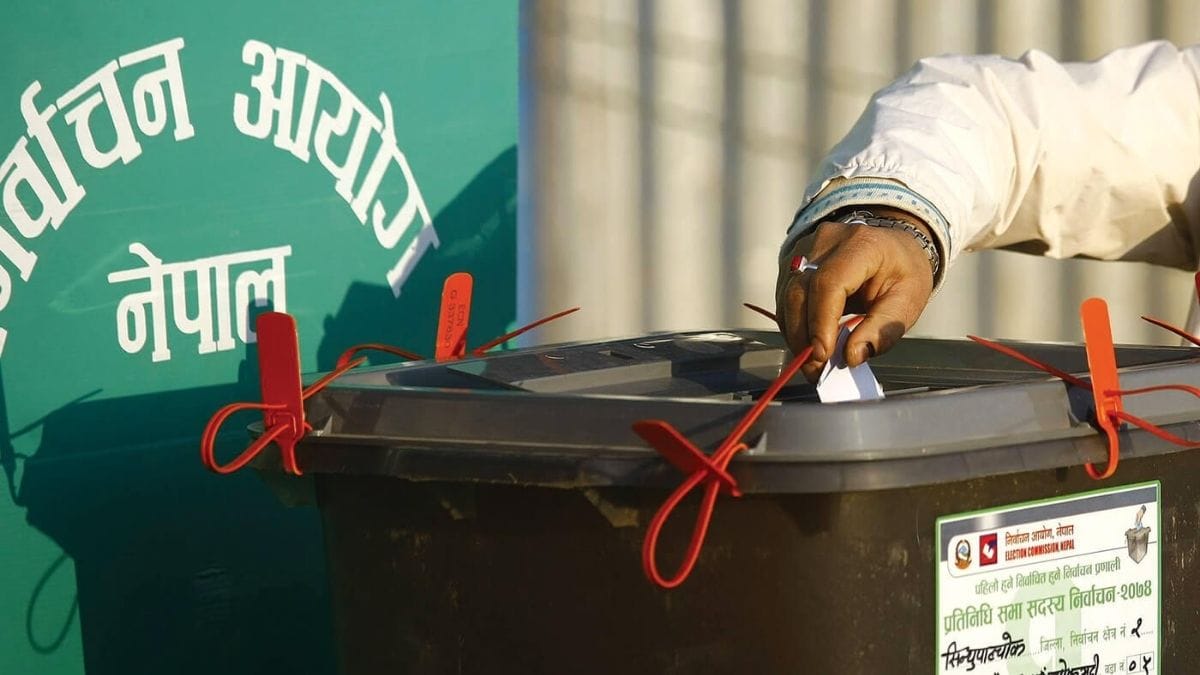
Nepal’s ballot is a curious stuff. Every voter casts two votes. One is for a local candidate, a straightforward race in which the highest vote-getter wins even if a majority preferred someone else. The second is for a party symbol. Those votes are added up across the country and determine 110 of the 275 seats in the House of Representatives. These are the PR seats, handed out roughly in proportion to each party’s share of the national vote.
The idea is not unusual. Proportional systems operate across Europe, from Germany to Scandinavia. Nepal introduced its version after the civil war, hoping to bring marginalised groups into the state and curb the winner-takes-all tendencies of its politics. Women, Dalits, Janajatis, Madhesis and Muslims were meant to secure a place in a parliament long dominated by hill men with familiar surnames. In theory it worked: the chamber grew visibly more diverse almost overnight.
But institutions do not stay fixed at birth. They bend to the pull of politics. In Nepal that pull drags power upward, to party headquarters, and away from the electorate. PR seats are not chosen by voters. Parties submit closed lists to the Election Commission before polling begins. When the votes are tallied, a party that wins, say, 14 PR seats sends the first 14 names on its list to parliament. Voters never see the list. They cannot rearrange it or strike out a name, meaning the party decides who enters.
The results in 2022 showed just how powerful this hidden channel has become. The Nepali Congress, the country’s oldest party, captured the largest share of the PR vote—around 3.2m ballots—earning 32 seats. The Communist Party of Nepal–Unified Marxist Leninist (CPN-UML) trailed closely, securing 34 seats from a slightly smaller vote share, thanks to the quirks of allocation math. The Maoist Centre, once the dominant force of post-war Nepal, eked out 14 seats. The Rastriya Swatantra Party (RSP), barely months old and built on the celebrity of Rabi Lamichhane, surged to 13.
Those numbers carried more weight than many constituency outcomes. The Maoists, floundering in direct contests, would have been a rump without PR. The RSP, with support scattered across the country, might have faded into irrelevance. And a string of senior politicians, spurned by voters in their own districts, would have faced sudden unemployment.
Instead many slipped back in via the list. Some were leaders too senior—or too contentious—to be allowed to fail twice. Others were loyalists who had fallen just short in tight races and needed a second chance. A few were relatives or long-serving insiders, quietly rewarded for years of loyalty. The inclusion rules offered the official excuse; party bosses chose the names.
This is where the paradox sets in. PR was meant to curb the power of strongmen and open politics to outsiders. In reality it has reinforced the top. Losing a constituency still hurts—it bruises authority within the party and tarnishes public image—but it does not kill careers. A party chair can flounder at the ballot box, keep the leadership and slip back into parliament via PR, protected from the very voters who turned him away.
The escape hatch is not without limits. A leader who is not an elected MP cannot step straight into the prime minister’s office. Nepal’s constitution demands that the head of government be a sitting member of the House. Nor can such a leader command the parliamentary party—someone else must run the caucus. Yet these restrictions tend to be fleeting. By-elections are called, allies step aside and seats open up. Politics, as always, finds a way.
Symbolism, however, carries more punch than the law. Losing one’s own seat signals a fraying link with voters. Party rivals notice, so do coalition partners notice. Yet PR softens the blow. What might have been a reckoning becomes merely a pause.
The gap between votes and power is extraordinary in Nepal’s recent history. The Nepali Congress has regularly led the popular vote since democracy returned in 1990, and did so again in 2022. Yet it did not dominate government. Seat counts, coalition deals and PR calculations reshuffled the balance. UML, with fewer votes, equalled or outpaced Congress in parliamentary strength. Minor parties gained outsized influence. Governments were forged through negotiation, not directly handed down by the electorate.
Proponents of PR insist that this is the point. Nepal is fragmented, its communities numerous and varied; simple majorities, they argue, would exclude too many voices. Inclusion is not a luxury but a stabiliser. They are right that scrapping PR would likely reinforce old hierarchies and shut out newcomers. Few politicians seriously suggest doing so, at least not in public.
Critics, however, note a cost. PR MPs answer to party bosses rather than voters. They behave differently from constituency-elected colleagues: they switch loyalties with less hesitation, rise quietly through internal ranks and rarely rock the boat. Accountability runs upward. Directly elected MPs worry about winning the next vote. PR MPs worry about surviving the next list.
The effect is subtle but cumulative. Parliament comes to host two types of lawmakers: those who fought—and won—in public, and those who survived in private. Incentives tilt and debate bends towards keeping coalitions intact. Leadership battles stretch out, cushioned from the jolt of voters.
None of this means PR has failed. It has altered who occupies the chamber and whose voices carry weight. It has made politics more reflective of Nepal’s patchwork society. Yet it has also softened loss in ways older systems never did. Defeat no longer shuts doors: it slides them open to back corridors.
That trade-off sits at the centre of Nepal’s fragile democracy. Voters cast ballots and parties make lists. Power flows through both, but never evenly. So long as PR offers a ladder back into parliament, leaders will keep climbing it after losing elsewhere. The big question is whether voters will ever get a real voice over who rises, and who stays rooted. ■




