
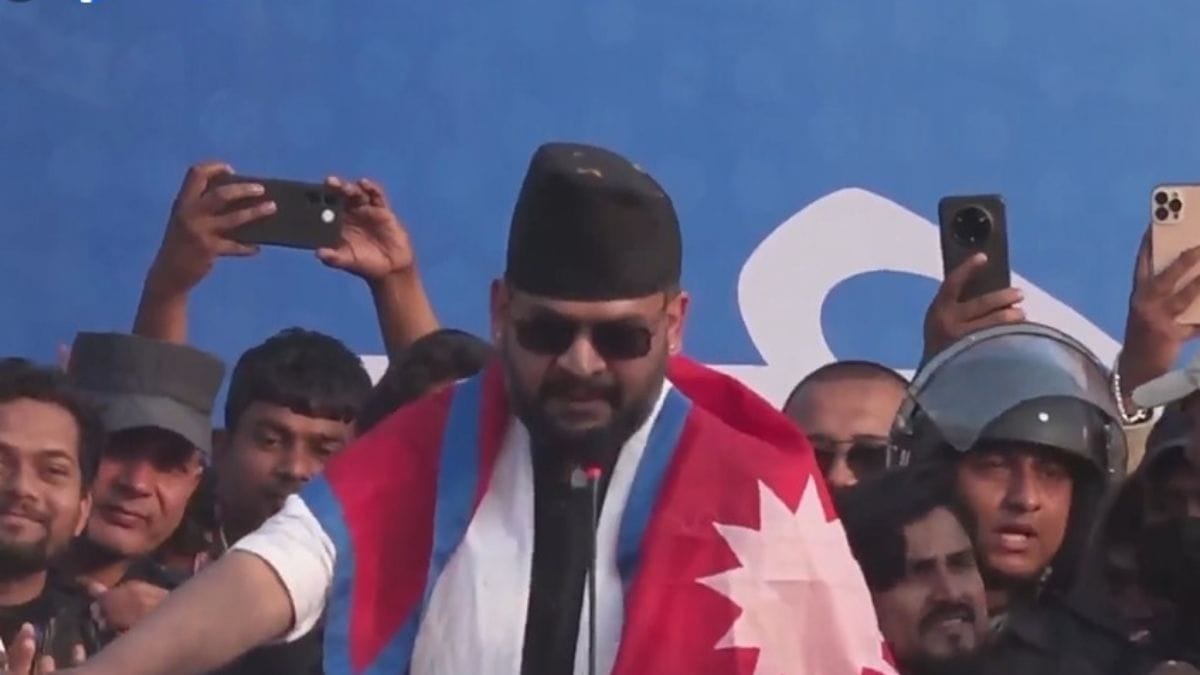
IMAGE VIA FACEBOOK | JANAKPUR
THE ARRIVAL OF a man in dark sunglasses in Janakpur usually suggests a film set. But the crowd gathered in the capital of Madhesh Province on January 19th was not there for a Bollywood star. They came for Balendra Shah, the 34-year-old rapper and structural engineer who resigned as the mayor of Kathmandu this week. He has joined the Rastriya Swatantra Party (RSP), led by Rabi Lamichhane, a former television presenter with a taste for spectacle. Mr Shah will be the party’s prime-ministerial candidate and contest a parliamentary seat in Jhapa-5, the constituency of none other than former prime minister K.P. Sharma Oli.
The young man on the stage was direct. “Honestly, I’m not in the mood for long speeches,” he tells the crowd, after paying respects to local martyrs and to Mother Janaki, the town’s presiding Hindu deity. “I am a man of action. I believe in working rather than just talking.” This pitch from Mr Shah is landing with force far beyond the capital. On a tour of the southern plains, he is projecting himself as Nepal’s prime minister in waiting. His blend of cultural pride, administrative pragmatism and blunt populism is exposing the brittle foundations of the country’s established political order.
Mr Shah is no ordinary outsider. His credibility comes from a tangible record in city hall. He recites his achievements like a manifesto checklist. “As mayor of Kathmandu, we provided 20,000 scholarships annually to students,” he boasts. “Additionally, 10% of hospital beds in costly hospitals were made free for the underprivileged. This is socialism in practice.” The brand of socialism he advocates is fiercely local and administrative, labelled as practical problem-solving rather than as ideology. His core argument is that this model should be replicated nationwide. “This kind of socialism should not only be in Kathmandu,” he argues to the Janakpur audience. “It should be in all seven provinces and all 753 local governments. Shouldn’t it?”
That question is a direct challenge to the country’s ageing political dynasties and their grand, unfulfilled promises of federalism. Mr Shah’s critique of centralised power in Kathmandu resonates deeply in provinces like Madhesh, where Janakpur is located. “Currently, most administrative powers are concentrated in Kathmandu,” he points out. “If Janakpur were a provincial capital, it would have more authority to manage local affairs, rather than people having to go to Kathmandu for every decision.” He couples this with an appeal to regional cultural pride, seamlessly weaving religious heritage into an economic case. Noting that Nepal attracts about 1m tourists while India’s Ayodhya draws 100m, he declares that the shrine of Mother Janaki alone “has the potential to attract 10 million tourists”. Heritage, he laments, is untapped capital. “Temples and ponds must be preserved.”
His rhetoric is a canny fusion. It acknowledges identity without being overtly ethno-nationalist, and champions development while critiquing the centre. “He has successfully packaged local grievances into a national narrative of competent, anti-establishment governance,” says a political consultant in Kathmandu. The established parties, led by the Nepali Congress and the communist UML, are watching uneasily. They perfected a politics of patronage and ideological vagueness after the civil war ended in 2006. Mr Shah’s proposition is specific: vote for me and you get the potholes fixed, the scholarships granted and the tourists arriving.
The mayor’s confidence is palpable. He closes his Janakpur speech with a bold prediction. “Finally, this young man will become prime minister,” he says, referring to himself. It is a remarkable claim in a system dominated by figures twice his age. His appeal lies in presenting himself as both a son of the soil and a modern manager. He speaks of “destination weddings” at the site of Ram and Janaki’s marriage, and of streamlining municipal bureaucracy, in the same breath.
The danger for the old guard is that this is not mere rhetoric. Mr Shah’s RSP appears to have the upper hand ahead of the snap election on March 5th. His call for “action over speech” taps into profound disillusionment with a political class seen as corrupt and talkative. The established parties have long governed through consensus among themselves, marginalising radical alternatives. Mr Shah, with his municipal report card and cultural fluency, is not so easily dismissed as an extremist. He embodies a new formula: the administrator-populist.
His rise suggests a possible reordering of Nepal’s democracy. The post-war settlement emphasised inclusion through ethnic federalism and power-sharing among big parties. Mr Shah’s model offers inclusion through service delivery and direct accountability. It is a threat not because it seeks to overthrow the system, but because it might simply bypass it, municipality by municipality. As he barnstorms the country—next stop Damak, Mr Oli’s hometown—the question is whether voters, long denied power and prosperity by the centre, will now withdraw their trust from it and gamble on him instead. The Kathmandu man is betting they will. ■




