

ILLUSTRATION: ALBERTO MIRANDA
FOR FOUR DECADES Nepal enjoyed the most sensible financing arrangement imaginable. When it needed to build a road or a dam, it borrowed from the World Bank or the Asian Development Bank at near-zero interest rates, with repayment periods so long that the civil servant who signed the paperwork might reasonably expect to be dead before the first instalment came due. It was, by any measure, a spectacularly good deal.
Lately Nepal has abandoned it. Without explanation and almost without anyone noticing, the government has switched to borrowing at home: expensively, short-term and in steadily escalating amounts.
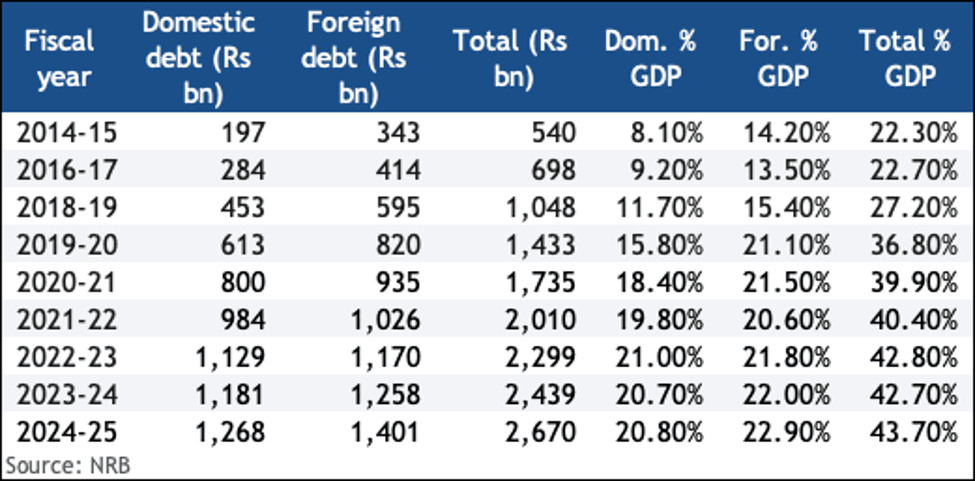
The numbers are ugly. In 2020 domestic debt stood at Rs613bn. Five years later, it has more than doubled to Rs1.27trn ($8.94bn), growing at 15.6% a year—more than thrice the pace of the economy and well ahead of revenue. For the first time in the country’s fiscal history, the government now borrows almost as much at home as it does abroad (see table). This amounts to a foundational reversal that has survived kings, revolutionaries and every conceivable coalition government. It has also attracted almost no public comment.
ddd
Why the silence? Because the headlines look good. Foreign-exchange reserves have ballooned to $22.5bn, enough to cover nearly two years of imports. The current account is in surplus. Inflation is falling. Total public debt, at 43.7% of GDP, sits comfortably below the levels that worry rating agencies. On the surface, Nepal appears to be a model of macroeconomic stability.
But reserves are not the same as fiscal health. Those dollars come from remittances—nearly $12bn a year sent home by workers in the Gulf and elsewhere—and from depressed imports, rather than from government prudence. Strip away the flattering headlines and a different picture emerges. Debt service has risen 171% in five years. It is now the fastest-growing item in the government accounts. For every Rs100 the treasury collected in revenue last year, nearly Rs27 went to servicing past borrowing. That leaves Rs73 for everything else: salaries, schools, hospitals, roads. The IMF, for what it is worth, suggests paying attention when that ratio surpasses 18%. Nepal is at 26.8% and climbing.
The shift matters because the terms are so different. Multilateral loans cost well under 2% and run for 40 years. Domestic treasury bills mature in 91 days and must be endlessly rolled over. When the banking system tightened during a balance-of-payments wobble in 2021-22, the rate on 91-day paper shot from 2.2% to 9.5% in a year. The government was rolling over large chunks of its then-Rs1trn domestic stock at those peak rates. The surge in financial expenditure now visible in the accounts is simply the bill coming due.
How did this happen? By institutional gravity. Multilateral loans require completed projects; Nepal’s capital spending has been chronically poor. When roads don’t get built, the money doesn’t flow. The government turns instead to the domestic market, where treasury auctions run weekly and the paperwork is rather less demanding. Borrowing abroad takes years of negotiation and appraisal; borrowing at home takes a Thursday. The result is visible in the expenditure tables. Over the past eight years, budgeted capital spending has barely budged in nominal terms—a real-terms decline. Financial expenditure has nearly tripled. The government is spending vastly more on the cost of past decisions than on future investment.
None of this is yet a crisis. The external position is strong. The banking system is liquid. Concessional foreign financing remains available. Debt-to-GDP, while rising, is not alarming. These are the conditions under which structural problems are easiest to address—when the finance ministry can afford to think, rather than to panic.
That window will not stay open indefinitely. On current trends, debt service will swallow 30% of revenue within a few years. At that threshold, discretionary spending collapses; capital expenditure gets crushed; and the politics of adjustment turn vicious.
Fiscal data has a way of remaining invisible until it cannot. Nepal’s numbers have been sitting in the central bank’s annexes for years, undiscussed. They will not wait forever. ■





