
PHOTO: BIKRAM RAI
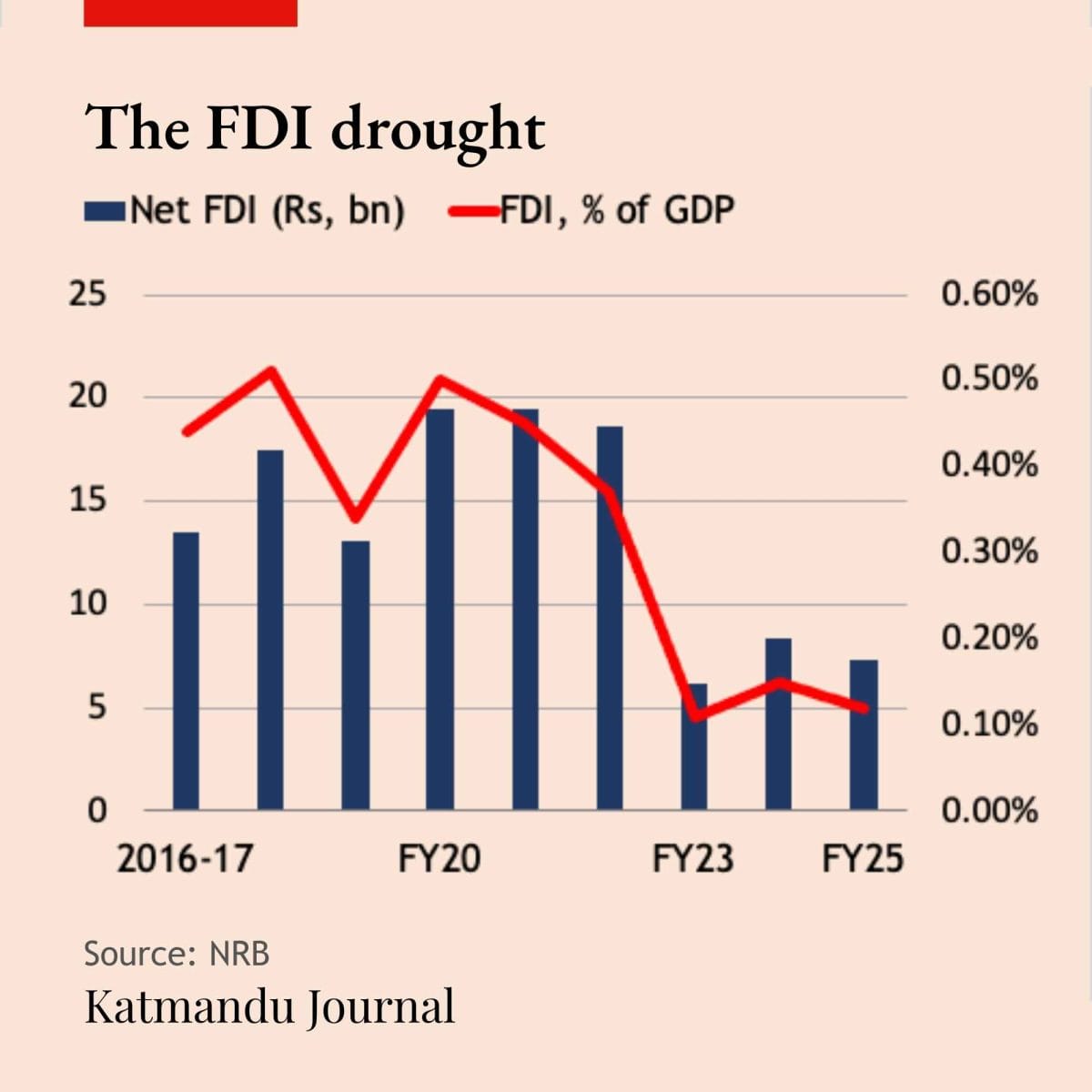
ON A MAP of Asian investment flows, Nepal appears as a blank space. In the fiscal year that ended in July 2025, the country received net foreign direct investment of Rs7.3bn—roughly $53m at prevailing exchange rates. That is 0.12% of GDP (see chart below). To grasp the scale of the absence, consider Cambodia, where foreign investment typically surpasses 12% of national output. Vietnam, a manufacturing powerhouse, absorbs 6-8% of its GDP in FDI a year. Even Bangladesh, a country not known for welcoming foreign capital, pulls in five to ten times as much, relative to its economy. Nepal is not in the same conversation. It is barely in the same universe.
This is not a recent collapse, though the numbers have worsened. For a brief period after the pandemic, in 2020 and 2021, annual inflows touched Rs19.5bn. Investors appeared to take an interest. Then the figure cratered to Rs6.2bn in 2022-23 and has languished near that floor ever since. The government, which changes with bewildering frequency—27 administrations in three decades—holds regular investment summits, replete with promises. In 2019 dignitaries announced pledges worth Rs2.2trn. In 2023 they did it again. The gap between what is promised and what arrives measures the distance between Nepal’s aspirations and its investment climate.
That climate is, by most accounts, forbidding. Foreign executives tick off the obstacles in weary order: political instability so chronic that policy consistency is a fantasy; courts that enforce contracts with agonising slowness, if at all; land acquisition rules that resemble a bureaucratic obstacle course designed by a committee of sadists; a regulatory environment where the rules shift without notice and discretion is exercised opaquely; and labour laws that make hiring and, more critically, firing nearly impossible.
All this for access to a domestic market of 30m people with weak purchasing power. For a manufacturer seeking economies of scale, the maths does not work.
The absence of FDI might not matter much if it were merely a missing financing flow. At 0.12% of GDP, it barely registers in the national accounts. The deeper cost is invisible in the aggregate numbers. Foreign investment is a vehicle for technology, for management know-how, for connections to global supply chains. Without it, a country’s private sector must reinvent wheels that others have long since perfected.
In manufacturing Nepali firms operate at a permanent productivity disadvantage relative to Vietnamese or Thai competitors that have spent decades absorbing techniques from Japanese, Korean and Western partners. In tourism the lack of international-standard hospitality and adventure infrastructure leaves the country’s spectacular assets—the mountains, the temples, the trekking routes—underexploited. In agriculture, modern processing, packaging and logistics remain alien concepts, consigning perishable goods to informal markets while equivalent products from other countries fill supermarket shelves abroad.
That is the well-known story of a country stuck in a low-investment trap. But Nepal’s predicament has a second, stranger dimension. The central bank’s latest balance-of-payments data, for the six months to January, records an extraordinary item: Rs56.8bn spent by Nepalis on education abroad. That is families paying for degrees in Australia, Britain, Canada and Japan. On an annualised basis, the outflow approaches Rs114bn—more than the entire stock of foreign direct investment that has accumulated in Nepal over years, perhaps decades.
Young Nepalis and their parents are, in effect, voting with their rupees. When households accumulate enough capital, typically from remittances sent by family members already overseas, they invest it not in a factory, not in a hotel, not in a food-processing plant in the Terai plains. They invest it in a plane ticket and a university tuition bill.
This is individually rational. A foreign degree offers a credential that the domestic education system cannot match. More importantly it provides a pathway to a job abroad, often to permanent migration. For a young Nepali with ambition, the choice between trying to build a business in a country with 27 governments in 30 years and trying to build a life in Melbourne or Toronto is not much of a choice at all.
But what is rational for the individual is devastating in aggregate. The country is exporting its most enterprising young people and importing, in exchange, a stream of educational services. The human capital that families finance with such sacrifice is deployed not in Kathmandu but in the hospitals, accounting firms and IT departments of rich countries.
The two phenomena—the vanishingly small inflow of foreign capital and the torrential outflow of spending on overseas education—are connected. They reflect the same revealed preference. No one who has the means and the mobility chooses to invest substantially in Nepal. Foreigners do not build factories. Nepalis do not build them either; they build their children’s futures somewhere else. The money that might have capitalised a domestic enterprise flows instead to a university in the English-speaking world. The skills that might have upgraded a local industry are applied in a foreign economy.
Governments in Kathmandu have tried, in their intermittent way, to reverse this. They have offered tax holidays, established special economic zones, held summits. Nothing has worked, because the problem is not a missing incentive. It is the accumulated weight of experience. Investors, domestic and foreign alike, have learned that promises in Nepal are not the same as performance. A contract is not a guarantee. A government is not a durable entity. A market is not an opportunity if you cannot reliably supply it.
The result is a quiet catastrophe. Nepal’s young people leave. Its capital follows them. The factories that might have been built remain drawings. The jobs that might have existed remain a hypothetical. And the country, beautiful and mountainous and full of potential, remains a blank space on the investment map—a place where the sums that matter are not the ones that arrive, but the ones that depart. ■





