IMAGE: BOOGIE FOTO
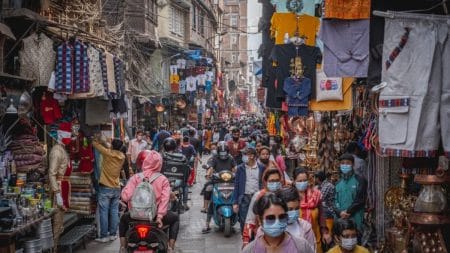
THE MONEY arrives each month, wired from Doha, Kuala Lumpur or Seoul. It pays for new tin roofs, motorcycles, children’s school fees and the construction of concrete houses that rise, storey by storey, along the highways of the Tarai plains. Nepal receives Rs1.72trn ($12.5bn) a year from its diaspora—more than the entire budget of the government, more than the value of everything the country invests in fixed capital. By any conventional measure, the economy looks stable. Inflation is low. The banks are full of deposits. The current account is in surplus. Foreign-exchange reserves are comfortable. The shopfronts of New Road are bright with imported goods.
Lift the bonnet, however, and the machinery is seizing up. Gross fixed capital formation—the investment in roads, factories, machinery and power lines that determines what an economy will be capable of producing in ten years’ time—has fallen from 33.8% of GDP in the fiscal year 2018-19 to 24.1% in 2024-25 (see chart below). A nine-percentage-point decline in six years is troublesome. Nepal is becoming an economy that consumes much and builds little.
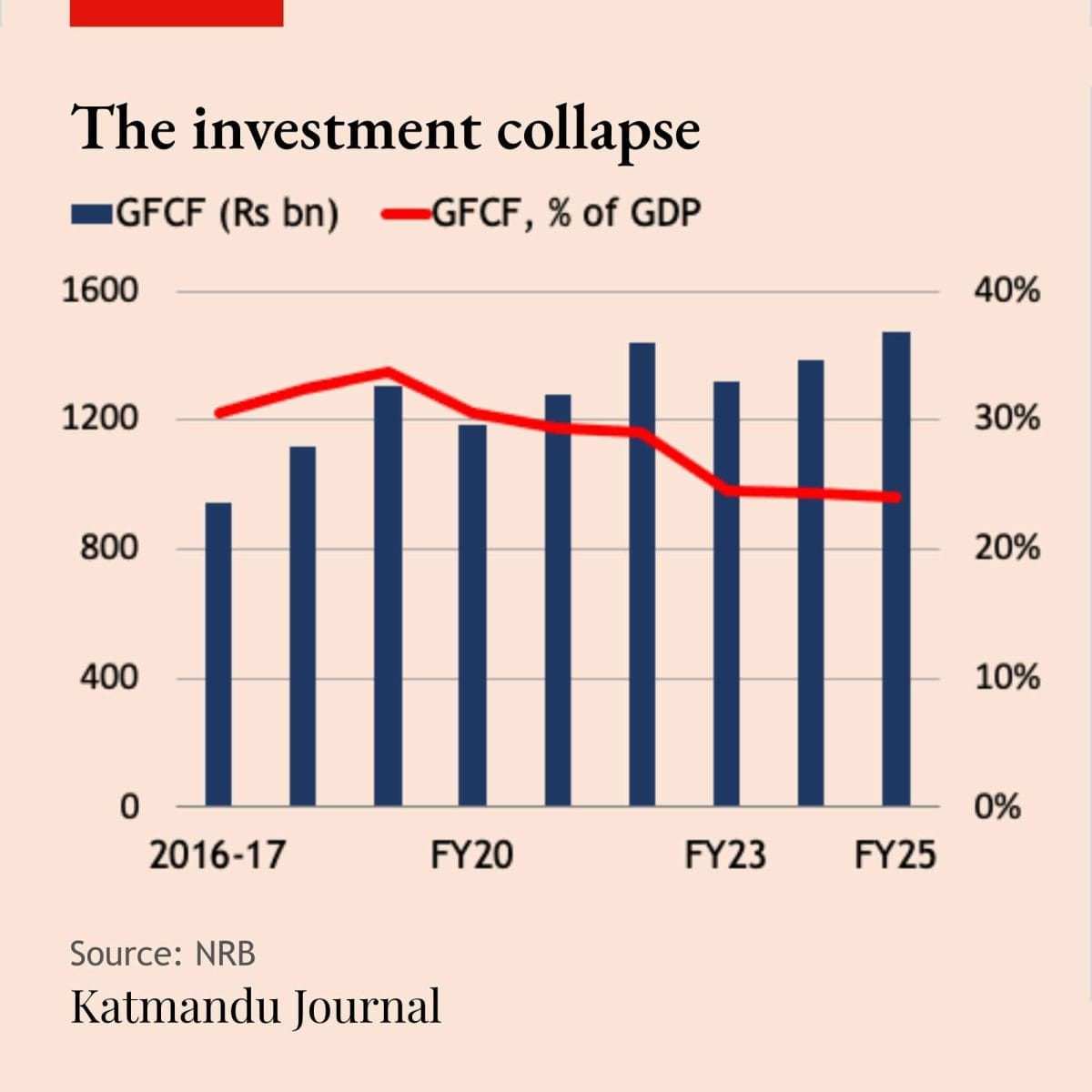
According to data published by the central bank, between 2018-19 and 2024-25, nominal GDP expanded by 58%, from Rs3.86trn to Rs6.11trn ($42bn). Fixed investment over the same period rose from Rs1.3trn to Rs1.47trn—an increase of just 12.6%. For every Rs100 of additional output the economy generated, barely Rs7 went into new productive assets. At the peak of the investment cycle in 2017-18, the ratio was more than Rs20. The economy is running harder but laying down less track.
The composition of what investment remains is itself revealing. Private hydropower development has held up, financed by bank credit that expanded 26% in 18 months to Rs463bn. But hydropower is a single sector, concentrated in the hands of a few developers, and its returns flow to equity holders and lenders rather than spreading through the wider economy. Elsewhere, the picture is one of retreat. Manufacturing investment is flat. Commercial construction has slowed. The government, which might be expected to fill the gap, is doing the opposite.
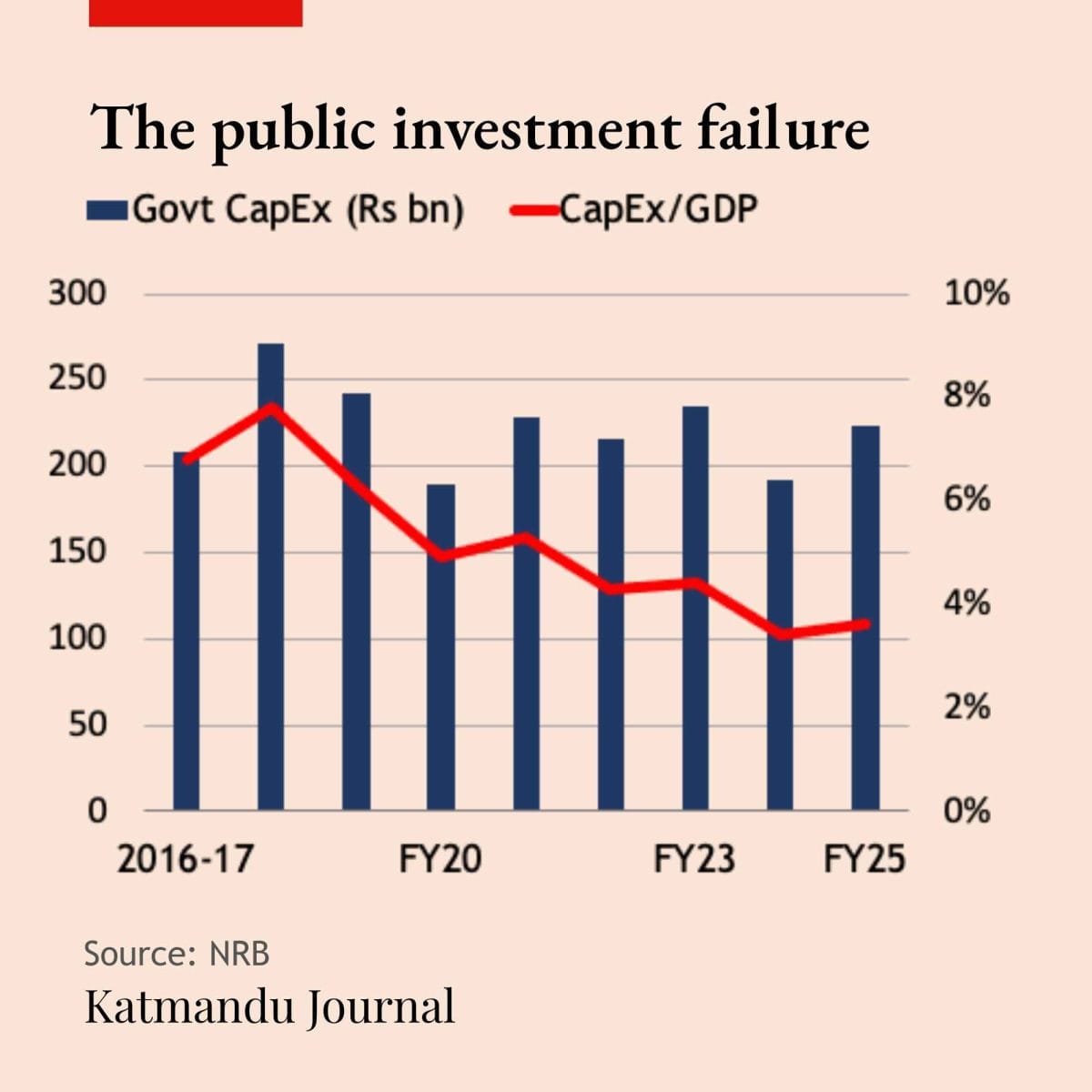
Public capital expenditure as a share of GDP has nearly halved since 2017-18, from 7.8% to 3.6% (see chart). In absolute terms, the government spent less on capital projects in 2024-25 than it did seven years earlier, despite an economy that is 77% larger in nominal terms. The reasons are familiar to anyone who has watched Nepal’s budget cycle: allocations are made for ambitious projects in the July budget speech, but by March the funds remain unspent, trapped in procurement disputes, land-acquisition battles and the endless churn of coalition politics. The unspent money is either surrendered or carried forward, and the roads, irrigation canals and industrial parks that might have attracted private capital stay on paper.
What makes the retreat especially damaging is its interaction with the government’s rising debt-service burden. Financial expenditure—interest payments and principal repayments—has risen from Rs118bn in 2019-20 to Rs320bn in 2024-25, an increase of 171%. Last fiscal year, debt service surpassed capital spending by Rs97bn. The government is now spending more on the cost of past borrowing than on new physical investment. That inversion, typical of fiscally stressed emerging economies, carries a growth penalty: the assets that debt service crowds out would have generated returns for decades while the borrowing itself financed consumption and recurrent expenditure.
The collapse in domestic savings explains why Nepal must rely so heavily on remittances to fund what little investment remains. Gross domestic savings—the share of GDP that households, businesses and the government set aside rather than consume—has fallen from 15.3% in 2018-19 to 6.6%. In absolute terms, domestic savings have dropped from Rs590bn to Rs403bn despite the economy growing 58%. Nepal’s residents are saving dramatically less out of a much bigger income, precisely the opposite of what development economics would predict.
The explanation lies in the structure of the remittance economy. Money sent home by workers abroad flows through the banking system and appears in the national accounts as gross national savings, which stand at a respectable 36% of GDP. But those savings are not mobilised locally in the way that domestic savings would be. They are, in large part, channelled into consumption: the new house, the wedding, the motorcycle, the pilgrimage. When they do find their way into investment, it is often in non-productive assets such as land, whose price appreciates but whose contribution to future output is zero. The distinction between domestic and national savings is not an accounting technicality. It is the difference between an economy that builds its own future and one that rents it from abroad.
Foreign direct investment, which might provide an alternative source of long-term capital, has all but vanished. Inflows for 2024-25 were Rs7.3bn ($52m), or 0.12% of GDP—among the lowest in Asia. At its peak in the mid-2010s, Nepal attracted around $170m a year. The current figure places the country below landlocked African peers and far behind its South Asian neighbours. Investors cite the usual litany: policy inconsistency, bureaucratic discretion, difficulties in land acquisition, the absence of a one-window clearance mechanism that actually functions. But beneath these specific complaints lies an uglier reality. Nepal offers few of the enabling conditions that private capital needs. The public investment that might build industrial parks, improve logistics and guarantee power supply is not happening. The regulatory environment does not compensate for the infrastructure gap. So the capital stays away.
The savings-investment gap—the difference between what Nepal invests and what it saves domestically—has remained between 17% and 25% of GDP for a decade. That gap has not been closed by rising domestic savings or by foreign direct investment. It has been financed, year after year, by remittances. The implication is this: Nepal’s productive investment base is almost entirely dependent on the labour of approximately 3.5m workers abroad. If those remittances were to slow—because of a downturn in the Gulf, because of automation in the hospitality sector, because of competition from other labour-exporting countries—the consequences would run far beyond consumption. Investment would collapse with them.
The efficiency of what investment does occur is itself deteriorating. The incremental capital-output ratio, a rough measure of how much investment is needed to generate a unit of growth, stood at 12.3 in 2023-24—roughly three times the benchmark for a developing economy. Even the improved figure of 6.6 for 2024-25 remains elevated. Nepal is not only investing less: it is getting less growth per rupee of the investment it undertakes. That suggests problems of project selection, execution and the wider enabling environment that no amount of remittance inflows can solve.
What would it take to reverse the trajectory? The maths is unforgiving. To return to the investment rate of 2018-19, Nepal would need to increase fixed capital formation by roughly Rs500bn a year—a 35% increase from current levels. That sum is larger than the entire government capital budget. It is larger than total FDI inflows for the past decade combined. It would require either a dramatic increase in domestic savings, which would mean a fall in consumption that households show no sign of accepting, or a sustained inflow of external capital on a scale Nepal has never experienced.
The more plausible path is a continuation of the current trend: remittances sustaining consumption and the current account while the investment rate drifts slowly downward, settling perhaps at 22% or 21% of GDP, a level at which the capital stock barely keeps pace with population growth and depreciation. That would mean an economy capable of 3-4% growth in good years, but with no prospect of the acceleration needed to absorb the hundreds of thousands of young Nepalis entering the labour market each year. They will, as their predecessors did, look abroad.
Gross fixed capital formation for 2024-25 is estimated at Rs1.47trn. Remittances for the same period are Rs1.72trn. The country’s workers abroad send home more money than the entire economy invests in its future. The new roofs glint in the sun. The motorcycles fill the streets. But beneath them, the foundation is eroding. Nepal is not a poor country running short of money. It is a country receiving more money than it knows how to invest—and choosing, year after year, not to try. ■