IMAGE: WHO NEPAL
A QUARTER of a century ago Nepal was one of the poorest and sickest places on earth. A woman giving birth faced a one-in-200 chance of dying, a risk comparable to parts of medieval Europe. A child under five was more likely to die than a pensioner in the West. Tuberculosis stalked the hills. Two-thirds of adults smoked.
Today that world is barely recognisable. Maternal mortality has dropped by 70%. Child deaths have been cut by two-thirds. Tobacco use has more than halved. The share of Nepalis living on less than $3 a day has collapsed from 56% to 2%. By most conventional measures, the country has achieved something extraordinary.
Yet there is one number that has refused to budge. Since 2000 Nepal’s suicide rate has hovered stubbornly around 10 per 100,000 people, reckons the WHO. In some years it has risen slightly. In others it has fallen a fraction. Over two decades of extraordinary progress, the line is essentially flat. The contrast with every other health indicator is so sharp that it demands explanation.
The explanation is not that Nepal has somehow failed to notice a mental-health crisis. It is that the country’s entire development model has been built to solve problems that are visible, measurable and amenable to simple intervention. Vaccination campaigns, sanitation drives and maternal-health outreach work brilliantly when the goal is to stop a child dying of diarrhoea. They do nothing for a man alone in a Gulf state, a woman managing a household in an empty village or a young graduate with a degree and no job.
Start with the men. Nepal’s economy runs on remittances. Some 400,000 people, almost all of them young men, leave the country a year, mostly for the Gulf. The money they send home, equivalent to 30% of GDP, has lifted millions out of poverty. But the psychological toll on the migrants themselves is written in the data. Male suicide rates peaked at 13.78 per 100,000 in 2019, the same year net outmigration hit its highest level in two decades. Working under the kafala system, with restricted movement, few rights and long separation from family, produces well-documented distress. The men who survive it return, often, to villages that have learned to function without them.
Those villages present their own burden. When working-age men leave, women take on the farming, the finances and the raising of children alone. Formal measures of women’s status have improved dramatically: parliamentary representation has risen from 6% to 33%, legal rights have expanded. But survey data on attitudes to domestic violence tells a more complicated story. The proportion of women who believe a husband is justified in beating his wife fell sharply after the end of the civil war in 2006, then rebounded to nearly 30% by 2016, according to data compiled by the World Bank. It has since fallen again, to 19%, but the volatility suggests attitudes are less transformed than the headline numbers imply. A third of women are still married before 18. More than one in ten report recent physical or sexual violence. The female suicide rate, which has risen slightly since 2000, reflects some of that accumulated weight.
Then there is what Nepalis are drinking. Alcohol consumption per capita has increased nearly sixfold since 2000, from 0.2 litres of pure alcohol to 1.36 litres. The rise tracks almost perfectly with the inflow of remittance money and the erosion of traditional social norms. Tobacco by contrast has been subject to sustained public-health campaigning and taxation, and its use has collapsed. The contrast is striking: what gets measured and managed can be moved. Alcohol, left alone, has become a big contributor to the country’s mental-health burden, both as a depressant and as a disinhibitor that turns ideation into action.
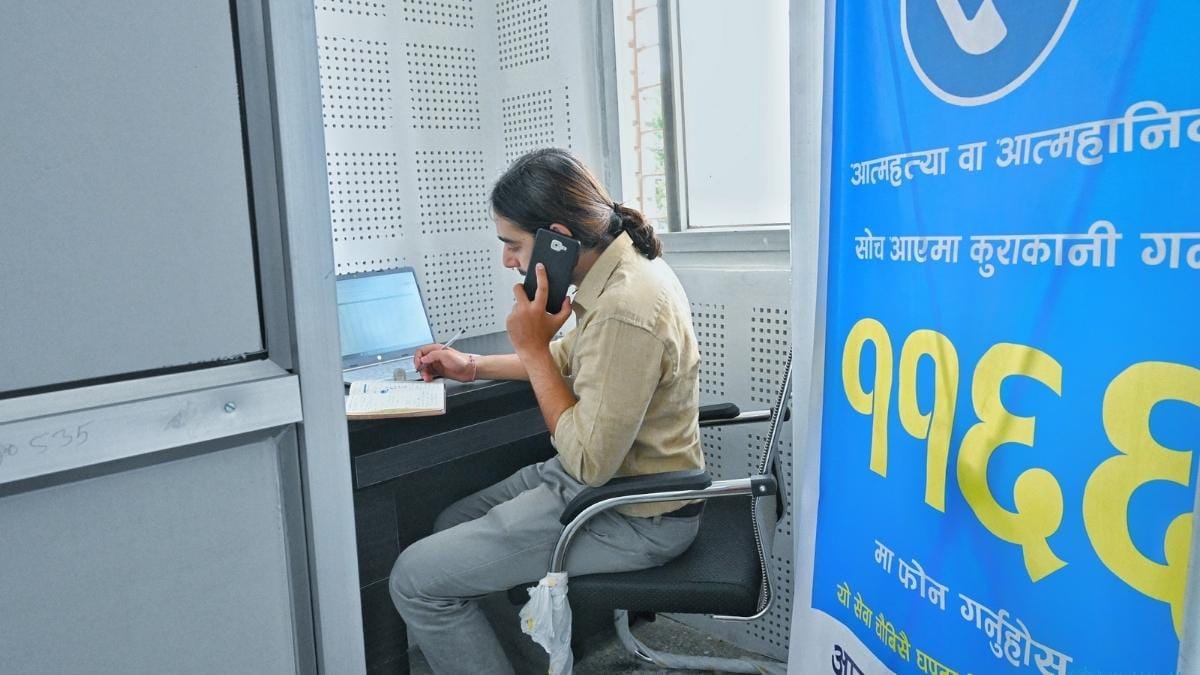
The health system, for all its improvements, was never designed to catch any of this. Government health spending has risen from 0.5% of GDP to just over 2%, still well below the South Asian average. Out-of-pocket payments are stubbornly above 50% of total health expenditure, a powerful deterrent to seeking help for conditions that need repeated contact. The universal health-coverage index, which Nepal has improved from 20 to 54 since 2000, does not even include a mental-health component. The country could score 100 on the index while providing no psychological care at all. It has perhaps 0.5 psychiatrists per 100,000 people, one of the lowest ratios in Asia. The female community health volunteers who led the revolution in maternal and child health are not equipped to recognise depression or suicidal ideation.
The puzzle deepens when you compare Nepal with its neighbours. Bangladesh, with comparable remittance dependence, reports a rate below 4. Nepal’s stagnation is not an inevitability. It is a choice, or rather a series of choices, about what to measure and what to fund.
The most uncomfortable implication is that material progress and psychological wellbeing have decoupled. GDP per capita has risen more than sixfold. Life expectancy has increased by eight years. Poverty has been dramatically reduced. Yet the suicide rate has not moved. The experience of being left behind, of watching children emigrate, of acquiring education that the domestic economy cannot use: none of this is captured in the standard development indicators. A young person in Nepal today is far more likely to complete secondary school than their parents were. They are also far more likely to leave the country. Youth unemployment has sat at around 22% for two decades, a figure that flatters the reality because participation rates have fallen. The graduates stay, or they leave, or they stay and wish they had left.
Mental health lacks the political economy of maternal mortality or infectious disease. There are no ribbon-cuttings for a new counselling centre in a remote hill district. Nepal has solved the problems it set out to solve. The problem that remains is the one it has not yet learned to see. ■