ILLUSTRATION: KATMANDU JOURNAL
When a bank forecloses on a defaulted loan, it does not intend to become a long-term property manager. But in Nepal, that is exactly what has happened. The country’s 20 commercial banks now, according to the central bank, sit on Rs43.6bn ($301m) of assets they never wanted to own—office blocks, half-built hotels, factory shells and tracts of land.
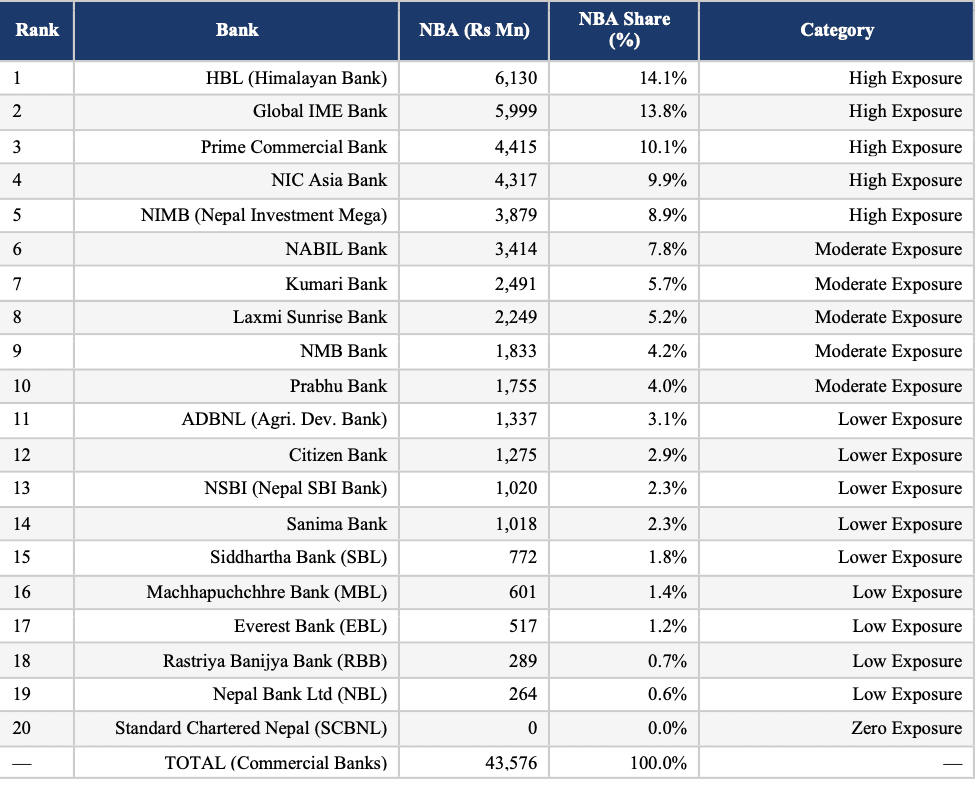
These are the physical remnants of a lending boom that went sour. Since mid-2023, the stock of such “non-banking assets” (NBA) has more than doubled. Himalayan Bank alone holds Rs6.1bn of seized property, equivalent to 14% of the system total (see table below). Standard Chartered Nepal, by contrast, reports none. Its underwriting discipline, apparently, is a choice.
The accumulation is not a mystery. Between 2018 and 2022, banks lent with abandon. Private-sector credit expanded by 61% in three years, much of it flowing into real estate, construction and hospitality: sectors where collateral values were appraised at peak-cycle optimism. Then the economy stalled. Real GDP growth, which had touched 8.6% in the fiscal year 2016-17, slipped below 2% in 2023-24. Interest rates spiked above 12% in 2022-23 as the central bank tightened liquidity. Borrowers who had bet on perpetual expansion found themselves unable to service debt. Foreclosures followed. And the seized properties began to pile up on bank balance sheets.
The scale is still small relative to the economy: NBA equals about 0.71% of GDP. But the trajectory is what concerns regulators. The stock is growing at roughly 35% a year, five times the pace of nominal GDP. If that continues, it will approach Rs80bn by 2028, or 1.1% of projected output.
More important, each rupee tied up in NBA earns no interest. At the system’s average net interest margin of 3.5%, the pile is suppressing annual banking income by about Rs1.5bn, estimates Katmandu Macro Advisory, research arm of the Katmandu Journal, a small but compounding drag.
The six most exposed banks—Himalayan, Global IME, Prime, NIC Asia, NIMB and NABIL—account for nearly two-thirds of the total. These are large private lenders that expanded aggressively into sectors where collateral quality was poorly scrutinised. The state-owned banks, Nepal Bank and Rastriya Banijya, report among the lowest NBA figures. That is not due to better lending. It reflects the political difficulty of foreclosing on state-connected borrowers, and a slower legal machinery.
The problem is not merely that banks hold bad assets. It is that they cannot sell them. Nepal’s auction market for distressed property is slim. Commercial real estate outside Kathmandu Valley tends to fail to attract a single bidder. Agricultural land carries title disputes. Hotels and resorts require operational expertise that banks lack.
And there is a deeper trap: selling at market value would mean recognising a loss, because the collateral was originally valued at boom-time prices. Recognising that loss would eat into capital ratios. So banks hold, hoping for a recovery that does not arrive.
This is where non-banking assets differ from non-performing loans. An NPL is a financial claim; it can be restructured, written off or sold to an asset-reconstruction company. An NBA is a physical object. It requires maintenance, legal clearance and a buyer with cash and patience. Banks are not built for this. They are intermediaries not property developers.
Other Asian economies have faced the same bind. After the 1997 financial crisis, South Korea established KAMCO, which acquired distressed assets worth $110bn from the banking system, using government capital to absorb the difference between book value and disposal price. Malaysia’s Danaharta resolved $12.7bn of NPLs with a recovery rate of 58 cents on the dollar. India’s NARCL, set up in 2021, uses a hybrid structure of cash and government-guaranteed security receipts to take bad loans off public-sector banks’ books. The common thread is centralisation: a single institution with the mandate, capital and legal powers to do what individual banks cannot.
Nepal now needs its own version. A Nepal Asset Management Company (NAMC) would acquire NBA from banks at a transparent discount, paying partly in cash and partly in government-backed securities. That would give banks immediate liquidity and capital relief while allowing them to defer the full loss recognition. NAMC would then clear titles, manage the properties and dispose of them through auction or private sale over a defined period—say, ten years. Its board would need independent professionals, not serving bankers, and its operations would require special statutory powers to bypass the court delays that now bog down property transfers.
The macroeconomic window is favourable. Foreign-exchange reserves are at record highs, above $22bn. Interest rates have fallen: the 91-day Treasury bill now yields less than 3%, down from over 10% two years ago. Growth is recovering, albeit slowly, with the IMF projecting 3-3.5% for the current fiscal year. A cleaner banking sector could lend into that recovery. If NAMC acquired 70% of the NBA stock and recycled the capital, it might unlock Rs160bn-180bn in fresh credit—roughly 3% of GDP.
The alternative is stagnation. Each quarter of delay adds to the pile. The properties deteriorate. The legal complications multiply. And the banking sector, weighed down by assets it cannot use, remains unable to finance the investment that Nepal’s economy needs. The country’s investment-to-GDP ratio has already fallen by 13 percentage points since 2018-19. That is reflected in the growth numbers.
Nepal’s banks did not set out to become landlords. But they are, and the tenancy is not working out. A dedicated asset-management company would not solve every problem in the financial system. It would, however, clear the balance sheets of the past cycle’s residue. That is a necessary condition for lending to the next one. The alternative is to let the stockpile grow and watch the economy shrink in proportion. ■