IMAGE: THAIER AL-SUDANI/REUTERS
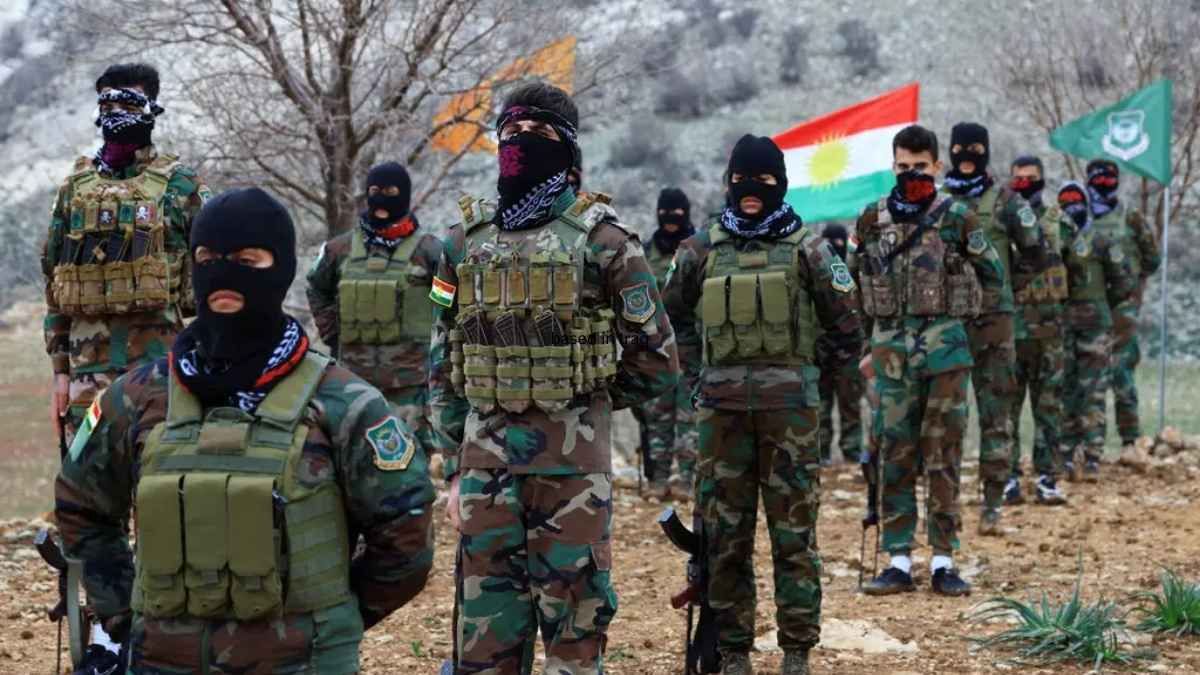
IN THE DAYS since American and Israeli bombs killed Iran’s supreme leader, a different kind of assault has been taking shape along the border. Thousands of fighters from six Iranian Kurdish parties have gathered in camps across Iraqi Kurdistan. They are receiving money and arms from the CIA, part of a covert programme that began before the current war, and encouragement from Donald Trump. On March 3rd the American president spoke by phone with Mustafa Hijri, the head of the Democratic Party of Iranian Kurdistan (PDKI), the oldest of the Kurdish factions. The plan, according to people familiar with it, is for these forces to cross into Iran and open a new front.
The Kurds of Iran number perhaps 9m people, concentrated in the mountainous west. They have nursed grievances for decades: their language was banned, their culture suppressed and their political leaders jailed or killed. When protests erupted across Iran in 2022 after the death in custody of Mahsa Amini, a young Kurdish woman, their towns were among the most restive. But armed struggle has long been a fringe pursuit, conducted from exile in Iraq. The parties now gathering have military wings, but their weaponry light. The CIA has provided only small arms, not the tanks or heavy artillery that would be needed to hold territory against the Islamic Revolutionary Guard Corps (IRGC).
That has not stopped the planners from dreaming. The coalition that has come together, the Coalition of Political Forces of Iranian Kurdistan, includes six parties with varied ideologies: the PDKI, a member of the Socialist International; Komala, further to the left; and the Kurdistan Freedom Party (PAK), which openly seeks an independent republic. They have agreed, for now, to set aside separatism in favour of federalism. Their leaders speak of a democratic Iran in which Kurds have autonomy. But many Iranians, including opponents of the Islamic Republic, hear something else: the rumble of ethnic war.
The objections are not merely paranoid. Iran is a patchwork of peoples. Kurds are Sunni in a Shia-majority state. Azeris, who are Shia, live in adjacent provinces and have their own complicated history with Tehran. Baluch militias on the Pakistan border, some with jihadist ties, are also rumoured to be part of the planning. The Army of Justice (Jaish al-Adl), a Baluch group with roots in al-Qaeda, recently rebranded as the Popular Fighters Front, perhaps to sand off its harder edges. The MEK, a cultish opposition group once designated terrorist by the State Department, may also be hovering on the edges. For many Iranians, this looks like a recipe for fragmentation instead of liberation.
“Fostering an armed ethnic insurgency in Iran would be the mother of all strategic, moral and political mistakes,” says Behnam Ben Taleblu of the Foundation for Defense of Democracies. “This is almost guaranteed to end in a failed state.” That view is shared across the Iranian political spectrum. Amir Hossein Ganjbakhsh, a pro-democracy activist, warns that the plan would unite Iranians who cherish territorial integrity, whether monarchist or republican, religious or secular. The memory of 1953, when the CIA engineered a coup that toppled a democratically elected prime minister, is long. Any American-backed force will carry that stain.
The regime for its part is already hitting back. On March 4th the IRGC dispatched 230 attack drones against targets in Iraqi Kurdistan. Ali Larijani, Iran’s national security adviser, has warned repeatedly against ethnic insurgency. The IRGC has played minorities against each other for decades and knows the terrain. It can muster perhaps 1m men in uniform. The Kurdish forces, by contrast, number in the thousands.
The Iraqi Kurdish regional government, caught between Tehran and Washington, has declared neutrality. Its leaders have long memories, too. After the 1991 Gulf war, America encouraged a Kurdish uprising in Iraq—then stood by as Saddam Hussein’s forces slaughtered the rebels. “The United States has a reputation for abandoning the Kurds,” notes an analyst. That history is not lost on the fighters now massing at the border.
Mr Trump remains the wild card. He has spoken of three candidates for Iran’s supreme leader, then suggested they are all dead. He has called on Iranians to rise up, then said he might work with remnants of the regime, as he did in Venezuela. On March 5th he told Reuters he should have a role in choosing Iran’s next leader, echoing the language of a colonial power.
The regime has asked residents to evacuate Marivan, a Kurdish city of 200,000. The roads to the border are empty. The drones are in the air. For years Iranians have feared that their struggle against theocracy might tip into chaos. That fear is now a military plan. ■