JHAPA | IMAGE VIA FACEBOOK
IN THE weeks before Nepal’s election, K.P. Sharma Oli told anyone who would listen that his seat in Jhapa-5 was unassailable. The Communist Party of Nepal (Unified Marxist–Leninist) had won here for so long, in his telling, that victory was a matter of natural law. “Even if UML fielded a shoe as a candidate,” he declared, “it would still win the election here.”
Late on Saturday, with counting nearly complete, the shoe had 18,734 votes. The man who defeated him, a 35-year-old former rapper and structural engineer named Balendra Shah, had 68,348. The margin—49,614 votes—is not a swing: it is a routing. Oli himself won this seat in 2022 by a margin of 28,576, which was considered a strong result. Balen has nearly doubled that, and in the opposite direction.
The result is the most consequential constituency outcome in Nepal since the 2006 People’s Movement ended the Maoist war. It is not merely a defeat for Oli, a four-time prime minister who spent 14 years in prison under the old Panchayat system. It is the electoral validation of something larger: the Gen Z uprising that forced Oli from office last September, the collapse of the triangular settlement between UML, the Nepali Congress and the Maoists that has governed (and mismanaged) Nepal for two decades, and the arrival of a new political figure whose biography defies every category.
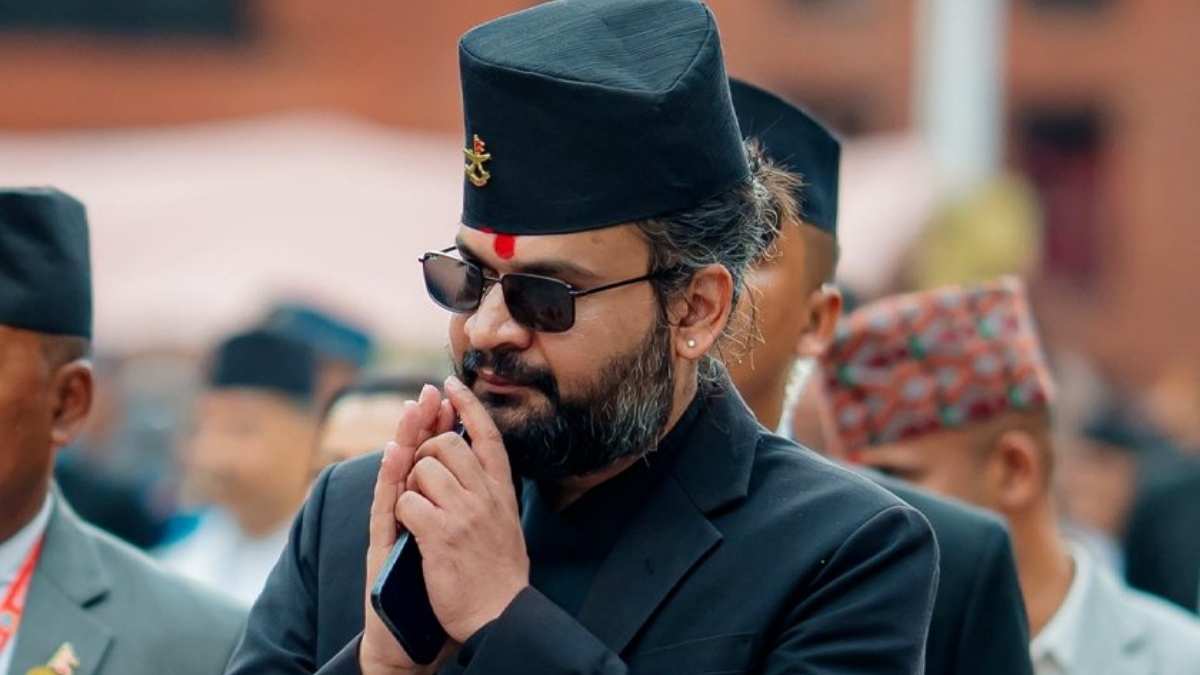
Balen Shah, as he is universally known, is not a product of student politics, party hierarchies or family dynasties. He is a civil engineer who completed a master’s degree in structural engineering in India; a rapper whose songs about corruption and social injustice have millions of YouTube views; and the man who coordinated building-damage assessments during the 2015 earthquake—skilled, dangerous work performed at personal risk. In 2022, running as an independent, he won the Kathmandu mayoralty with 40% of the vote, defeating candidates from all major parties. His three years in office were defined by aggressive anti-encroachment drives, revenue collection from tax defaulters as well as a communications style (combative, direct and social-media-native) that drove the old media crazy and his young constituents to adoration.
He wears dark sunglasses, has 3.6m Facebook followers and resigned the mayoralty in January to join the Rastriya Swatantra Party (RSP), which promptly named him its prime ministerial candidate. Then he did something audacious: he chose to contest not in Kathmandu, where his victory was assured, but in Jhapa-5, Oli’s home turf. It was either strategic genius or reckless overreach. It proved to be both.
The Jhapa-5 result is the headline, but the full picture is worse for the old parties. With more than half the proportional votes counted, the RSP has 57.2%—a number that, if sustained, would give it a working majority without coalition partners. The Nepali Congress trails with 17%, UML with 8%. In first-past-the-post contests, the RSP has won 63 seats and is leading in 58 others. UML, which once dominated eastern Nepal, is on course to lose all five seats in Jhapa district. Oli’s defeat is the most visible data point in a regional collapse.
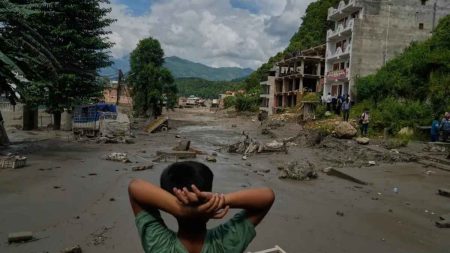
To understand how this happened, one must go back to September 2025. The protests began over a social media ban but quickly metastasised into something larger: a leaderless uprising against corruption, unemployment and a political class perceived as captive to itself. When police fired on demonstrators outside parliament, killing 19, the movement turned violent. Government buildings were set ablaze. Oli was evacuated by army helicopter minutes before protesters reached his residence. At least 77 people died.
The movement, loosely labelled Gen Z in reference to its young, digitally native core, was not a conventional protest. Its organising infrastructure was Discord. Its demands were systemic change. When Oli resigned under pressure, replaced by an interim government led by former chief justice Sushila Karki, the protesters had won something rare: the complete capitulation of an entrenched political establishment.
Balen’s relationship to the movement was complex. He was not an organiser, but as Kathmandu mayor he embodied a proof of concept: a young, competent, non-legacy figure actually running things. His music gave him cultural fluency with the protesters. His social media presence gave him direct reach. And when the movement crested, he posted a message: “Dear Gen Z, the resignation of your killer has come. Now your generation will have to lead the country. Be prepared.”
The election became the mechanism for that preparation. Across Nepal, young voters turned out in numbers that startled party operatives. First-time voters—approximately 800,000 of them—were concentrated in the demographic most alienated from legacy politics. Exit data, where available, suggests Balen won under-35 voters in Jhapa-5 by margins surpassing four to one.
But Jhapa-5 was not merely a youth wave. Balen’s Madhesi identity (his family originated in the Terai) mattered in a constituency where Madhesi communities form a significant bloc. His engineering background mattered to voters exhausted by the improvisational governance of career politicians. His mayoral record mattered: he had done visible things; cleared illegal encroachments; collected taxes; made the city function. And Oli’s unprecedented campaign intensity such as door-to-door canvassing and community meetings mattered only in its failure. The harder he campaigned, the fewer votes he received. The ground had shifted.
UML’s collapse in Koshi Province, of which Jhapa is the heart, is structural rather than cyclical. The party’s voter base was disproportionately old, its identity formed during the communist organising of the 1970s. Those voters are being replaced by a younger cohort with no emotional connection to the party’s founding mythology and strong negative associations with its governance record. The patronage networks that sustained UML for decades (such as jobs and contracts) were disrupted by the uprising and have not been rebuilt. And the assumption that Jhapa was safe, bred by decades of victory, produced complacency exactly when adaptation was required.
What comes next is uncertain in ways that Nepal has not faced in a generation. Balen will almost certainly be prime minister. A 35-year-old structural engineer with a rap career and a mayoral record will lead a country of 30m people, sandwiched between India and China, with a diaspora remittance economy and entrenched institutional weaknesses. His party’s manifesto promises 1.2m new jobs, universal health insurance and a doubling of GDP: ambitious to the point of implausibility, but at least a departure from the usual pieties.
The risks are real. Expectation inflation is the first: the scale of the mandate has created hope that no realistic government can satisfy within a single term. Governance capacity is the second: running Kathmandu, a city of one million, is different from running a federal republic. Institutional resistance is the third: Nepal’s civil service and judiciary are staffed by people whose careers were built in the old system. And foreign policy is the fourth: Balen has no diplomatic experience, and both India and China will test him early.
But for now, the moment belongs to Jhapa-5. Oli, who survived prison, insurgency and decades of political warfare, has been beaten in his own backyard by a margin that defies spin. The shoe, as it turns out, did not win. The engineer did. And Nepal, for the first time in a long time, faces a future that really feels like one. ■