
IMAGE: SETOPATI
FOR MOST of its modern history, Nepal has been governed by coalitions of the weary and the wary, alliances built on little more than mutual exhaustion. The election on March 5th changed all that.
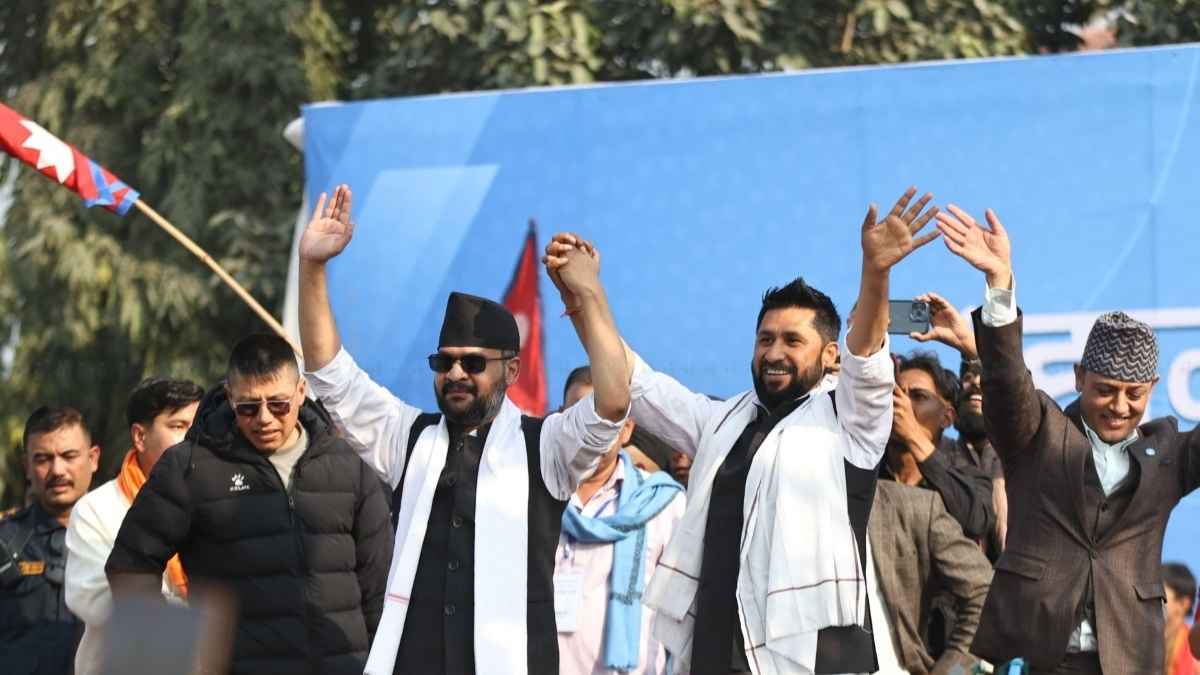
The Rastriya Swatantra Party (RSP), a movement barely four years old, won 182 out of 275 parliamentary seats—a near-supermajority built on the highest proportional vote share since 2008. It is the first single-party government since 1959. Its prime minister, Balendra Shah, a former mayor of Kathmandu, rode to power on the back of a generation that had set fire to the Prime Minister’s Office in September, after police killed at least 77 protesters. The old parties have been routed. The new one has political space that its predecessors could only dream of.
That space, however, comes with a burden. The RSP’s manifesto is a catalogue of ambitions that would test any government, let alone one with no ministerial experience. It promises to double the economy to $100bn within seven years, rewrite the constitution to create a directly elected executive, launch asset investigations against every public official since 1990, clean up a cooperative banking sector that has stolen billions from small savers, and build a competition regulator from scratch. Each of these would be a stretch on its own. Together they are a programme of extraordinary complexity. The RSP has the mandate; its capacity to use it is the issue.
Start with the economics. To hit the $100bn target, Nepal would need sustained real growth above 7%, more than double its recent average. That would require the investment rate to more than double. Domestic banks hold over Rs7trn in idle deposits; the private sector could plausibly mobilise some of it.
But the maths then turns cruel. Public spending would need to be executed at 85% instead of the usual 60%. And foreign direct investment, currently a pitiful $53m a year (the lowest in South Asia), would have to jump 28-fold to $1.5bn annually.
Trade data lay bare the same problem: in the first seven months of this fiscal year, Nepal imported Rs1.12trn of goods and exported just Rs168bn. For every dollar of electrical equipment it sells abroad, it buys $1,518 worth from elsewhere. This is not an economy poised for take-off. It is an economy held together by remittances and hope.
The RSP’s instinct on many of these problems is the right one. A competition regulator would help break the market concentration that keeps prices high and entry difficult. Tax rationalisation would address the unpredictability that deters foreign investors. Hydropower, where Nepal has already expanded capacity from 800 MW to nearly 3,900 MW in a decade, provides a real lever—provided India is willing to buy the power and build the grid connections.
But the gap between manifesto and implementation is where governments go to die. The bureaucracy has spent decades learning to resist reform. The RSP has no ministers with experience of navigating it. Its promise to abolish politically affiliated civil servant associations will be tested immediately: those associations are the immune system of a state that rejects change.
Then there is the clock. In November, just eight months away, Nepal graduates from Least Developed Country status. What should be a milestone instead threatens to become a crisis. The loss of preferential trade access could cost the economy nearly $1bn over five years, estimates the ILO, and eliminate 132,000 jobs, many of them held by women in the garment and textile sectors.
The RSP inherits a problem years in the making, with months to act. Its first 100 days will be watched for signs that it understands the difference between campaigning and governing. A credible transition plan for LDC graduation, a cooperative clean-up that produces restitution rather than headlines and a competition regulator that is independent in fact rather than name: these are the early tests. If the RSP passes them, the stability dividend alone (growth suppressed by political uncertainty is worth perhaps a percentage point of GDP) will begin to compound. If it fails, the window will close faster than it opened.
The geopolitical constraints are no less real. Nepal depends on India for some 60% of its goods and for the grid infrastructure to export its hydropower. The RSP’s manifesto includes a review of the rupee peg, a technical issue with big diplomatic implications. China accounts for 21% of imports and buys almost nothing in return. The RSP’s leaders are young and educated and untainted by the old parties’ networks—but those networks included decades of relationship capital with foreign governments. The transition from anti-establishment campaign rhetoric to diplomatic practice will need a balance that has confounded every previous government in Kathmandu.
The RSP’s mandate is extraordinary. But a mandate alone does not constitute a strategy. Its voters did more than demand a change of personnel: they wanted the system itself replaced. That expectation is now its burden. The RSP must choose between breadth—investigating everyone since 1990, promising everything at once—and credibility. The latter is harder and more important. A government with no rivals now faces the limits of the possible. If it governs as well as it campaigned, it might just change Nepal. If it does not, it will be remembered as the moment when a generation’s hope was spent in a single, wasted election. The 100-day clock is already ticking. ■




