IMAGE: SETOPATI
Editor’s note: The cabinet under Balendra Shah has decided to immediately implement the Karki Commission’s report.
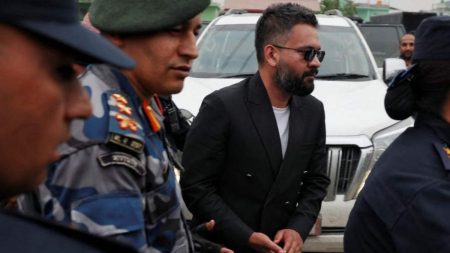
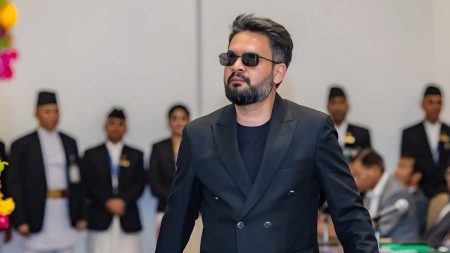
FOR A MAN who spent months accusing the state of murder, Sudan Gurung has just accepted a peculiar promotion. On March 27th he was appointed Nepal’s home minister, taking charge of the very security forces he blames for the deaths of 76 civilians during last September’s Gen Z uprising.
That uprising, which began as a protest against a ban on social-media platforms and widespread corruption, ended with the army seizing the streets, the prime minister resigning and over 2,600 live rounds fired by police in contravention of their own rules. Mr Gurung, a DJ-turned-activist-turned-lawmaker, was one of the movement’s principal coordinators. Now he sits at the desk that signs off on police transfers, internal intelligence and border security. His appointment is a loaded weapon placed on the table.
The Gen Z protests of September 2025 were Nepal’s most violent civilian upheaval since the restoration of democracy in 1990. A 907-page report by a commission led by Gauri Bahadur Karki, a former judge, later concluded that Ramesh Lekhak, then home minister, bore responsibility for authorising excessive force. It recommended that he and his prime minister, K.P. Sharma Oli, be prosecuted for criminal negligence. The report was completed on March 8th but withheld by the interim government until a leak this week, days before Mr Gurung’s appointment.
Mr Gurung’s route to the ministry runs through the same terrain of grief and grievance. In 2015, after a devastating earthquake killed nearly 9,000 people, he was present when a child died in his arms. He abandoned his work as an event manager and began coordinating relief through social media, eventually founding Hami Nepal, a non-governmental organisation that grew into a parallel emergency network. That network became the organising skeleton for last September’s protests. Mr Gurung publicly took credit for coordinating protest routes and safety logistics. When the army summoned movement leaders for negotiations after Mr Oli’s fall, Mr Gurung was in the room.
He entered electoral politics late, joining the Rastriya Swatantra Party (RSP) only in January, after the party had already chosen Balendra Shah, Kathmandu’s former mayor and a rapper, as its prime ministerial candidate. In March’s parliamentary election Mr Gurung won the Gorkha-1 constituency, the historical heartland of Nepali unification, by a margin of nearly 15,000 votes. The RSP itself took roughly two-thirds of the 275 seats in the lower house, the first single-party majority since 1999. For Mr Shah, the new prime minister, the calculation in appointing Mr Gurung to the home ministry is this: install a figure whose anti-corruption credentials are beyond dispute and whose loyalty is to Mr Shah, not to Rabi Lamichhane, the party’s chair and a man with his own complicated history with the September events. (The Karki report notes that Mr Lamichhane escaped from Nakkhu prison during the September 9th chaos.)
The most dangerous trap for Mr Gurung lies in the Karki report’s recommendations. His political base, the Gen Z constituency, expects the prosecution of Mr Oli and Mr Lekhak. Any delay or hesitation will be read as betrayal.
Yet moving aggressively would unite the old guard—Mr Oli’s Communist Party of Nepal (Unified Marxist-Leninist) and the Nepali Congress—against the new government. The home ministry does not directly prosecute: that task falls to the attorney-general’s office.
But it controls the Nepal Police, which investigates and gathers evidence. It also oversees personnel transfers, a patronage-heavy lever that has historically determined whether investigations advance or stall. Mr Gurung’s decision on whether to register a first information report against the two men will define his tenure more than any other act.
His authority comes from turning things upside down. He is a man of the street commanding the machinery that once fired on it. His experience running Hami Nepal gives him a district-level awareness of the country that few home ministers possess. His social media fluency gives him a direct line to a digitally mobilised youth population that will serve as both a constituency and an accountability mechanism.
But he has zero prior experience managing a government ministry. The home ministry is one of Nepal’s most complex institutions, overseeing police command, border security, immigration, disaster management and internal intelligence. His first months will be watched for signs of capture by bureaucratic resistance or, conversely, destabilising impulsiveness.
The internal politics of his own party add more complexity. Mr Gurung joined the RSP late and is closer to Mr Shah than to Mr Lamichhane. As home minister, he will command the agencies that manage law enforcement and the prison system—the same system from which Mr Lamichhane escaped during the September chaos. Any perception that he treats RSP leaders differently from opposition figures would corrode his anti-impunity mandate. That perception would be weaponised by both his rivals inside the party and the opposition outside it.
Then there is the international dimension. India, Nepal’s dominant security partner, has historically worked most smoothly with home ministers from the Nepali Congress or the communist parties. Mr Gurung’s nationalist streak, evident during Mr Shah’s earlier forays into the “Greater Nepal” map controversy, and his outsider status suggest he will be less deferential to New Delhi than his predecessors.
That could create trouble, particularly on border management and military recruitment schemes such as India’s Agniveer programme, which has become a political flashpoint in Nepal. But it could also create an opening for a reset, if managed with more discipline than confrontation.
The next 90 days will tell if Mr Gurung is a reformist who can bend the bureaucracy or a disruptor who breaks against it. The first indicator will be whether he moves to register cases against Mr Oli and Mr Lekhak. The second will be his first round of police transfers: patronage chains are broken or reinforced in such appointments.
The third, and most watched, will be how his ministry handles any new protest. Mr Gurung has said he favours non-partisan law enforcement. For a man who built his career challenging authority, the harder task will be learning to wield it without becoming what he once opposed.
The gamble of Mr Shah’s government is that the man who helped bring down the old order can now secure a new one. If Mr Gurung succeeds, he will have done something no home minister in Nepal’s modern history has managed: extract accountability from the state for its own violence, while keeping the state intact.
If he fails the Gen Z movement that carried the RSP to power will fracture, and the RSP’s experiment in governing will fracture with it. The ministry he now occupies was the target of his movement. If it becomes its instrument or its graveyard is a question he will answer with every decision he makes in the weeks ahead. ■
This piece has been amended.