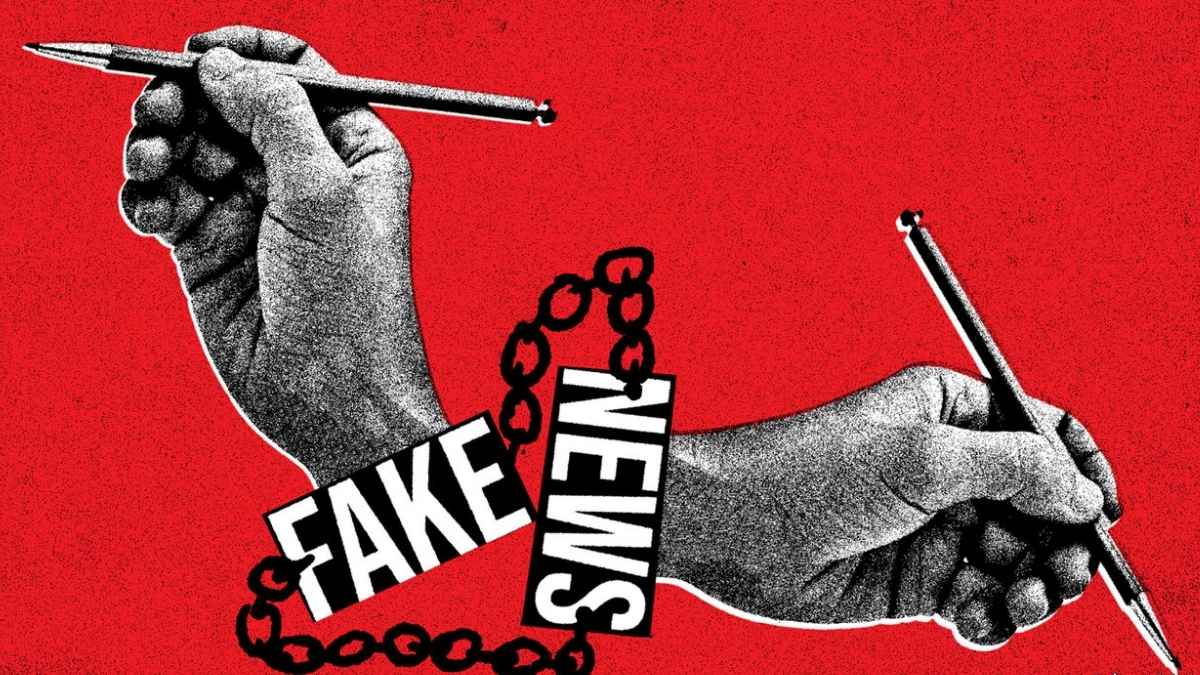
ILLUSTRATION: ADAM MAIDA
ON MAY 6TH Nepalkhabar, a domestic news portal, published a thrilling scoop: Meta Platforms, the parent of Facebook, would invest Rs5bn in a data centre alongside WorldLink, a local internet provider, under a confidential memorandum of understanding and a non-disclosure agreement. On the same day WorldLink issued a firm denial to the Katmandu Journal, stating that no such investment had ever existed. Another brick in the wall of mistrust that now encloses Nepal’s public sphere.
Nepal has become a laboratory for information disorder. In September 2025 a video of a man being dragged into the Bagmati River went viral. Many media outlets, in Nepal and abroad, identified the victim as finance minister Bishnu Paudel. The minister’s secretariat quickly stated that he had not been attacked. The actual victim, fact-checkers later established, was a police constable.
In November a hyena panic seized Rangeli, a rural market town in the Morang District, after doctored images of African spotted hyenas spread on Facebook; the District Forest Office deployed a capture team, only to find no trace of the animals. In January 2026 an AI‑generated video of snowfall in Kakarvitta, a town in Jhapa district, charmed TikTok users; a fact‑checking organisation confirmed the clip was a deep‑fake. Each falsehood, on its own, may seem minor or harmless, but collectively they add up to something much more serious and damaging
The underlying problem is structural. Nepal’s traditional media is crumbling. The Federation of Nepali Journalists recorded 139 incidents of press‑freedom violations in 2025, three times the figure for 2024. Two journalists died on the job. During the Gen‑Z uprising of September 2025 alone, media houses suffered institutional losses of Rs600m ($4m) and journalists’ private property was damaged to the tune of Rs180m.
More insidiously, the economic model that once supported independent reporting has broken down. The entire advertising market is worth perhaps $150m, less than a single mid‑sized American television station, and must be divided among more than 4,300 registered news outlets. Journalists commonly wait months for salaries; the FNJ recorded at least 18 complaints of professional insecurity in 2025, including non‑payment of wages and unlawful terminations. Under‑resourced and fearful of losing advertisers, many publications avoid investigations that might upset powerful companies.
Into this void step political operatives armed with artificial intelligence. During the March 2026 election, the Election Commission found widespread use of hate speech and deep‑fake content: videos created with off‑the‑shelf AI tools that purported to show candidates insulting opponents or using obscene language. Police arrested 35 individuals for spreading misinformation through AI tools. More than 600 cases of harmful election‑related information were referred to authorities; a UNDP study found that 54% of such harmful content consisted of deep‑fake pictures and videos generated by AI. The barrier to entry for disinformation has never been lower: a smartphone and a free AI tool now suffice to manufacture a political crisis.
Trust, once eroded, seldom recovers. A 2021 survey found that nine out of ten social‑media users in Nepal had received misinformation online: with Facebook identified as the most common vector. That trust deficit deepens as audiences flee traditional media: Facebook alone commands an 87% market share among social platforms in the country. The government’s ham‑fisted response—a September 2025 ban on 26 unregistered platforms—triggered the very protests that toppled the administration. Regulating disinformation by shutting down the internet is like curing a fever with a flamethrower.
What Nepal needs is neither censorship nor despair, but the unglamorous work of rebuilding journalistic muscle. That means sustainable funding: readers will have to pay for reliable news, and philanthropists will need to step in where advertisers have fled.
It means scaling up fact‑checking: the country’s sole accredited fact‑checking organisation published 92 checks in a year, a rounding error compared to the torrent of falsehoods. And it means digital literacy for a population where only 31% are considered digitally literate. Until these foundations are laid, each fake hyena, each phantom data‑centre deal and each AI‑generated snowfall will further bury the possibility of a shared reality. And without that, democracy in the Himalayas becomes a mere performance. ■