IMAGE INDIA’S FOREIGN MINISTRY
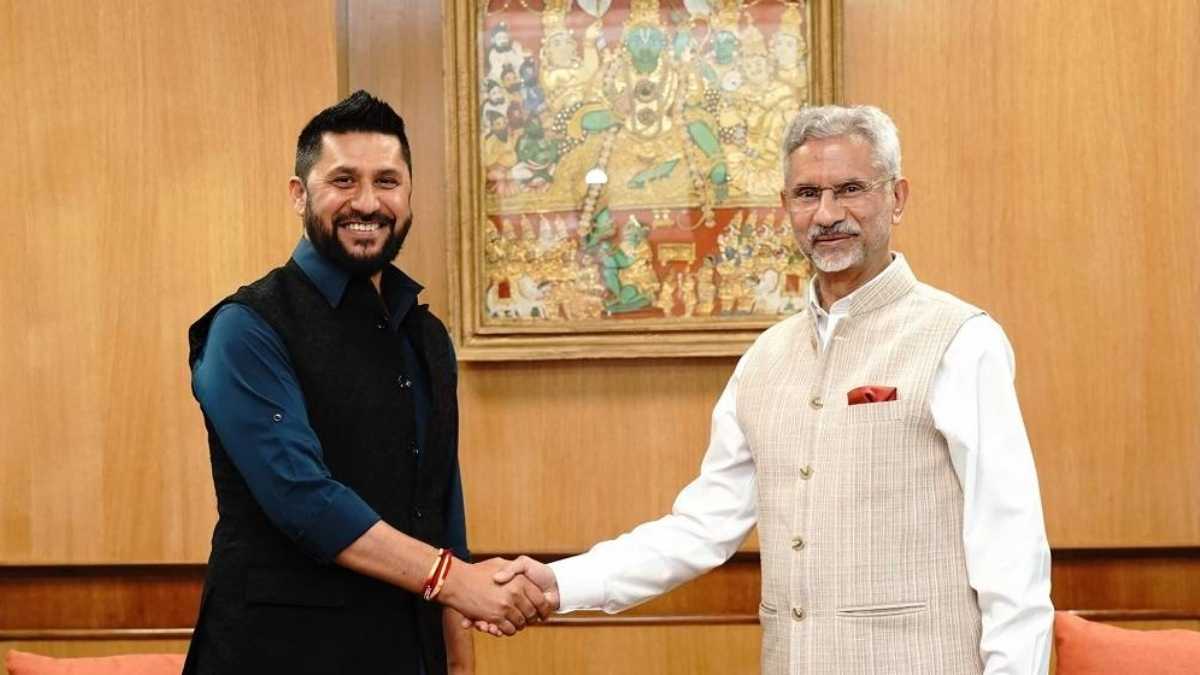
RABI LAMICHHANE arrived in New Delhi on June 1st at the personal invitation of Bharatiya Janata Party (BJP) president Nitin Nabin. Over the following four days he met, in sequence, BJP’s party president, home minister Amit Shah, external affairs minister S. Jaishankar, national security adviser Ajit Doval and on June 3rd prime minister Narendra Modi himself. The meeting with Modi lasted an hour. Lamichhane’s wife, two Rastriya Swatantra Party (RSP) lawmakers and diplomats from the Nepali Embassy were present. The delegation returned to Kathmandu on June 5th.
The meetings covered, according to official readouts, bilateral relations, development cooperation, people-to-people ties, cross-border connectivity, transborder crime and disaster management. These are the standard categories of a Nepal-India diplomatic encounter, and they will not, by themselves, resolve any of the specific disputes that have accumulated between the two countries. The Lipulekh Pass is still contested. Nepal’s protests over India’s use of the route for the Kailash Mansarovar Yatra in April have not been withdrawn. Prime minister Balendra Shah has not visited Delhi and has given no indication of when he will.
None of that made the visit unremarkable. What made it significant was a sentence Lamichhane delivered inside the Modi meeting, conveyed by a Nepali participant to the Kathmandu Post: he told the Indian prime minister that the RSP “has no political baggage and seeks to develop relations with India in a new way”.
That sentence is doing a lot of work. Nepal’s relationship with India over the past decade was conducted primarily through governments led by parties with strong communist formations; the CPN-UML of K.P. Sharma Oli and the CPN (Maoist Centre) of Pushpa Kamal Dahal. Both had ideological and rhetorical traditions that made their engagement with India complicated. Oli, specifically, built large parts of his political brand on populist anti-India sentiment: he made the Lipulekh and Kalapani issue into a constitutional amendment in 2020 and often calibrated his rhetoric towards Beijing when Delhi showed displeasure. India never found him easy to work with. Dahal, who had spent years fighting the Indian state’s preferred political order as a Maoist guerrilla, had his own complicated relationship with Delhi even when the two were formally aligned.
The RSP has none of this history. It was founded in 2022 by a television journalist. Its political identity is anti-corruption, anti-establishment and pro-reform. It has no ideological commitment to any foreign policy tradition, no historical debt to any power and no particular incentive to use India as a domestic political prop the way Oli did. Lamichhane’s “no political baggage” line was an offer: the RSP is available for a different kind of relationship, built around economic cooperation and connectivity rather than the old choreography of grievance and leverage.
Modi, according to the same Nepali participant, told Lamichhane that India is always with Nepal and is willing to be a partner in the country’s development, economic progress and prosperity. He described Nepal as India’s primary partner under its “Neighbourhood First” policy. He also sent a message through Lamichhane to Shah: “I have already sent an invitation to him and am ready to welcome him in Delhi.” That message, passed through the party chairman rather than through formal diplomatic channels, is itself a choice: a signal that India is willing to engage the RSP government on whatever terms it chooses to offer, party-to-party if not yet prime minister to prime minister.
The BJP’s readiness to host Lamichhane with this level of access did not emerge from nowhere. BJP has engaged Nepal’s political parties through the party circuit for years. Former Nepali Congress president Sher Bahadur Deuba and former Maoist Centre chairman Dahal had both visited BJP headquarters and met senior BJP leaders under similar formats. The party-to-party channel exists specifically for moments when state-to-state engagement is blocked or inconvenient. With Shah imposing a moratorium on foreign travel and the bilateral relationship stalled over Lipulekh, the party circuit was the most available option. India used it.
Lamichhane visited BJP headquarters under its “Know BJP” initiative, where discussions included, among others, the party’s organisational structures, grassroots outreach model and the role of younger generations in politics. BJP, as a party, has invested heavily in building institutional depth across India’s towns and villages. RSP, as a two-year-old party with 182 parliamentary seats and no comparable organisational infrastructure, is facing exactly the challenge of building something durable behind its electoral brand. The BJP offered a model. RSP will decide what to take from it.
What the visit did not produce was any resolution of the specific irritants that sit underneath the warm language. The Lipulekh dispute was, by all accounts, not substantively discussed. Shah’s visit to Delhi was invited but not scheduled. The joint projects, the power purchase agreements, the trade framework that could convert the goodwill into economic architecture: none of these were announced. What was announced was a mood: that both sides see the moment as an opportunity for a different relationship and are willing to do the preliminary work to find out what that relationship looks like.
For Lamichhane personally, the visit accomplished something additional. In two hours of meetings with India’s top four decision-makers, he established himself as an interlocutor of substantive weight: not a junior party figure doing a courtesy call, but a political leader conducting real diplomatic business. The question Kathmandu will spend the coming months answering is this: does that weight convert into authority within Nepal’s government, or does it create tension with a prime minister who stayed home while his party chairman met the neighbourhood’s most important leader? ■