IMAGE: HIMALPRESS
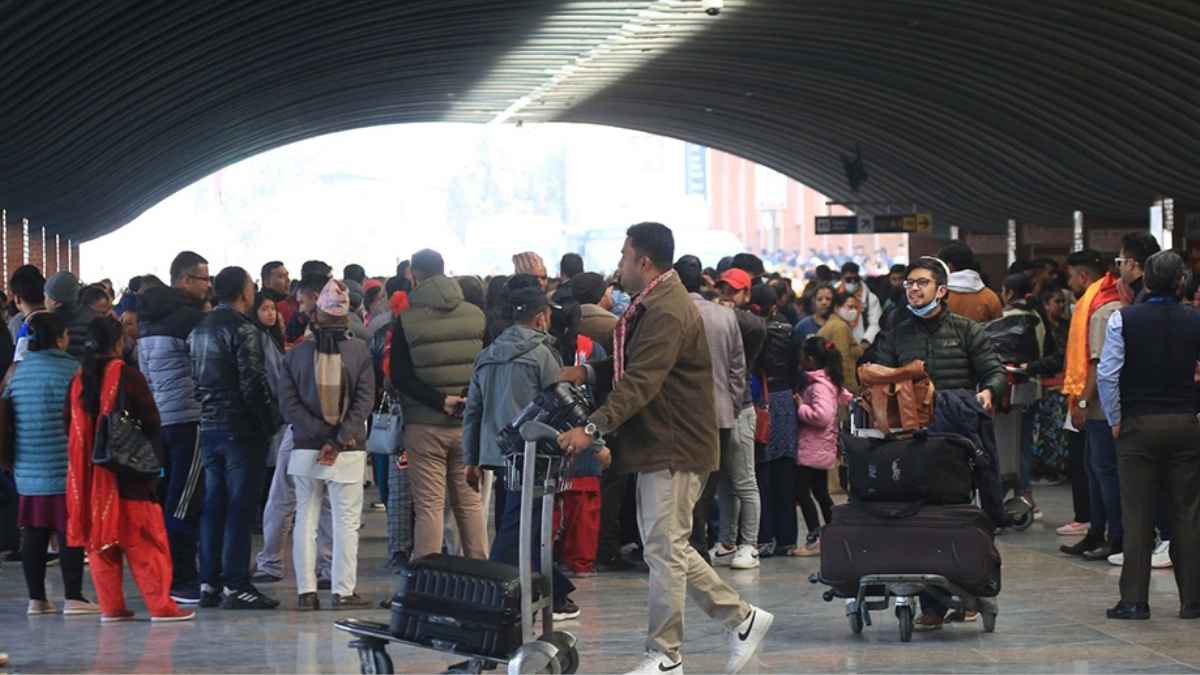
THE DEPARTURE hall at Tribhuvan International Airport in Kathmandu is the truest economic indicator Nepal produces. Every morning young Nepalis queue for flights to Doha, Dubai, Kuala Lumpur, and Seoul. Every evening, more queue for the same destinations. The Nepali Times once reported that 3,000 Nepalis leave on student visas from Kathmandu airport alone every day. The Department of Foreign Employment records some 1,700 labour departures daily, excluding the estimated 1.5m to 1.7m who cross to India by land without documentation. Over the past three decades 6.8m Nepalis have received formal labour approval to work abroad. Nepal has a population of 30m. The line does not shorten.
For most of that period, the leaving was accepted as a rational response to a poor country’s limited opportunities. The Gulf paid more. Malaysia paid more. Almost anywhere paid more. Families used the remittances—now equal to 28.2% of GDP, one of the highest ratios in the world—to build houses, put children through school and buy the gold that Nepali culture demanded at weddings. Migration was how Nepal insured itself against the state it had. The state, for its part, took note of the remittances and did not especially change.
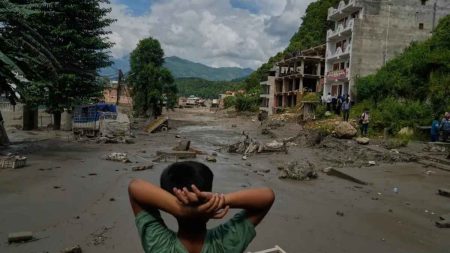
What September 2025 added was a different quality of emotion. On the morning of September 8th, young Nepalis—students, many of them still in school uniforms—marched to parliament in Kathmandu and in cities across the country. What started as a protest against a government-ordered ban on social media platforms became, within hours, a confrontation with everything the Nepali state had accumulated: the corruption, the impunity, the generation of politicians who had traded governing for rent-seeking across 32 governments in 35 years since 1990. Security forces opened fire. More than 74 people died. Prime minister K.P. Sharma Oli resigned. His government was the third South Asian administration in three years to fall to a youth-led uprising.
The movement’s immediate political demand was answered. Former chief justice Sushila Karki was sworn in as the country’s first female prime minister on September 12th. Parliamentary elections followed on March 5th 2026. The Rastriya Swatantra Party, running on an anti-corruption and reform platform behind 36-year-old Balendra Shah—a rapper-turned-mayor who became the youngest prime minister in Nepal’s history—won a near two-thirds majority. It was, by Nepal’s standards, a political revolution. The old parties that had governed in rotation since the 1990s were swept out in a single election.
The departure queue at Tribhuvan airport did not shorten. In the first eight months of the current fiscal year, 557,000 Nepalis received labour approvals to go abroad. The pace implies a full-year total well above 800,000: higher than before the protests, higher than before the elections, higher than any previous year. More than 100,000 students leave a year for degrees abroad, most in Australia, Canada, the United States and Japan. The 2021 census recorded 2.2m Nepalis living abroad; researchers consider that figure a significant undercount. Nepal’s own National Statistics Office estimates that 450,000 young people enter the domestic labour market a year after completing education. The formal economy has not, in recent memory, absorbed anything close to that number.
This is the paradox the RSP government has inherited. Political change happened. The economic reasons to leave have not changed with it. Dinesh Prasain, a Nepali sociologist, told the Nepali Times that “a lack of employment and meaningful earnings are the primary reasons for the young to leave. Basic items have become unaffordable even in fixed-income households.” The minimum wage in Nepal sits at Rs19,550 a month ($127). A worker in Qatar earns multiples of that doing harder work in worse conditions, but the money is real and arrives reliably. The calculation that drives the queue at Tribhuvan airport has not shifted because a 36-year-old became prime minister. It will shift when the wages available at home approach the wages available abroad, or when the infrastructure, governance and institutional reliability of Nepal’s economy make the comparison less brutal.
Finance minister Swarnim Wagle’s budget, presented on May 29th, targets 7% economic growth. The National Statistics Office estimates the economy grew at 3.85% in the fiscal year now ending. The discrepancy between those two numbers is the distance between what Nepal would need to generate employment at scale and what its current productive capacity delivers. Wagle knows the history: his own white paper, released before the budget, acknowledged that weak capital spending and poor execution have constrained growth for years. His budget allocates 60% of expenditure to recurrent costs—salaries and transfers—and 20% to capital investment.
The September 2025 generation did something historic. They removed a government and handed power to the youngest administration Nepal has ever had. The same generation is also leaving at a record pace, not necessarily out of despair but out of a rational assessment that the jobs the new government needs to create do not yet exist. Political faith and economic exit are not opposites in Nepal. In fact they are the two responses of the same generation to the same underlying failure, expressed in different directions on the same morning. ■