IMAGE: S. JAISHANKAR
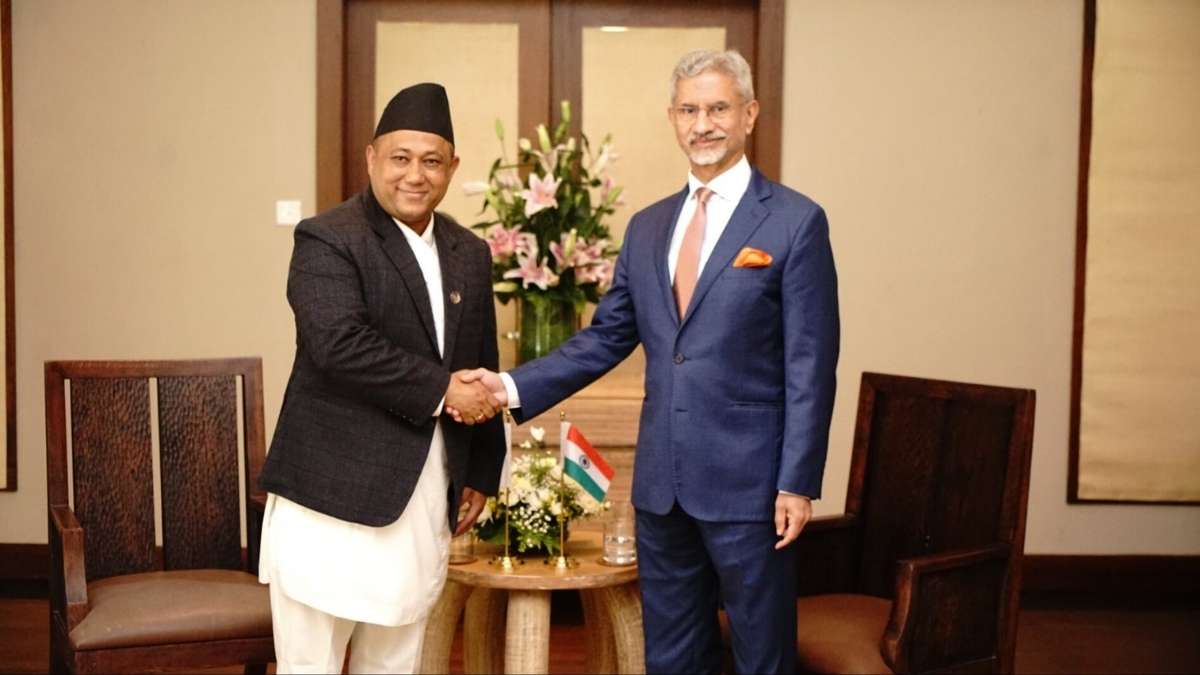
THE IMAGE Nepal’s government wants to project is a country that treats its two giant neighbours equally: visiting one, then the other, shaking both hands with the same firm grip, leaving both capitals with the sense that Kathmandu belongs to neither. Foreign minister Shisir Khanal’s India visit from June 5th to 7th, followed by his expected China visit from June 14th to 17th, is the clearest physical embodiment of that ambition. Both visits are at foreign-minister level. Both involve meetings with the counterparts. Both cover trade, connectivity and bilateral cooperation in tones of mutual warmth. On the surface, the balance is impeccable.
Then a senior foreign ministry official spoke to the Kathmandu Post, and the carefully managed picture changed. “In fact,” the official said, “he visited New Delhi on short notice only after his trip to China was confirmed.” That is a remarkable disclosure. It means the India leg—which looked like the primary trip, the first stop with a follow-up to Beijing—was in fact the hastily arranged preamble to the one that mattered. China was planned. India was added to avoid the optics of going to Beijing without having first stopped in New Delhi. The double-handshake was not the even-handed gesture it appeared. It was a diplomatic optical illusion, and a senior official explained it in a newspaper interview.
The reason Khanal needs to go to China at all is also spelled out in the same Kathmandu Post account. The same official said Beijing has developed “growing suspicion” that Nepal’s new government is leaning towards the West. The evidence, from Beijing’s perspective, is not hard to construct. Rabi Lamichhane, the RSP’s party president, flew to New Delhi and met India’s prime minister, Narendra Modi. Twenty-three European ambassadors flew to Kathmandu for a two-day charm offensive. The US special envoy arrived, was received at the ministerial level and left without a prime ministerial meeting. Chinese officials had landed in Kathmandu shortly after the March elections and met senior leaders of the ruling Rastriya Swatantra Party, but at a lower level of engagement than the India-and-Europe circuit suggested was on offer elsewhere.
Khanal’s Beijing visit is therefore not primarily about trade or connectivity, though the agenda covers both. It is about reassurance: telling the Chinese leadership that the RSP government has not made a choice between its neighbours. That it remains committed to balanced diplomacy. And that the Lamichhane-Modi meeting and the European ambassador convoy should not be read as a statement of direction. The foreign ministry official was unusually candid about this: the visit is “aimed at dispelling this perception and reassuring the Chinese leadership.”
In Beijing, Khanal will meet Chinese foreign minister Wang Yi and Liu Haixing, the head of the International Department of the Communist Party of China—the CPC’s formal channel for party-to-party diplomacy with foreign political organisations. That second meeting is notable. It mirrors, in reverse, what the BJP offered Lamichhane in New Delhi: a formal connection between the ruling party of one country and the political leadership of the other, running in parallel to the state-to-state diplomatic channel. China is extending the same courtesy to Nepal that India extended recently.
What neither visit has yet produced, and what distinguishes the diplomatic calendar from the actual bilateral relationship, is any movement on the things that really matter. India’s position on Lipulekh is unchanged. China’s Belt and Road Initiative has been in Nepal since 2017 and has not produced a single implemented project. The third meeting of the Nepal-China mechanisms for cooperation review, held earlier this month, “agreed on specific measures to expedite the timely and effective implementation of projects requiring immediate attention”: which is diplomatic language for the fact that the projects remain unimplemented and attention is required. The Kerung-Kathmandu railway is a feasibility study. The industrial zone in Damak is a plan. The cross-border connectivity that would make Nepal less dependent on Indian transit routes is, nine years after the BRI signing, still not built.
Against this backdrop, the double-handshake is what Nepal’s foreign policy looks like when it is being managed well and achieving little simultaneously. Khanal is doing the right things: visiting both neighbours, engaging at the right levels, keeping the signals symmetrical. The tough question—ie what non-alignment actually delivers for a landlocked country that needs roads, railways and reliable markets—is the one that no amount of careful scheduling can answer. ■