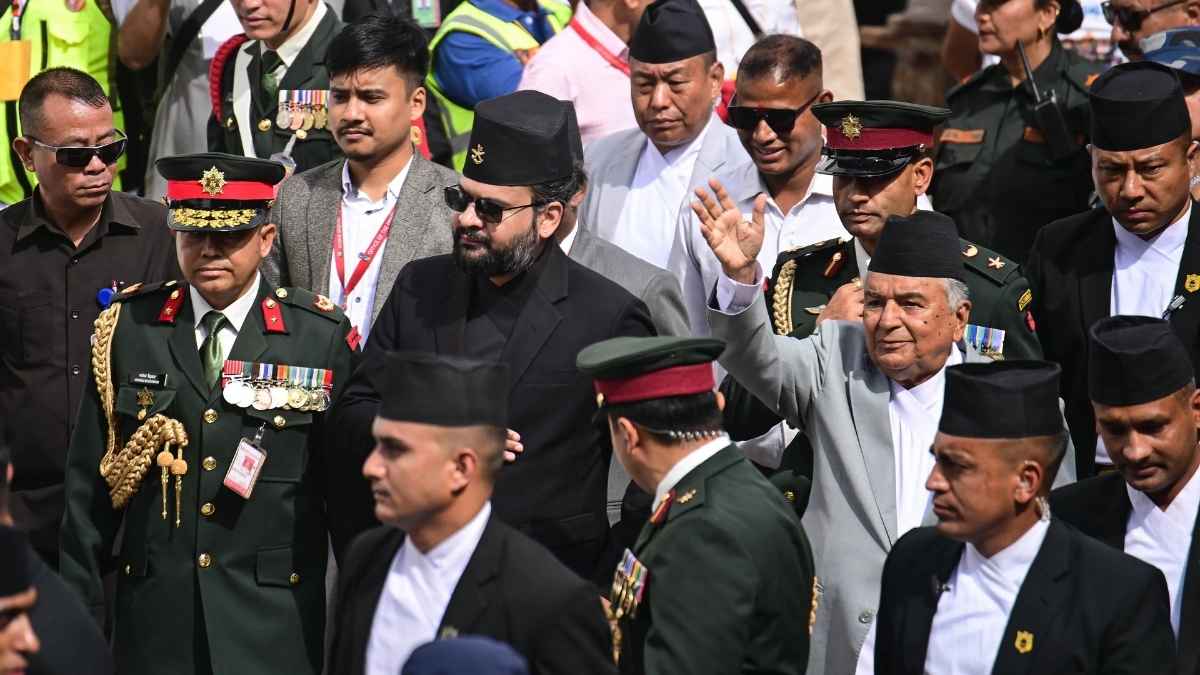
IMAGE: GETTY IMAGES
WHILE NEPAL’S foreign minister was being received by one of the most senior men in the Chinese Communist Party, Nepal’s prime minister was not in parliament. He has not been there in weeks. The reason he is absent is the same reason his government’s foreign policy keeps tripping over its own feet: the man running it cannot quite stop being the man he was before he got the job.
On June 15th Shisir Khanal sat down in Beijing with Wang Yi, China’s foreign minister, and then with Wang Huning, a Politburo Standing Committee member whose presence in the meeting was read in Kathmandu’s diplomatic circles as an unusually generous gesture from Beijing. China pledged to speed up the implementation of projects that have been promised and stalled for years. Coming a week after Khanal’s own visit to New Delhi, the symmetry was the point: two neighbours, two visits, equal billing. It was, on its own terms, a good fortnight for Nepali diplomacy.
It happened almost entirely without Balendra Shah. The prime minister has stayed away from the House of Representatives since making an offhand remark last month about Nepal’s western border that the opposition has spent weeks demanding be struck from the parliamentary record. Lawmakers used the session, held on the same day Khanal was shaking hands in Beijing, to ask the government whether the Lipulekh dispute had even come up during the China trip, while separately raising newly reported Indian military helicopter flights over Darchula. The two threads, foreign and domestic, are separable no more. Nepal’s foreign minister is conducting a careful, equidistant diplomacy in two capitals at once. Nepal’s prime minister is the reason nobody quite trusts how long the equidistance will last.
This is the part that outside analysis of Nepal’s “balancing act” tends to underplay. Shah’s caution about being seen to tilt towards any single power is usually described as strategy: an echo of King Birendra’s old “Zone of Peace” proposal, an attempt to stop Nepal behaving, as its founder once put it, like a yam squeezed between two boulders. There is something to that.
But Shah did not arrive at caution through pure statecraft. He arrived at it carrying a record that gives every foreign ministry in the region a reason to read his every move twice. As mayor, he called for a ban on Indian films. He displayed a map of “Greater Nepal” that swallowed Indian territory. He called Nepal’s own courts “Indian slaves” after a ruling went against him, and complied with it only once the contempt threat became real. He cancelled a planned visit to China in protest at Beijing’s refusal to recognise Nepal’s revised map. In November 2025 a late-night Facebook post used a profanity against India, China and the United States in the same breath, before he deleted it; the screenshots did not delete so easily. A man with that history does not get the benefit of the doubt simply by declining one-on-one meetings with visiting envoys.
That declining itself is the second domestic constraint recast as foreign policy. Shah’s office turned away a meeting request from Sergio Gor, America’s special envoy and ambassador to India, citing “domestic priorities and governance issues”—an honest phrase, if not in the way it was probably intended, since the domestic priorities in question are largely of Shah’s own making. Gor still got his audience with Khanal, with the finance minister and with Rabi Lamichhane, the Rastriya Swatantra Party’s chairman, who has now visited New Delhi and met China’s party-to-party channel without holding any government post at all. A foreign capital trying to read Nepal’s intentions now has at least three separate doors to knock on, and no certainty about which one actually carries the prime minister’s authority.
The third constraint is parliamentary chaos. The opposition is fighting the government over a budget it alleges was altered overnight between the speech and the printed copy. The civil service restructuring bill has unsettled a bureaucracy whose cooperation any foreign policy reset eventually requires. The RPP’s chief whip used the same session to point out that science and technology, the sector Shah has personally taken charge of and the one his government’s “$30 billion in tech exports” ambition depends on, received 0.18% of the entire budget. A government that cannot agree internally on its own appropriations bill is not a government foreign capitals expect to hold a position for long, whatever balance it claims to be striking.
None of this means the RSP’s foreign policy instincts are wrong. Equidistance, professionalised diplomacy, routing access through the foreign ministry rather than the prime minister’s living room: these are the right reforms for a country that has spent decades being managed by its neighbours rather than managing them.
The trouble is that good instincts executed by an undisciplined principal do not travel as far as they should. Khanal can shake every hand in Beijing and Delhi he likes. Until Shah stops being the most unpredictable variable in his own government’s foreign policy, the balance he is so determined to strike will keep depending on whether he can, for once, just stay hushed. ■