IMAGE: KJ
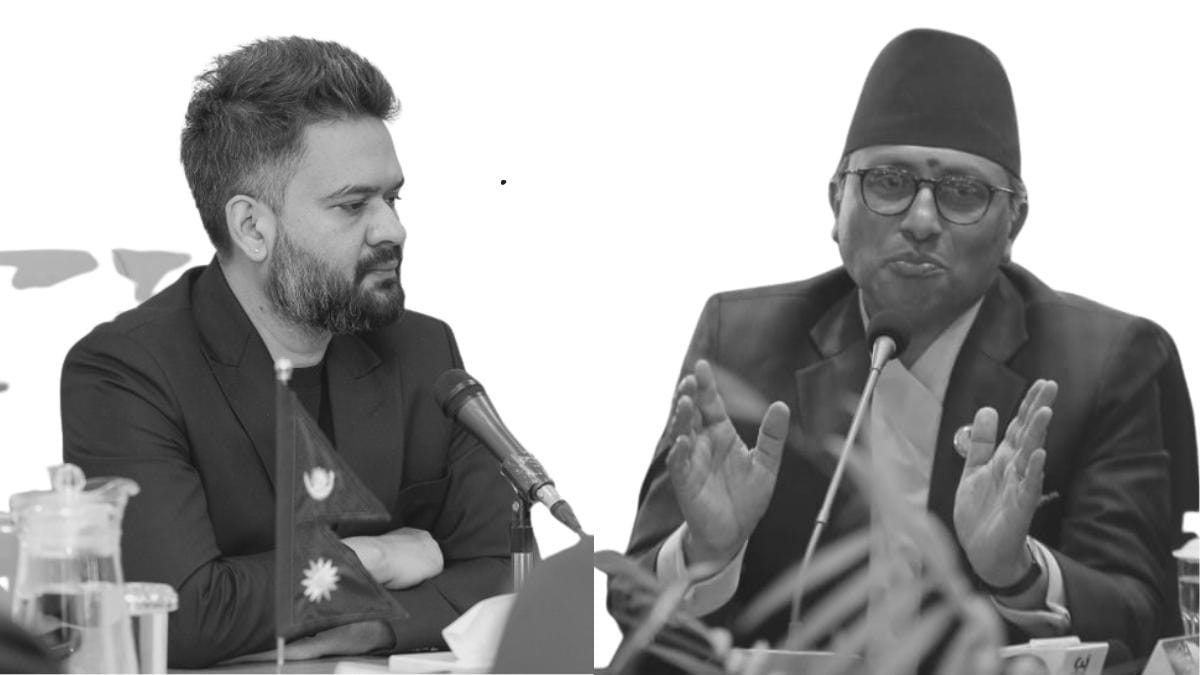
IT IS A reasonable question to ask about any government: who is actually driving the thing? In Balendra Shah’s cabinet, the answer is not obvious, because the two most consequential figures make up different theories of what Nepal’s problem is—and therefore what its solution requires.
Wagle’s theory is economic. On this view, Nepal’s problem is that public money gets allocated but not spent. That revenue is too narrow. That private investment has fallen from 25% of GDP to 19% because the business environment punishes confidence. And that fixing these things through better fiscal management and smarter capital deployment is what unlocks growth and jobs. In this theory, the finance minister is the crucial actor.
Shah’s theory is political. Nepal’s problem, in his view, is that the state has been captured by a small number of families, parties and networks that use public institutions to extract rather than to serve. No economic policy works well inside that system because the policy gets rerouted before it reaches its destination. The 25% of infrastructure budgets that actually reaches concrete, the revenue that disappears before it reaches the treasury, the regulations that get suspended for the right price: these are the systems working as intended for the people who designed them. In this theory, the prime minister is the crucial actor, because only someone with political authority and popular mandate can break the networks that cause the dysfunction Wagle is trying to fix.
Both theories are correct. That is what makes the question interesting.
Nepal has had credible finance ministers before, and the results are revealing. Yuba Raj Khatiwada, an internationally respected economist, served as finance minister under K.P. Sharma Oli and produced carefully constructed budgets. They were not implemented. Capital spending repeatedly fell below 60% of its allocation. Revenue targets were missed. Not because Khatiwada’s analysis was wrong, but because the political environment around him was not aligned with what the analysis required. A finance minister who diagnoses the problem correctly but operates inside a system committed to ignoring the diagnosis changes very little.
This is the argument for Shah’s primacy. He has something Khatiwada never had: political capital unconstrained by coalition partners who needed managing. The RSP’s near two-thirds majority is historically unusual in Nepali politics. It is not just a mandate in the normal sense but something rarer: an actual instruction from the population to do things that previously could not be done. Depoliticising the civil service, breaking the contractor-politician nexus, enforcing transparency in public procurement: none of these things requires Wagle. They require Shah. And they are the preconditions for any fiscal policy working as designed.
The argument for Wagle’s primacy is different. The anti-corruption arrests have given the Shah government momentum. The 100-point reform agenda has given it direction. But a government that cannot show falling youth emigration, rising wages as well as new employment within two to three years will face the sort of disillusionment that political mandates cannot survive.
Nepal’s September 2025 generation did not burn buildings because they wanted better governance in the abstract. They wanted jobs. Jobs come from economic policy—and that is Wagle’s job rather than Shah’s.
But here is the brutal assessment of the first three months: already Wagle has shown the limits of competence without political cover. His budget targets 7% growth (which the central bank says “ambitious”) on a baseline of 3.85% and projects 25% revenue growth in a single year. These are the projections of a man operating inside a political environment that needed ambitious numbers, and who provided them. The finance minister’s job is not just to design good policy. It is to fight for the conditions under which good policy survives contact with politics. Wagle has shown he can write a diagnosis. He has not yet shown he can defend one under pressure — and his threat to expose opposition MPs’ scandals from the floor of the Public Accounts Committee suggests that when pressure arrives, he reaches for the same toolkit as his predecessors.
Shah for his part has built political capital and spent it on accountability. What he has not shown is the ability to convert that capital into the patient, institutional work job creation needs: land acquisition reform, industrial zone development, regulatory simplification that actually gets done. His impulsiveness, flagged by multiple analysts within months of taking office, is the primary risk to his own mandate. A leader who centralises decisions and bypasses institutions may move faster in the short term and corrode the institutional capacity those decisions depend on over time.
The true answer is that Shah matters more for what Nepal needs politically, and Wagle matters more for what it needs economically; and each depends on the other to make his contribution count. A prime minister with mandate but poor fiscal management produces popular sovereignty without prosperity. A finance minister with good ideas inside a poorly governed system produces diagnoses without cures.
Nepal has had plenty of both, separately. Whether one administration can produce both at the same time is what the next four and a half years will determine. ■