IMAGE: ARTHA SAROKAR
WHEN THE Ministry of Infrastructure Development circulated its draft Vehicle and Transport Management Bill in late June, Kathmandu’s social media filled almost immediately with videos of motorists pulling out the tinted plastic strips from their car windows. The reason was this: under the proposed law, driving with a tinted window carries a fine of Rs100,000. Driving drunk carries a fine of Rs50,000 for heavy vehicles; Rs35,000 for light vehicles; and Rs25,000 for a two-wheeler. Nepal’s draft transport law, in other words, penalises a darkened window twice as severely as it penalises drunk driving. This is the detail that tells you most of what you need to know about how the bill was designed.
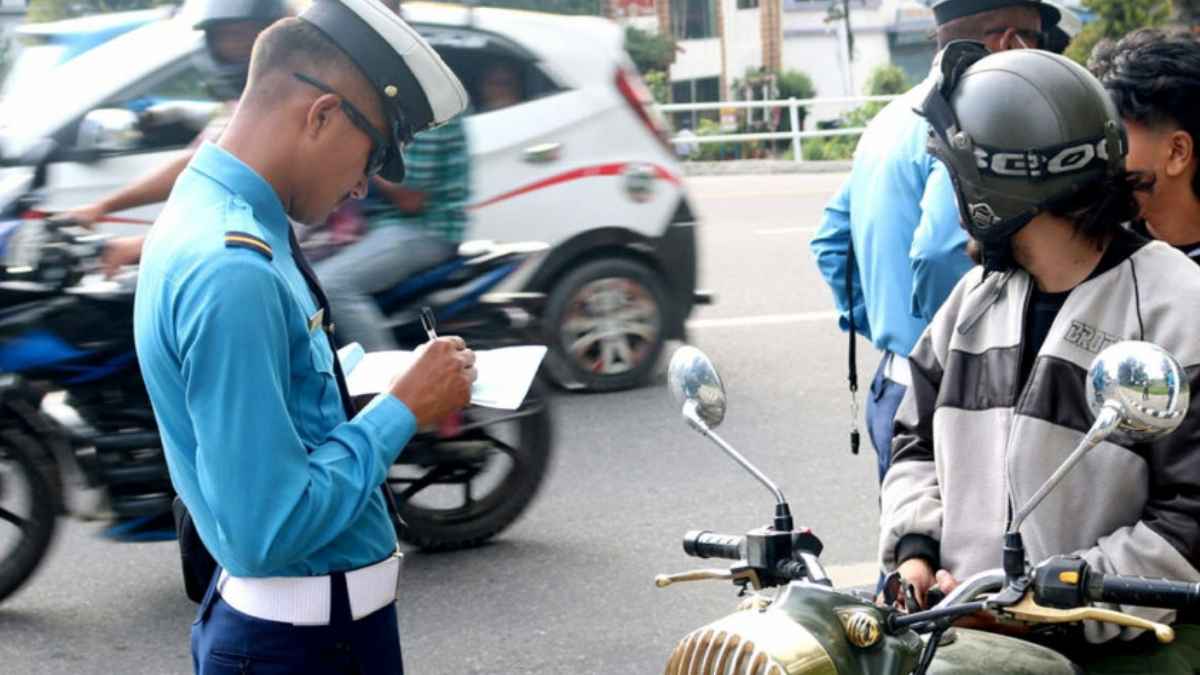
The proposal—formally titled the Bill to Amend and Consolidate Laws Relating to Vehicles and Transport Management—is currently being reviewed by the Ministry of Law and has not yet gone to parliament. It introduces fines ranging from Rs500 to Rs100,000, expands the number of offences for which traffic police can issue on-the-spot penalties from 20 to 39 and gives officers ranked Assistant Sub-Inspector and above the power to collect immediately. Speeding carries tiered fines. Driving too slowly carries Rs3,000 to Rs5,000. Overloaded public transport on long routes faces Rs20,000. Jaywalking costs Rs500. The stated goal is to update a law that hasn’t been substantially revised since 2016. The traffic death toll, averaging seven people a day, is the government’s evidence that something needs to change.
Road safety expert Bhagawati Sedhai pointed out that Nepal records 28 road fatalities per 100,000 population a year, which is among the highest rates globally, and argued that penalising citizens heavily without improving infrastructure and monitoring systems is unbalanced and could be counterproductive. She is describing the core problem with the bill’s logic, but it goes further than even her critique suggests. A fine deters behaviour only if the person being fined could have chosen to behave differently. In Kathmandu a substantial share of traffic chaos is not really a choice. Motorcyclists ride on pavements because the road surface has deteriorated to the point where the pavement is safer. Vehicles inch through intersections on red lights because the traffic light has not worked in six months and the junction is unpoliced. Buses stop in the middle of the road because there are no designated bus bays. You cannot fine your way out of an infrastructure problem by treating the symptoms as behaviour.
Lawmaker Gyan Bahadur Shahi raised the obvious question in parliament: if citizens are fined up to Rs100,000 for violations, should the state also be fined for potholes left unattended for 24 hours? Should traffic lights that are not functioning result in penalties for authorities? Should delays in issuing driving licences also carry fines for responsible offices? Nobody has answered Shahi’s question, because it does not have an easy answer. The bill creates accountability for citizens without creating any corresponding accountability for the state institutions whose failures produce the conditions in which violations occur.
Former Deputy Inspector General Keshab Adhikari warned that even with the current thousand-rupee fines, drivers frequently argue with officers or attempt to flee checkpoints, and that if fines skyrocket, reckless drivers might abruptly make dangerous U-turns upon spotting traffic police, risking fatal head-on collisions. In other words, raising fines without improving the enforcement system’s credibility may produce more road deaths, not fewer.
The income dimension adds a layer the bill’s authors appear not to have considered seriously. Many people earn between Rs25,000 and Rs30,000 a month. A Rs50,000 fine for a single traffic violation constitutes some two months’ gross salary.
At that scale, fines are not deterrents in the normal economic sense. They are financial emergencies that produce desperate behaviour: arguing with the officer, offering a bribe or fleeing the checkpoint. The Nepali Times captured the aspiration behind the bill well: Nepal’s leaders want to be reincarnations of Lee Kuan Yew, and like to say that they want to turn Nepal into Singapore. Singapore’s fines work because Singapore’s roads are maintained; its traffic systems are functional; its officers are well-paid enough not to negotiate; and its citizens are wealthy enough that fines are proportionate rather than catastrophic. Nepal shares none of those preconditions. Copying the fines without building the system needed to enforce them turns road safety into a way of raising revenue.
This publication is not saying traffic fines should not go up. The current maximums are too low to deter much of anything, and the case for higher penalties on road-safety violations (drunk driving, overloaded trucks on mountain highways, mobile phone use while driving) is reasonable.
Yet doubling the fine for tinted windows while Kathmandu’s roads remain full of potholes, broken traffic lights and missing road markings is not a road safety policy. It is the easiest thing for the government to do while avoiding the ugly task of fixing the roads. That has been Nepal’s governing habit for three decades. ■