
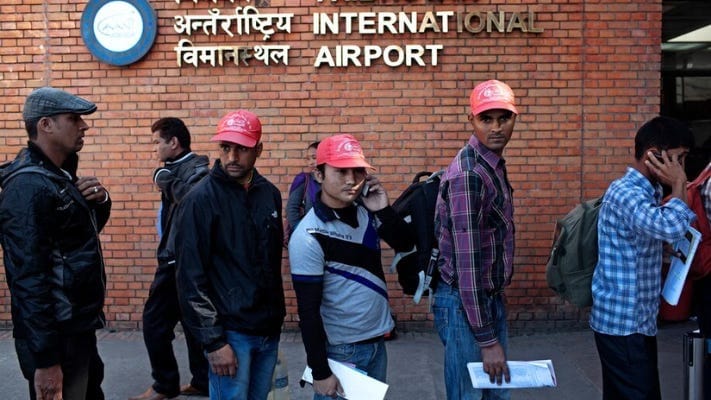
IMAGE VIA THE WASHINGTON POST
THIS WEEK the Nepal Rastra Bank released its eleven-month macroeconomic figures through mid-June for fiscal year 2025-26. On the surface the numbers are extraordinary. Worker remittances reached Rs2.12trn, or $15.7bn. Foreign exchange reserves swelled to $24.67bn. For a small, landlocked country often associated with poverty and political instability, this looks like a triumph. It is nothing of the sort.
Kathmandu has become an unwitting laboratory for a development model that has captivated policymakers from Manila to Mexico City. The model runs on a simple premise: export surplus labour to richer countries, let migrants send hard currency home and watch poverty fall and reserves rise. The World Bank has championed remittances as a stable, counter-cyclical force that bypasses corrupt bureaucracies and reaches the poor directly. Yet Nepal’s latest data suggests something else—one of stagnation masked by cash flows, of industry hollowed out by the very wealth that keeps households afloat.
Consider the underlying arithmetic. Strip away the remittances and the domestic economy is running a deficit of alarming proportions. Merchandise imports stand at Rs1.89trnbn against exports of just Rs278bn, a trade gap of some Rs1.6trn. Without the foreign exchange sent home by workers in Qatar, Malaysia and the Gulf, Nepal’s currency would be under speculative attack and its reserves in freefall. The surplus is entirely exogenous, generated not by the efficiency of domestic firms but by the sweat of Nepali labour abroad.
This dependence has produced a peculiar variant of Dutch Disease. The classic version afflicts countries that discover natural resources: a flood of foreign currency appreciates the real exchange rate, killing off other exports. Nepal has replaced oil wells with airport departure lounges. The remittance inflows have pushed up the price of non-tradable goods— (real estate, local services) while destroying the competitiveness of what remains of domestic manufacturing. Gross fixed capital formation has fallen to 26.3% of GDP, down from a peak of 41.4% in 2018-19. East Asian tigers during their boom years commonly sustained rates above 40%. Nepal cannot build roads, hydroelectric dams or factories because remittance wealth seeks safe havens: land speculation and imported consumer goods.
The import surge tells the rest of the story. The money comes in as foreign exchange and flows straight back out to buy automobiles, electronics and petroleum from India and China. Nepal supplies the labour; its neighbours supply the goods. The value-added manufacturing, technological spillover and job creation happen beyond its borders. The country has become a transit economy for its own wealth.
The financial sector offers the most striking evidence of paralysis. Total deposits have surged to Rs8.01trn, driven largely by remittance inflows. Yet private sector credit growth has crashed to a historic low of 6.4% year on year. Banks are drowning in liquidity but cannot find viable borrowers. Legitimate industrialists are not expanding, thanks to policy uncertainty and the effects of Labour Dutch Disease.
So the banks park their excess cash in government Treasury Bills, driving the 91-day rate down to 2.64%. In a developing nation with vast infrastructure needs, this is a catastrophic misallocation of capital. A $24bn reserve buffer and an Rs8trn banking system should be building hydro-dams and special economic zones. Instead the money finances recurrent state expenditure while the private sector starves.
The stock market reflects the same apathy. The NEPSE index has flatlined at 2724.0, with market capitalisation to GDP stuck at 70.5%. In a normal low-interest-rate environment, equities should boom as investors seek yields above government paper. In Kathmandu they are dead. Investors understand that domestic companies cannot generate earnings growth when the wider economy is hollowed out by remittance dependency.
Inflation provides the most urgent warning. Nepal must import almost everything of value, and when global commodity prices rise, the pain transmits straight to consumers. The wholesale price index has spiked 8.47% year on year, with fuel and power up 36.78% and basic metals up 32.20%. Consumer price inflation stands at 5.22%, but wholesale prices are rising much faster, suggesting further retail price increases are baked in for the coming months.
The central bank faces an impossible task. Raising interest rates to fight inflation would crush the already comatose private sector credit growth. But the inflation is not domestic in origin: it is imported through structural dependency. Remittances have robbed Nepal of monetary sovereignty.
Then there is the geopolitical risk. The entire macroeconomic architecture rests on the assumption that host countries will continue absorbing cheap labour in massive numbers. That assumption is dangerous. Gulf states are pursuing automation and robotics under their Vision 2030 programmes. Construction sites that once required thousands of Nepali workers are increasingly using modular methods and automated machinery. Malaysia and other Southeast Asian hubs are moving up the value chain, requiring skills that Nepal’s largely unskilled migrant pool cannot provide. A 20% slump in remittances would swing the current account to a massive deficit, drain $3-4bn from reserves annually, break the peg to the Indian rupee and trigger a collapse in real estate prices that would flood the banking system with non-performing assets.
The tragedy for Nepal—and for other nations following the same path—is that remittances have masked structural weaknesses for so long that no alternative safety net exists. The domestic export sector is far too small to absorb the shock. Government revenue growth is sluggish at 6.4%, and debt is rising. When the global labour market contracts, as it almost certainly will within the next decade, these economies will find themselves with no Plan B.
The lesson from Kathmandu is not that remittances are useless. In fact they have prevented a balance-of-payments crisis and lifted many households out of extreme poverty. But they are a painkiller and not a cure. They numb the economy to chronic diseases (from low investment to industrial collapse and governance failures) while the underlying condition worsens. Developing nations that have structured their macroeconomic architecture around labour exports are sitting on a ticking time bomb. The data from Nepal is a preview of a coming crisis. ■





