IMAGE: JAGADMBA
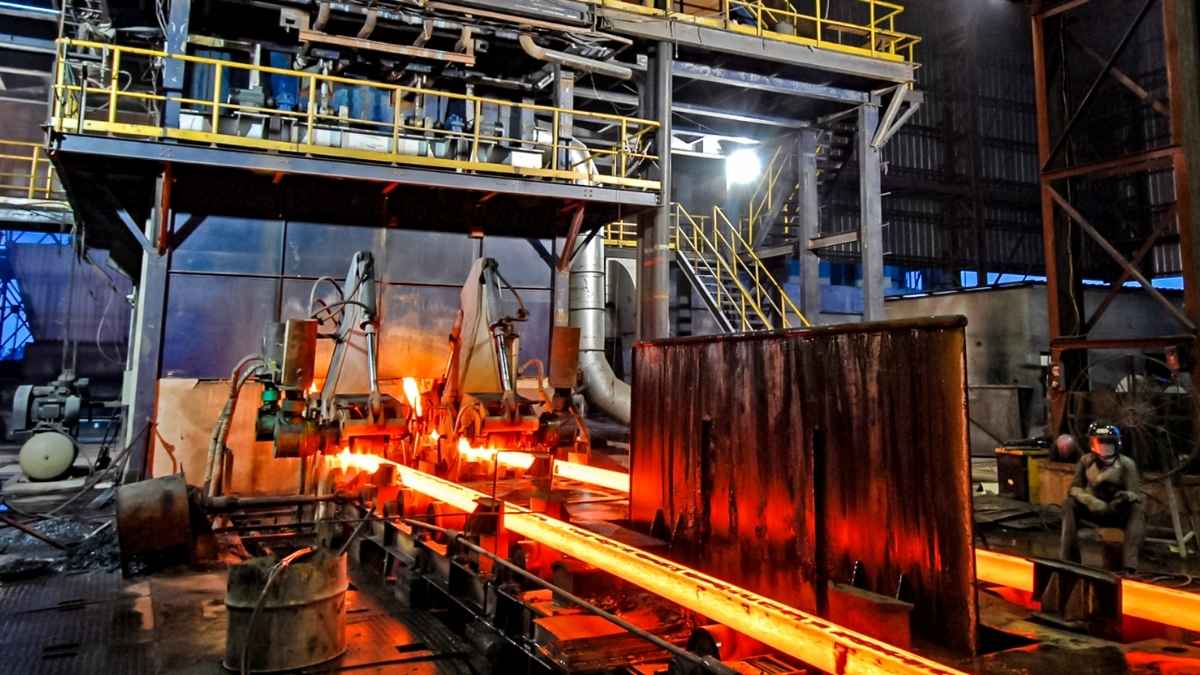
FOR THREE decades the manufacturing sub‑sector has shrunk from nearly 10% of GDP to below 6%. Over the past ten years the industrial sector’s contribution has slipped from 14.1% to 12.8% or so. Nepal is losing its factory base before it has properly built one. Economists call this premature deindustrialisation: a country moving from agriculture to services without the manufacturing middle that creates mass formal employment and the productivity gains that accompany it. Governments have announced industrial policy after industrial policy intended to prevent that sort of embarrassment. Yet they have failed spectacularly.
The policy documents say the right things. The data say something else. Manufacturing has contributed an average of only 5.4% to GDP over the past decade. While the overall economy expanded by 4.2% annually, manufacturing grew by just 2.9%. Only 461 industries registered in the first six months of the last fiscal year — a number that would barely fill a single industrial estate in a country that claims industrialisation as a national priority. Factory utilisation falls. Industrial lending stalls. Manufacturing’s share of the economy continues its long decline.
Start with the Special Economic Zones. The first was established in Bhairahawa in 2000 to manufacture mineral‑based products and kitchen utensils. An Export Processing Zone followed in Simara, mainly for garments.
Twenty‑five years later both are significantly underutilised. Bhairahawa’s SEZ sits adjacent to Gautam Buddha International Airport, which itself has averaged just 23 international flights a month since opening in 2022. The zone’s infrastructure exists. What it lacks is industrial activity. Manufacturers who have considered locating there cite the same obstacles: land‑lease terms that make long‑term investment hard to justify, inconsistent utilities and regulatory approvals that require clearances from agencies based in Kathmandu, instead of in the zones themselves.
The budget does not help. In fiscal year 2024‑25, nearly 89% of the Ministry of Industry’s funds remained under federal control. Only 11% reached subnational governments. In 2025‑26 the figure is set to top 90% at the centre. This is the central contradiction of Nepal’s industrial federalism: a constitution that distributes governing authority to seven provinces and 753 local governments, combined with an industrial ministry that keeps almost all the money in Kathmandu.
Madhesh, with its flat terrain and border proximity, and Bagmati, with its infrastructure and labour, cannot act independently on industrial promotion. The budgets to do so do not reach them.
The credit structure confirms the problem. Banks lend more to trading companies than to manufacturing and processing combined. From a banker’s perspective this is rational. A trading business turns capital over in weeks, carries lower risk and holds inventory that can be liquidated if the borrower defaults. A manufacturing business borrows for three to five years, requires specialised land and equipment as collateral, employs workers whose rights create legal complexity, and takes two to three years to break even.
Both pay 9‑12% interest. One is a structurally better credit risk. The government has not compensated for that with patient capital, credit guarantees or manufacturing‑specific lending requirements. The banking sector optimises for its own portfolio quality and produces, as a predictable result, a loan book heavy in trade finance and light in factory construction.
The VAT refund system has been a running wound for more than a decade. Manufacturers who export pay VAT on inputs and are entitled to refunds. Those refunds take months or years to arrive, which in turn means working capital is locked in a government receivable that earns no interest while the manufacturer pays interest on the borrowings used to replace it. The finance ministry’s published backlog of outstanding refunds has been cited as a big problem in every economic survey since at least 2015. Finance Minister Swarnim Wagle’s most recent budget acknowledged it. The backlog has not been cleared.
Garments offer the clearest case study of what happens when Nepal fails to use the time it has. Garments were once Nepal’s largest export sector. When the Multi‑Fibre Arrangement’s quotas were removed in 2005, the industry largely collapsed. Because firms had used the protected decade to optimise for quota gaming rather than productivity. Clothing and textiles remain on the export list, but current apparel exports stand at some Rs13bn against imports of Rs44bn. Nepal is a net importer in a labour‑intensive sector it once led. Bangladesh, which faced the same quota removal at the same time, had spent the preceding decade improving productivity. It now generates $40bn a year in garment exports. Nepal generates $90m or so.
Wagle’s budget for 2026‑27 targets 7% growth and contains provisions for industrial development that follow the template of every budget for the past twenty years: tax holidays for priority industries, subsidised credit for exporters, promises to simplify industrial licensing, commitments to clear the VAT backlog. These measures have been announced, in some combination, by every government since the mid‑1990s. The manufacturing share of GDP has continued declining throughout. The announcement is not the policy. The policy is what happens afterwards, in the district offices where land is acquired, the banks where credit is approved and the ministries where regulations are enforced. That is where a decade of industrial ambition has repeatedly dissolved into the fiasco of Nepali implementation. ■