
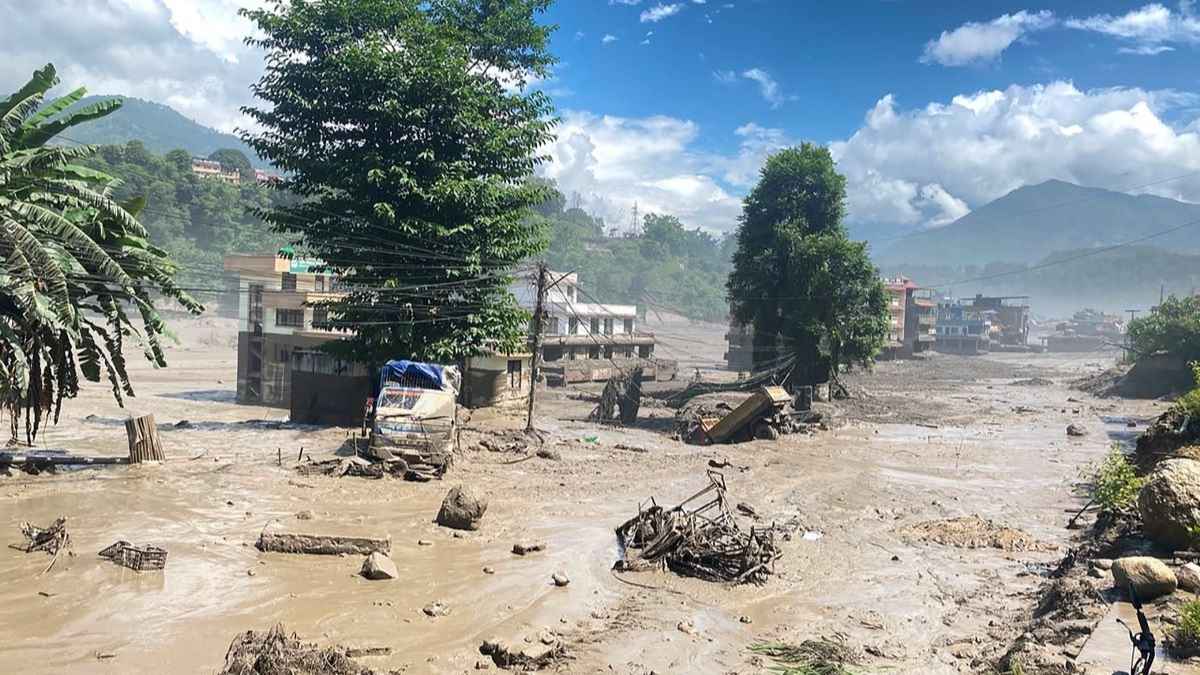
IMAGE VIA SETOPATI
THE ROAD TO Rasuwagadhi was never much of a highway. In the Bhotekoshi gorge, the asphalt clung to the mountainside like a narrow shelf, the river roaring far below. Two cargo trucks could barely squeeze past each other. At the end of this precarious corridor lay Nepal’s main overland gateway to China, opened in 2014 and upgraded to an international crossing three years later. On August 26th the Bhotekoshi flood erased it.
The death toll from the flood has reached 734, with 2,498 people still unaccounted for, according to the National Disaster Risk Reduction and Management Authority. The number of missing includes 589 foreign nationals and 933 people linked to hydropower projects.
Bodies have been recovered hundreds of kilometres downstream, carried by floodwaters that swept through the Trishuli river system. In Chitwan 259 bodies have been found. In Nawalparasi East, 184. In Rasuwa, the district that hosts the border crossing, 562 people remain missing.
The road’s destruction matters beyond the gorge. Rasuwagadhi had become Nepal’s critical trade artery with China, particularly after the 2015 earthquake damaged the alternative Tatopani route.
Through it flowed garments, electronics, vehicles and machinery, connecting Chinese markets with Kathmandu. Around 8,000 of the roughly 11,000 BYD electric vehicles imported into Nepal entered through this crossing, according to Yamuna Shrestha, managing director of Cymex Inc., the authorised distributor. The company estimates that 1,000 electric vehicles and containers carrying spare parts were swept away by the flood.
The timing compounds the loss. August and September are peak business months at Nepal’s northern border points, coinciding with the Dashain and Tihar festivals, when demand for consumer goods rises heavily. Under normal conditions, 60 to 70 cargo vehicles moved through Rasuwagadhi each day.
Now the Department of Customs has asked traders to use alternatives. The most obvious is Tatopani, but rerouting through that border adds some 550 kilometres to the journey. The route is considered highly vulnerable to floods and landslides. The Korala point in Mustang, opened for trade last September, sits at 4,650 metres and cannot accommodate heavy vehicles. It has no proper customs facilities. Officials operate from makeshift tents.
The government has released Rs67.5m to 15 local units in five districts for search and rescue. Rasuwa and Nuwakot have each received Rs100m. A further Rs675m has been distributed among local units. China has sent 50 tonnes of emergency relief supplies, including tents, blankets and first-aid kits, on two military transport aircraft. Nine tunnel experts have been dispatched to assist with rescue operations.
The fate of those trapped inside hydropower tunnels remains uncertain. At the Upper Trishuli 3A project, the Nepali Army located the crown, or uppermost section, of the tunnel on Sunday afternoon after three days of continuous work. When rescuers drilled through and called out, there was no response.
At least 35 people are believed to be trapped inside. The Nepal Electricity Authority estimates that 265 of its workers remain out of contact at four projects. Between 30 and 40 people, including experienced technicians and engineers, were working inside the Trishuli 3A powerhouse when the flood struck.
The scale of the disaster has created a big challenge for authorities trying to identify the dead. At Pokhara Academy of Health Sciences, 102 bodies recovered from Gorkha, Tanahun, Dhading and Nawalparasi East have been brought in. Where faces are no more recognisable, relatives are identifying bodies through school ties, tattoos and jewellery.
Raj Kumar Tamang of Nuwakot spotted his five-year-old son Prince in a photograph on the Nepal Police website, wearing a school tie. The body had been recovered on the banks of the Narayani river in Nawalparasi, far downstream. More than 1,000 relatives arrived in Pokhara on Saturday alone to search for loved ones. The mortuary has 72 refrigerated compartments but is holding more bodies than its official capacity. Authorities have arranged smaller bodies and dismembered remains in the available space.
The economic cost of the flood is extreme as well. The Nepal Electricity Authority’s preliminary assessment points to losses worth hundreds of billions of rupees. The Rasuwagadhi Hydropower Project has been completely washed away. The Chilime project has been buried. At least 13 hydropower projects, both operational and under construction, have been damaged in Rasuwa and Nuwakot. The Independent Power Producers’ Association estimates losses at around Rs25bn to Rs30bn, roughly 25 to 30 percent of total project costs.
Insurance will determine how quickly projects are rebuilt. Private hydropower projects are generally insured. Government-owned infrastructure may not have comprehensive coverage. Sushil Dev Subedi, executive director of the Nepal Insurance Authority, said a detailed assessment of physical damage had yet to begin because rescue operations remained the immediate priority.
The Prithvi Highway, a vital artery linking Kathmandu with Pokhara and western Nepal, has also been severed. A section at Krishnabhir in Dhading sank after the Trishuli river eroded its base, completely blocking the Muglin-Kathmandu section. The disruption comes as the BP Highway, another key route into Kathmandu, remains vulnerable after major flood damage in September 2024.
The disaster has once again exposed the vulnerability of Nepal’s northern trade routes. The Rasuwagadhi-Kerung crossing suffered a similar flood last year, when the Miteri Bridge was swept away. China took nearly six months to construct a temporary bridge. The latest flood has destroyed the crossing entirely. The Chinese side has already alerted traders that Tatopani is also at risk. Traders have written to the embassy in Beijing and the consulate in Lhasa requesting permission to reroute goods. For many businesses, the festival season, already uncertain, is now lost.
Back in the gorge, rescue workers continue their search. The government has mobilised 19,895 security personnel. Helicopters have evacuated 279 people trapped inside a hydropower tunnel over two days. Another 227 foreign nationals have been rescued by helicopter.
But the silence from inside the Upper Trishuli tunnel deepens the anxiety of the waiting families. Jiban Khadka, whose relative is believed trapped inside, put it plainly: “What is being attempted today should have begun two days ago. If the rescue process had started on Thursday or Friday, there would have been a greater chance of finding our people alive.”
For Nepal, the road to Rasuwagadhi wass a bet on reducing dependence on a single southern neighbour and on the promise of Chinese investment and markets. That bet has now been swept away, along with hundreds of lives, billions in investment and a year’s worth of festival goods. The alternatives are slower and themselves vulnerable. The reconstruction of the road will take months. The reconstruction of confidence in Nepal’s northern trade routes may take longer still. ■




