
IMAGE: ASSOCIATED PRESS
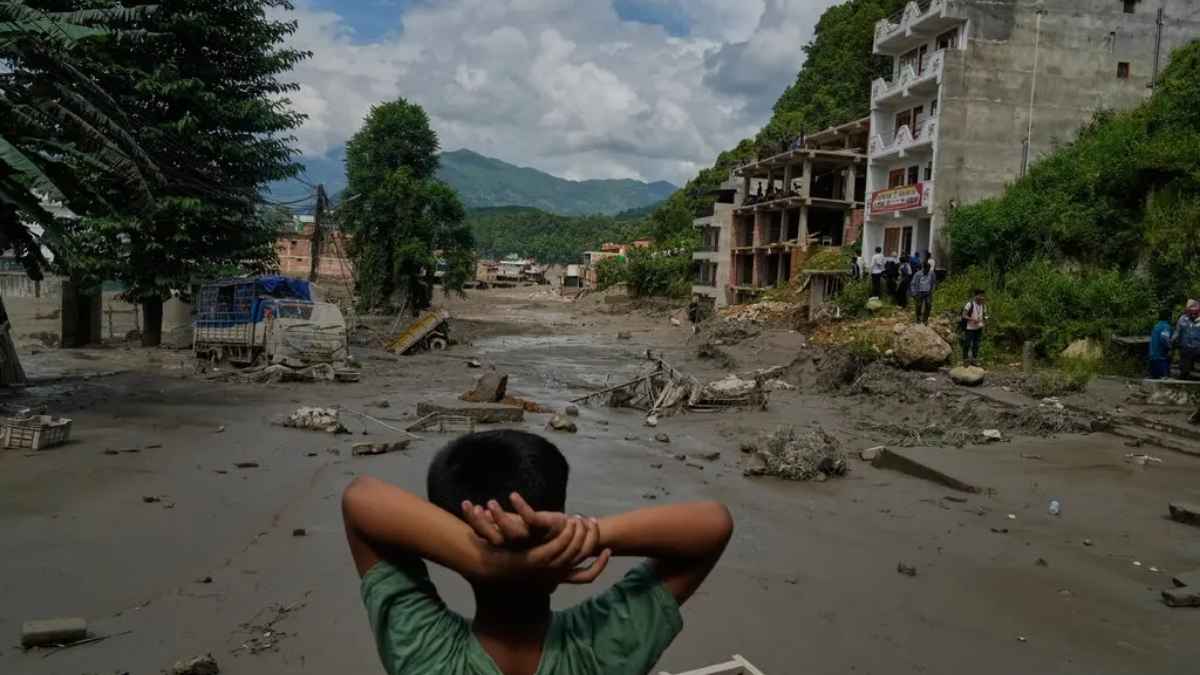
TARADEVI TAMANG’S village exists on official maps. On the ground it looks as though it was never there at all. Two weeks ago floodwaters from the Trishuli River ripped through her home in Nuwakot district, sweeping away her tin roof, her savings, her gold jewellery and 265 piglets and 34 wild boars—her family’s main source of income. She is now one of roughly 3,500 people sheltering in government-run facilities across Rasuwa, Nuwakot and Dhading, the three worst-hit districts.
The disaster struck on August 26th, when a collapsing glacier and ice-rock avalanche dammed the Lhende river on the Nepal-Tibet border. The subsequent surge of water and debris coursed down the Bhotekoshi and Trishuli gorges. By September 7th the confirmed death toll in Nepal had reached 1,355; more than 5,000 people ARE still missing. The estimated financial loss stands at some Rs 387.5bn ($2.56bn). The reconstruction bill, according to Finance Minister Swarnim Wagle, could strike $4bn to $5bn, which is nearly a tenth of the country’s annual economic output.
For survivors like Tamang, the numbers are abstract. Yet the loss is not. “We lost our house during the earthquake but still had the land to rebuild with aid,” she said at a shelter in Nuwakot, referring to the 2015 quake that killed nearly 9,000 people. “We don’t have anything to hold on to now.” Salina Nepali, 20, watched her family’s clothing shop vanish overnight, along with Rs 1.2m ($7,700) in new stock delivered the day before the flood. She and her father walked away with two bags of clothes.
The humanitarian response has been substantial. The government has mobilised the army, police, helicopters and medical teams. Prime Minister Balen Shah, who came to power after the Gen Z-led uprising of 2025, has pledged that the state will operate at full capacity until every affected citizen is safe. Cabinet ministers have donated a month’s salary to the relief fund. The Asian Development Bank has provided a $5m grant. Yet these sums are a fraction of what is needed.
The devastation has struck an economy already buckling under old burdens. Nepal is still repaying the $9bn reconstruction bill from the 2015 earthquake. Government debt has climbed from 26% of GDP to 45%. Almost a quarter of government spending now goes toward debt payments and interest. The weakening rupee and rising fuel costs, exacerbated by the war in Iran, have added to the pressure. The floods have now destroyed or damaged 14 hydroelectric projects, taking 12% of the country’s generating capacity offline—a severe blow to an industry that was meant to lessen Nepal’s dependence on remittances. Tourism, which contributes nearly 7% of GDP, faces disruption to pilgrimage routes and the risk of reputational damage.
All of this points in one direction: outward. Long before the floods, Nepal was a country of emigrants. About 800,000 people leave each year in search of better-paying jobs. Remittances account for more than a quarter of GDP. The disaster will accelerate that flow. For families who have lost land, homes and livelihoods, overseas work is not a choice but a necessity.
Yet migration is a poor substitute for recovery. Remittances support consumption; they do not rebuild roads, bridges or power stations. They do not restore the rice terraces buried under silt, or the schools that more than 17,000 children have lost. They do not bring back the missing. And they cannot replace the economic activity that the floods have washed away—the piglets, the clothing shops, the hydropower turbines, the tourist dollars.
The government faces a cruel arithmetic problem. The disaster relief fund holds just Rs 2.34bn (about $15m). International donors have pledged support; South Korea has expressed willingness to assist and India has sent aid. But the sums on offer are measured in millions; the need is measured in billions. A UN climate-disaster recovery fund could provide some relief but not nearly enough.
What, then, can the government do? It has formed a special committee to identify areas that require relocation and potential sites for new settlements. It has established a task force to complete a comprehensive damage assessment within six weeks, to serve as the basis for an international donors’ conference. These are sensible steps. But relocation is contentious—people do not easily leave ancestral land—and donor conferences take time. In the meantime, the survivors wait in shelters, picking through mud for what remains.
The big problem is that Nepal’s vulnerability is not a one-off event. This is the second major flood on the same river tributary in 14 months. A flash flood paired with a landslide killed 244 people two years ago. The Himalayas are warming, glaciers are retreating. And glacial lake outburst floods are becoming more frequent. Each disaster erases years of progress. Each recovery is more expensive than the last. ■





