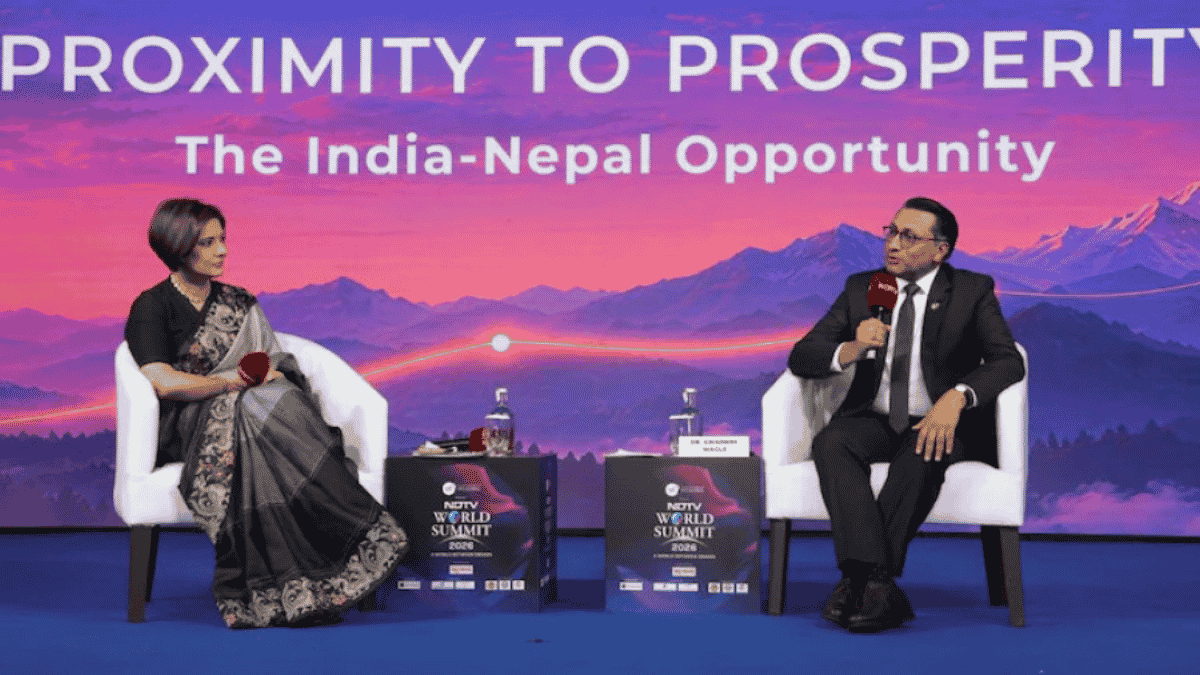
IMAGE: NDTV WORLD
A FINANCE MINISTER went to New Delhi to discuss Nepal’s future and came home to a brawl over its past. Swarnim Wagle’s offence was this sentence: “There was a time when nationalism in Nepal was associated with anti-India sentiment. But that era is over.” Speaking at the NDTV World Summit on October 23rd, he argued that a younger generation wanted prosperity and good governance, alongside better relations with its neighbours. The backlash has since spread from politicians to academics and public figures.
The argument is bigger than a badly received line. Nepal has spent decades treating its relationship with India as both an economic necessity and a test of national dignity. Wagle wants to shift the emphasis towards trade as well as energy and connectivity. His critics fear a government eager to reset relations could mistake a warmer atmosphere for a better bargain—and get royally screwed.
Kamal Thapa, a former foreign minister, argued that opposition to border encroachment, flooding or blockades should never be confused with hostility towards India. Former foreign minister Pradeep Gyawali called Wagle’s remarks undiplomatic. Actor Rajesh Hamal questioned whether the finance minister had exceeded the bounds of his office.
Their concern has a real historical basis. India imposed an unofficial blockade on Nepal in 2015, after disagreements surrounding Nepal’s new constitution. The disruption exposed the brutal cost of dependence on a neighbour that supplies essential goods and provides access to seaports. Border disputes involving Kalapani, Lipulekh and Limpiyadhura are still unresolved. For many Nepalis, nationalism grew from the experience of living beside a much bigger country whose decisions can shaft daily life.
Yet nationalism can also become a filthy political business. Parties have repeatedly used disputes with India to rally domestic support, sometimes with zero progress on the underlying problems. A loud argument over sovereignty can generate political credit even when it produces few practical gains. Wagle’s claim that this habit should end deserves examination on its substance, rather than dismissal because he made it in Delhi.
The setting still matters. A finance minister speaking abroad carries the authority of his government. Wagle is also a senior figure in the ruling Rastriya Swatantra Party. His words can therefore be read as an indication of policy, even if he intends them as commentary on a generational change. The government has yet to make clear, in reports available by October 28th, how his formulation should be understood as official policy.
More important, a friendlier relationship carries no automatic economic dividend. India is Nepal’s largest trading partner, a major source of petroleum supplies and its principal transit route for overseas trade. Nepal needs access to Indian markets, investment and cross-border electricity trade. That dependence gives cooperation substantial value. It also gives Nepal a reason to negotiate carefully—instead of bending over.
Wagle has himself identified the practical agenda: improved air routes, rail links, an updated trade treaty and greater integration into Indian supply chains. In September he told The Hindu that the government intended to address the border dispute constructively while pursuing closer economic ties.
These are useful ambitions. Their success will depend on what Nepal secures in return. Better access for, say, Nepali goods and reliable electricity markets would give the reset economic meaning. Warm statements and high-level visits would be a pathetic substitute.
There is also a strategic complication. Nepal wants Chinese investment and infrastructure links, while India has concerns about Chinese involvement in projects from which it may buy electricity. Wagle has acknowledged this tension as part of the region’s new geopolitical reality. Nepal must work around those constraints alongside preserving room to make its own choices.
Wagle may be right that young Nepalis care more about jobs and opportunity than the political theatre of earlier generations. But prosperity and sovereignty are linked. A country that relies heavily on a neighbour for fuel and trade needs a practical relationship with that neighbour. It also needs the balls to disagree when its interests demand it.
The finance minister’s sentence has become a controversy over the meaning of nationalism. The better measure of his policy will be whether Nepal gets more from its most important economic relationship. A warmer handshake is easy to arrange. A better deal is a bitch to secure. ■