Illustration: Katmandu Journal
Interest rates in Nepal behave with the composure of a yogi. Fiscal deficits swell, debt piles up and yet the cost of borrowing slumbers. In most economies, such imbalances would provoke bond vigilantes to rattle the cage. Here they barely blink. A study by Shoora B. Paudyal, a local economist, offers a tidy empirical summary: government deficits have exerted no statistically significant impact on nominal interest rates for over two decades. The finding is counterintuitive, and yet the evidence is stubborn.
Conventional wisdom warns of crowding out. In textbook economies, state borrowing bids up interest rates, drawing capital away from private investment. The Keynesian response allows more leeway: if output is below potential and credit demand is weak, deficits can stir activity without displacing anyone. In Nepal the latter view finds empirical comfort. Since 1980s the fiscal tap has run steadily. The debt market has barely stirred.
Dr Paudyal’s analysis shows the coefficients linking deficits to interest rates are directionally correct but statistically unconvincing. Interest rates appear largely self-referential, drifting according to their own past, rather than responding to shifts in public finance. This suggests a peculiar sort of equilibrium: stable yet structurally unsound.
Nepal’s financing model has evolved. External concessional loans once anchored the budget; now the government leans heavily on domestic sources. Banks and financial institutions hold more than 90% of domestic government securities. Yet the rebalancing has not rattled yields. In the first half of the 2025 fiscal year, interest payments outpaced capital spending by nearly two percentage points of GDP. Borrowing costs remain low. Returns do not.
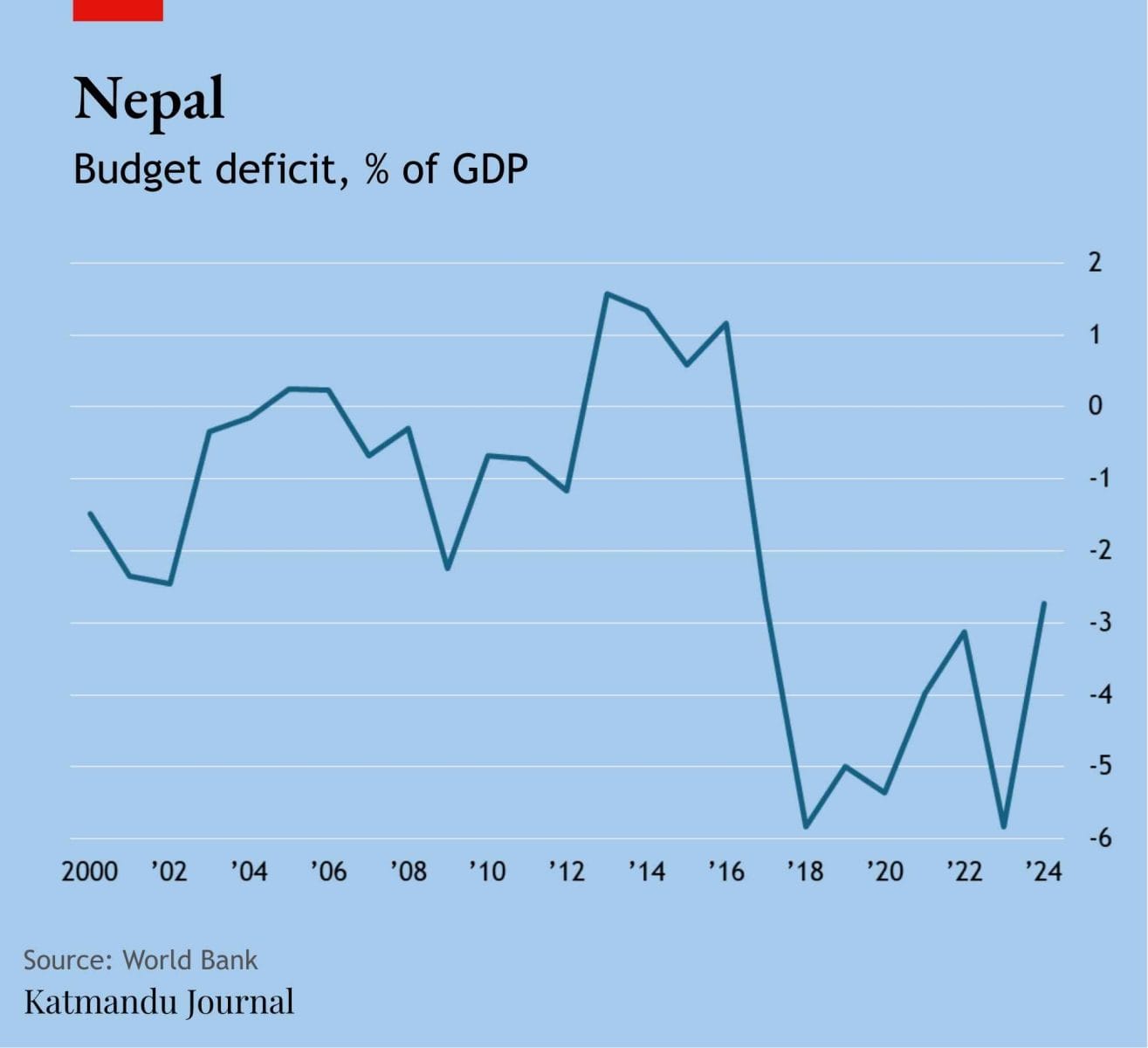
Nominal fiscal discipline appears to have improved. The budget deficit fell from nearly 10% of GDP in the late 1980s to 2.73% last year (see chart). But under the ground, inefficiencies fester. Subnational governments frequently underspend, more so on development projects. Conditional transfers are disbursed with bureaucratic ceremony and executed with minimal urgency. Much of the budget is consumed by recurrent expenditures, leaving little for infrastructure or innovation.
Notwithstanding those faults, the bond market remains inert. Several factors explain the apathy. First, banks are awash with liquidity, courtesy of remittance inflows that surpass 20% of GDP. This persistent glut depresses rates and softens the heat of government borrowing. Second, capital markets remain stunted. Alternative investment options are scarce, leaving financial institutions with few places to park their excess cash. Government bonds become the default option: not out of confidence but convenience.
A third explanation leans on Ricardian logic. If households anticipate higher taxes tomorrow they may save more today to cushion the blow. Households, cautious by habit and scarred by experience, exhibit such tendencies. The trauma of insurgency and inflationary spirals has bred a savings culture that is both risk-averse and liquidity-obsessed. Public dissaving is neutralised by private thrift.
Yet structural passivity is not the same as fiscal soundness. Interest rate inertia has spared policymakers difficult choices. There is little urgency to reform the tax base; rationalise subsidies; or evaluate public investment. Budget documents grow thicker each year, execution thins. When interest rates do not react, governments feel free to borrow—sometimes to build, often to pay. Public debt has risen over the years: today it is around 42%, evenly split between domestic and external sources. The number matters less than the trajectory.
Servicing the debt is becoming more burdensome. Domestic repayments in the first half of 2025 hit a little under 2.5% of GDP. Capital expenditure meanwhile lingered below 1%. Infrastructure projects miss deadlines with regularity. Hydropower plants stall. Road networks stop mid-curve. Digital initiatives exist mostly in concept notes. The deficit is not the problem: the deployment of borrowed funds is.
Nepal’s fiscal machinery exhibits grand pronouncements, subdued execution, minimal consequence. This detachment from market feedback allows inefficiency to perpetuate. When interest rates ignore deficits, policymakers receive no nudge to confront hard truths. Revenue remains narrowly sourced. Expenditure remains regressive. Institutional accountability remains notional.
There are risks to that complacency. Should remittance inflows moderate (or inflation accelerate) the rate environment could change abruptly. Ratings agencies, until now content to observe, may begin to react. With debt repayment absorbing an increasing share of fiscal resources, the space for investment—or for error—shrinks.
For the moment the country’s deficits are benign in effect, if not in cause. The market’s silence is frequently mistaken for confidence. In truth it signals something more troubling: a system that neither punishes nor rewards, merely persists. The symptoms are manageable. The diagnosis is chronic. When treatment finally arrives, it may come with interest. ■