Photo: VCG
Nepal is projected to have exported over Rs106bn of soyabean oil in fiscal year 2024-25. That would make it the country’s single biggest export, accounting for nearly 39% of all merchandise trade. It would also represent a more than hundredfold leap from the previous year. No one ordered a revolution in vegetable oil, but one seems to have arrived all the same.
Nepal’s export profile, although nominally expanding, is dangerously concentrated: both in what it sells and to whom. A country that touts the diversity of its landscapes, cultures and languages is still struggling to build similar variety into its trade flows.
In 2000 Nepal sent 43.5% of its exports to regional low- and middle-income economies. That figure peaked at 80.9% in 2021, before falling to 70.5% in 2023. This is more about location and politics than real progress. India, by far Nepal’s most important trading partner, dominates both exports (of its total exports, 81% went to India last fiscal year) and imports. Bangladesh, Sri Lanka and Pakistan are additional markets, but they are tiny in scale. Regional trade agreements and shared infrastructure lower costs, but they also tether Nepal tightly to its neighbours’ fortunes.
Such dependence brings risk. Indian regulatory changes or tariff disputes or currency moves can send tremors through Nepal’s economy. A single customs bottleneck in Bihar can do more damage to export flows than a policy paper in Kathmandu. Despite this, attempts at market diversification have been half-hearted at best.
Nepal’s exports to East Asia and the Pacific peaked at 4.35% in 2014. By 2023 they had slipped to 1.47%. The Arab world fares even worse, attracting less than 0.5% of domestic goods in most years. There are logistical explanations—landlocked Nepal faces stiff freight disadvantages—but policy inertia plays a role. Expanding into new markets means standards enforcement, trade diplomacy as well as long-term industrial strategy. None of these has featured prominently in Nepal’s export planning.
Soyabean oil’s ascent may owe more to re-exports or tax arbitrage than to genuine industrial capacity. Palm oil tells a similar tale in reverse. It once dominated Nepal’s trade table but collapsed by 61.9% between 2023-24 and 2024-25. These swings hint at a trade regime that is reactive, even opportunistic, rather than strategic. Nepal chases margins where it can, but rarely builds from them.
Other sectors provide glimpses of steadier progress. Exports of polyester yarn and thread, woollen carpets, jute goods and cardamom all show stable year on year growth. Tea exports rose by 26.5% in 2024-25, and readymade garments, though declining, remain a staple of the trade mix. Together, the top 20 commodities make up nearly three-quarters of merchandise exports, hardly a sign of resilience but at least a measure of specialisation.
Beyond those, Nepal’s export ambitions are grounded. ICT goods, for example, peaked at 0.63% of total exports in 2012 and have since faded into statistical irrelevance. India and Vietnam, meanwhile, have turned tech manufacturing and software services into engines of growth. Nepal has neither the infrastructure nor the skills base to follow suit—at least, not yet. There is nascent potential in digital services, but it will need broadband connectivity and a functioning investment climate.
Electricity exports, on the other hand, offer more immediate promise. Thanks to its rivers and hydropower plants, Nepal exported nearly Rs17.5bn of electricity in 2024-25. Most of this flows to India. It is a rare case in which Nepal’s geography is an asset rather than a constraint.
Value, of a kind
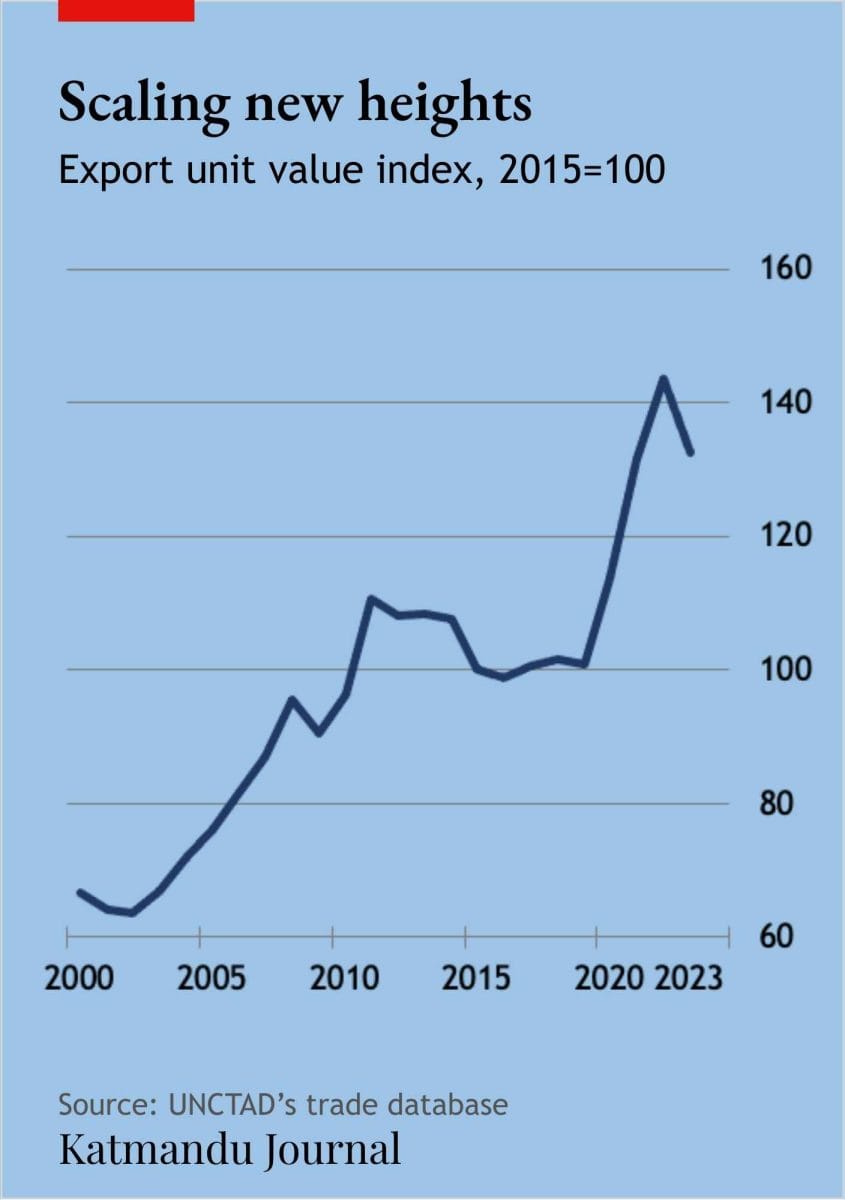
Nepal’s export unit value index—a proxy for the quality or pricing power of its goods—rose from 66.6 in 2000 to 143.6 in 2022. It dipped slightly in 2023, but the bigger trend suggests that Nepali exporters are slowly climbing the value chain. This may reflect improved product quality or better packaging. It may also be flattered by currency movements and global price cycles. Either way it is an improvement.
Supporters of the current trajectory point to the 81.8% projected growth in total exports between 2023-24 and 2024-25. That figure is impressive, but heavily skewed by soyabean oil. Remove the outliers and the underlying pace is more pedestrian. What is more, such growth is unlikely to be sustained unless Nepal addresses its underlying structural weaknesses.
Some argue, including this publication, for a more deliberate export strategy. This would mean investing in education and logistics; strengthening the capacity of export-oriented industries; and negotiating trade deals beyond South Asia. It would also mean reforming customs systems and reducing corruption as well as managing the currency with an eye to competitiveness. Few of these are politically easy.
Nepal is exporting more, but it is not exporting better. A handful of products and a narrow band of markets continue to dominate the trade. When these perform, so does the headline data. When they falter, the vulnerability is exposed.
Diversification will mean a willingness to make difficult reforms, which is not available in bulk. Still, if Nepal is to lessen its dependence on a single corridor and a few commodities, it will have to start somewhere.
The soyabean boom may pass as quickly as it arrived. Whether anything useful is built in its shadow is to be seen. ■