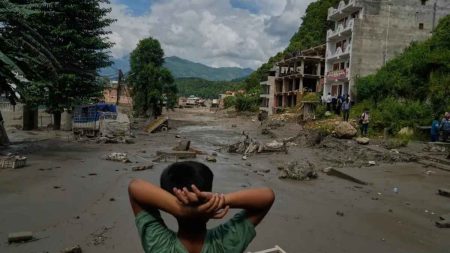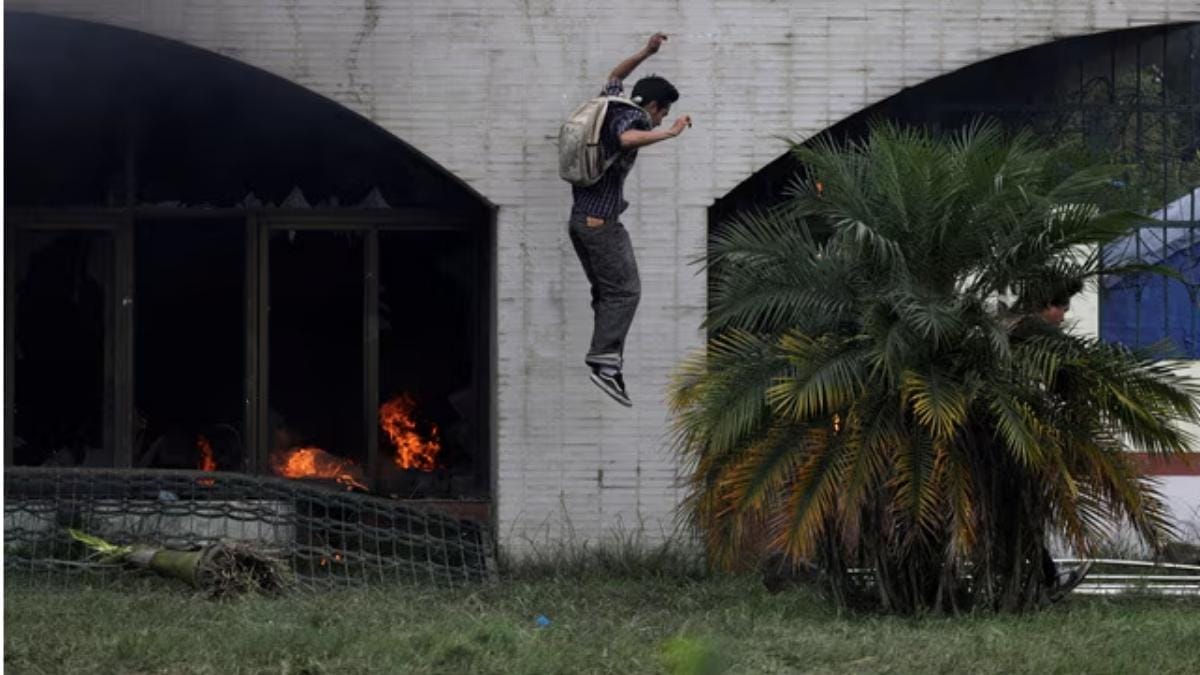
A haze of smoke now shrouds Kathmandu. The seat of government at Singha Durbar, scorched and gutted. The homes of former prime ministers and sitting ministers lie in ruins. Nakkhu Jail, emptied by demonstrators. Even the city’s more recent monuments to wealth—Chhaya Centre, Bhatbhateni, the Hilton—have been targeted. The capital’s political and commercial architecture is quite literally being torn down. For a fragile federal republic long sustained by elite bargains and donor support, this is more than unrest: Nepal is in the midst of an unravelling.
The proximate cause is chilling: the killing of at least 19 young protesters on Monday afternoon. That crackdown, widely circulated on social media, turned a restless movement into a combustible one. The demonstrators, mostly in their twenties, were already rallying against corruption, nepotism as well as systemic failure. Now they are dismantling the very institutions they hold responsible.
Over the past two days events in Kathmandu have outpaced the state’s capacity to respond. Prime Minister KP Sharma Oli has reportedly fled. Police forces have withdrawn from key administrative zones. Protesters, unimpeded, have taken control of government compounds, ransacked public offices and torched party headquarters. Even the army has hesitated, calling for “dialogue and discipline” rather than launching a counteroffensive. In effect, much of the Kathmandu Valley is under informal control of a loosely unified coalition of dissent.
That coalition defies easy categorisation. At its core are Gen Z organisers who emerged from an anti-corruption campaign. But the movement now includes monarchists nostalgic for pre-republic stability, disillusioned Maoist cadres, anti-federalists and dissidents from every major party. Their demands are contradictory but their anger is coherent: the republic, they argue, has failed because it was never allowed to function on its own terms.
Nepal’s modern history is littered with abrupt transfers of power (palace coups, royal interventions and revolutionary surges) but each has replaced one elite order with another. The 1960 royal coup dissolved Nepal’s first experiment with parliamentary democracy. The 2001 royal massacre ushered in Gyanendra’s final reign. Even the 2006 people’s movement, which ended the monarchy and introduced federalism, ultimately transferred power to the same political families in new offices. Today’s uprising appears distinct in both scale and intent: it seeks a dismantling of the political architecture altogether.
That structure was already unstable. Since the adoption of a federal constitution in 2015, Nepal has cycled through ten prime ministers in as many years. Coalition governments have traded ministries like patronage tokens and state budgets have ballooned without scrutiny. The judiciary has waded deeper into partisan terrain. KP Oli, the current target of popular fury, ruled erratically—dissolving Parliament twice in 2020, reinstated only after Supreme Court intervention. His administration was marked by economic stagnation, vaccine mismanagement alongside deepening scandals, including the money laundering case that saw Rabi Lamichhane, now freed by protesters, briefly imprisoned. Amid the turmoil, even Kantipur Media Group, the country’s largest private media conglomerate, saw its offices torched and its websites taken offline.
What remains of the state is splintering. Ministers have gone into hiding. Bishnu Poudel, the finance minister, was reportedly assaulted by a crowd while attempting to escape via the Bagmati river. Former Prime Minister Sher Bahadur Deuba and his wife, the foreign minister Arzu Rana Deuba, were attacked in their residence. The homes of the health minister, the home minister and senior bureaucrats have been vandalised or set ablaze. Local government offices, once heralded as a pillar of Nepal’s federal vision, are now being overrun or abandoned. Even elite schools such as Ullens and Global College have been targeted, perhaps for their perceived alignment with privilege.
In the void, new figures are testing their influence. Balen Shah, Kathmandu’s mayor and former rapper, has gained legitimacy with young protesters, urging talks with the army after Parliament falls. Former Maoist PM Baburam Bhattarai proposes an interim unity government including protest leaders and a directly elected presidency. Though Oli has resigned, his cabinet will stay on in a caretaker role until a new government forms. The imminent dissolution of Parliament now seems likely.
Some international observers have drawn analogies to Sri Lanka’s uprising in 2022 or even to Thailand’s periodic anti-government protests. But Nepal’s rupture is arguably more systemic. Sri Lanka experienced a financial meltdown, Nepal is undergoing a political implosion. Unlike in Bangkok, where the monarchy and army provide enduring backstops to authority, Kathmandu lacks a functioning centre of gravity. The federal parliament is besieged and the security forces in disarray. The economy, dependent on remittances and tourism, is likely to suffer, but the deeper damage is institutional.
Nepal’s donor partners—India, China, the United States and various multilateral agencies—have so far issued anodyne calls for calm. But behind closed doors, diplomats acknowledge a stark reality: the political consensus forged after the civil war and the abolition of the monarchy has collapsed. The republic may yet survive but it will not do so in its current form.
Whether this uprising coalesces into a democratic renewal or degenerates into factional collapse is unclear. What is evident is that a generation raised under Nepal’s federal experiment has rejected the terms of its inheritance. The republic, born in fire, now faces a reckoning of equal intensity. Burned buildings can be rebuilt. Legitimacy, once lost, is harder to recover. ■