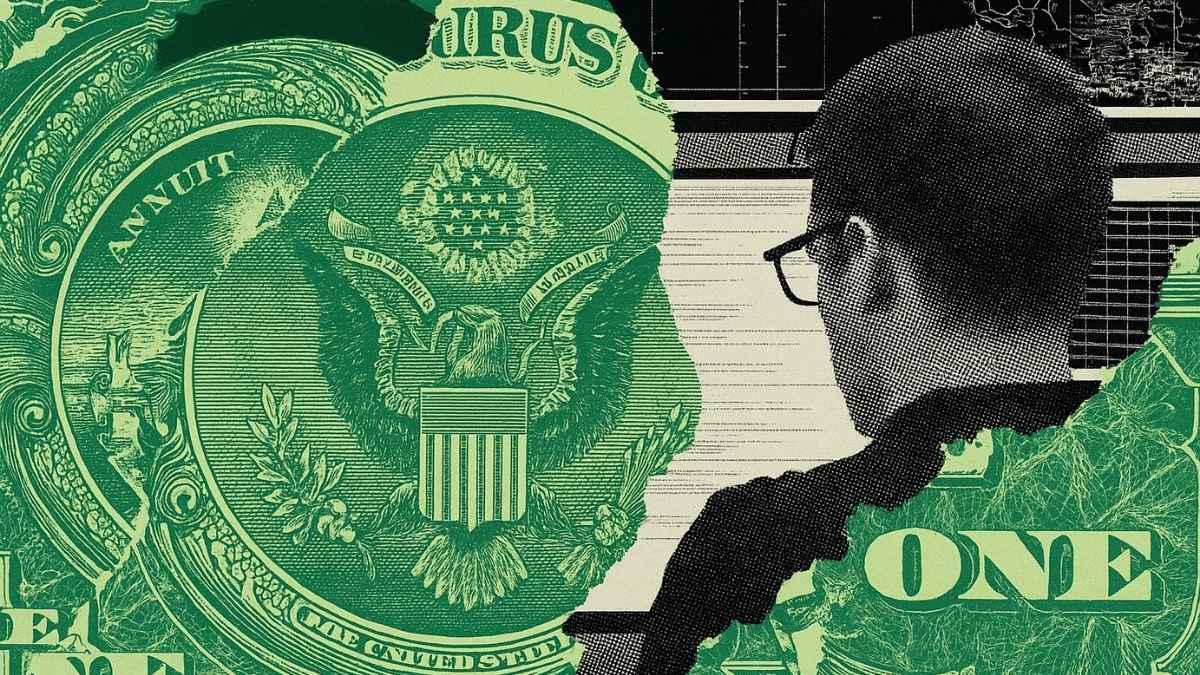
When interest payments on a country’s debt outstrip its defence budget, something has gone awry. In fiscal year 2024, the United States paid $880bn to service its obligations, $30bn more than it spent on the world’s most powerful military. Gross debt now hovers just shy of $37trn, and the interest due rises by $370bn for every percentage point increase in rates.
The world’s most trusted borrower is behaving like a debtor who believes the bank will never call.
For over two decades, Washington has relied on debt as its primary economic instrument to combat recessions, financial crises, wars and pandemics. Policymakers made no serious attempt to reduce the debt burden during periods of strong growth. The low-interest rate environment after 2008 gave the illusion that borrowing was costless, and the dollar’s privileged role as the world’s reserve currency dulled any market reaction. No longer.
Bond markets, once tolerant, are growing testy. Yields on long-term Treasuries are rising. Credit rating agencies have turned sceptical. Foreign investors, who once viewed U.S. debt as a haven, now increasingly see it as a risk. The economic foundations of the dollar’s reserve status—stability and trust among others—are beginning to crack under the weight of political dysfunction and fiscal profligacy.
Donald Trump blames the Federal Reserve for the spike in borrowing costs. He is mistaken. The Fed sets short-term rates but the market determines long-term yields, which reflect global inflation expectations and investor confidence. Undermining the Fed’s independence, a temptation in some corners of the Republican Party, would do little to tame interest rates, and much to undermine the credibility of America’s institutions.
If markets begin to suspect the Fed will be manipulated for political gain, the result will not be cheaper money. It will be capital flight.
America’s fiscal misadventures threaten the most valuable economic privilege any nation can possess: the global demand for its currency. The dollar’s reserve status has long allowed the U.S. to borrow more cheaply—perhaps by 0.5 to 1 percentage point—than it otherwise could. Yet this advantage rests on perception as much as policy. If the perception falters, the privilege may vanish.
Some in Trump’s orbit have proposed policies that would accelerate this unravelling. A draft “Mar-a-Lago Accord” floated the idea of selectively defaulting on debt held by foreign governments. Congress came within a whisker of taxing foreign holders of U.S. debt by 20%. Though the proposal was removed, the damage to confidence lingered.
Global alternatives—the euro, the Chinese yuan, even dollar-backed stablecoins—lack America’s depth and liquidity for now. But they are improving. The dollar’s reserve status is still intact. Its invincibility is not.
The U.S. now meets three of the four classic conditions for a debt crisis: a precarious fiscal position, high borrowing costs and political dysfunction. The missing ingredient is a trigger: a geopolitical shock, a climate catastrophe or a cyberattack, according to Kenneth S. Rogoff, professor of economics at Harvard University. The formal act of default is not required. A loss of confidence in Treasury markets would suffice to shake the global economy.
Even without a rupture, the trajectory is grim. America’s debt-to-GDP ratio is expected to strike 172% by 2054. Biden ran a deficit of $1.8trn in 2024 (6.4% of GDP), a peacetime record. Trump plans similar or higher deficits through the 2030s.
Betting on the robots
Trump’s economic advisers argue that productivity gains from artificial intelligence will rescue the economy. If annual growth hits 2.8%, the economy would double in 25 years. The Congressional Budget Office (CBO) projects a more modest 1.8%, doubling output in 39 years. Much of the Trump camp’s optimism rests on the near-term emergence of artificial general intelligence (AGI), a form of AI capable of human-level reasoning.
That is possible—but far from certain. Barriers remain: energy constraints, regulatory bottlenecks, trade frictions and immigration limits all threaten to delay or dilute AI’s economic impact. Voters, too, may recoil at job displacement, further slowing adoption. Even if AI delivers, the fiscal clock may run out before the benefits arrive.
Some in Washington continue to dream of a return to the halcyon days of ultralow interest rates. The CBO assumes an average Treasury yield of 3.6% through 2055. The market disagrees. Thirty-year Treasuries now yield nearly 5%. The belief that rates would remain permanently low—championed by economists such as Lawrence Summers, Paul Krugman and Olivier Blanchard—has faded. Modern Monetary Theory, which gave intellectual cover to higher spending, has lost traction.
The reality is harsher. Rising geopolitical risk, demographic pressures, climate adaptation as well as the costs of industrial policy have pushed debt loads higher across the G7. Net debt-to-GDP in advanced economies has risen from 55% in 2006 to 95% in 2025. The supply of debt has increased. The appetite for it may not keep pace.
Should confidence collapse, the consequences would be swift and punishing. Asset prices would fall. Interest payments would crowd out investment. The usual Keynesian response—bigger deficits—could backfire, triggering a debt spiral. America would face a menu of unpleasant choices: default, which has happened before (notably in 1933, when the U.S. refused to honour gold clauses in debt contracts); inflation, which devalues the debt but savages savers and the poor; financial repression, a form of stealth taxation where governments compel institutions to hold low-yielding bonds; and digital channelling, using stablecoins or a central bank digital currency to direct private savings into Treasuries.
Each approach brings risks. Inflation may get out of hand. Financial repression deters foreign investors. Stablecoins, though promising, could destabilise traditional banking or be misused. A digital dollar might mitigate some risks but would require tight regulation and robust safeguards.
Can the Fed step in? Not without consequences. It is institutionally independent, but that could change. A future administration might expand the Fed’s board, pressure its governors or override its policies through emergency legislation. The Fed’s credibility would be the casualty. Inflation would likely follow. Trust, once lost, is costly to rebuild.
Great powers do not fall solely on the battlefield. More often they sap their influence through internal decay. Spain in the 16th century, the Netherlands in the 17th and Britain in the 19th all surrendered financial dominance after fiscal overreach and economic stagnation. America risks joining that list.
If the U.S. can no longer manage its debt without inflation or coercion or default, the dollar will cease to be the global benchmark. The loss would be systemic.
A debt crisis in the United States remains a scenario, not a certainty. But it is now a plausible one. The conditions are in place. What is lacking is the will to confront them. For decades policymakers assumed that growth would outpace debt and that markets would forgive everything. That assumption is fraying.
If the U.S. continues to bet on optimism instead of reform, it may learn what happens when a superpower believes it is too big to fail. So may the rest of the world.