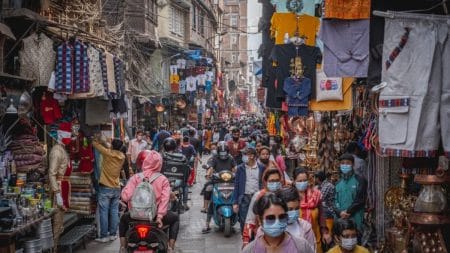
IMAGE: STEFANO RAVALLI
By 2050 a new economic hierarchy will be in place. Giants such as India and Indonesia are betting heavily on industrial heft and commodity muscle to secure their place in the front row. Others—richer, older economies—hope to innovate their way forward. In this global sprint Nepal seems an unlikely competitor. It has no oil, no rare earths, no ports. Its per capita GDP is stuck at $1,447, roughly where China was in 2003. Its politics is fractious. Its exports are negligible. On nearly every development metric, Nepal is a laggard.
And yet, in a century where many nations are failing by trying to run too fast, Nepal’s slower pace may prove to be an advantage. It is not attempting to outspend India on chip fabs or to match China’s command over rare metals. Rather it is pursuing a humbler, more grounded strategy: one that builds on hydropower, digital services and human mobility. The ambition is not to become the next Singapore but to avoid becoming the next cautionary tale.
The old route to prosperity—urbanisation, industrialisation, export-led growth—is looking less reliable. Labour-intensive manufacturing no longer generates jobs at the same scale thanks to automation and global overcapacity. Protectionism has made global supply chains harder to plug into. Countries chasing industrial glory now compete on subsidies rather than specialisation, an expensive game for those without fiscal firepower.
Against this backdrop, Nepal’s structural limitations may function more like guardrails than barriers. It cannot waste billions chasing a semiconductor dream because it simply does not have billions to waste. Instead its development strategy is being shaped around assets that are hard to outsource or replicate.
The country’s most underutilised asset is water. Nepal’s share of the Himalayas feeds ten of Asia’s major rivers. It also gives the country one of the highest hydropower potentials in the world: over 40,000 megawatts of economically feasible capacity. Currently Nepal produces only about 3,500 megawatts and most of that during the monsoon.
That is slowly changing. Big projects on the Arun and Tamakoshi rivers are coming online. Nepal has started exporting electricity to India and a recent deal with Bangladesh opens a second market. Unlike fossil fuels, hydropower is local and renewable. It reduces Nepal’s oil import bill, stabilises foreign reserves and—if reliable—could underpin domestic productivity.
Hydropower is also a foundation, beside being a commodity. Norway built much of its postwar prosperity on cheap hydroelectricity, exporting not only electrons but also aluminium and industrial technology. Nepal is not there yet. Corruption and land disputes among others remain endemic. But even incremental improvements, if they result in a few thousand megawatts of reliable surplus, could be transformative.
If not factories, then people. Every year hundreds of thousands of Nepalis leave the country for work, mostly to the Gulf, Malaysia and South Korea. Remittances account for nearly a quarter of GDP, one of the highest shares globally. The standard narrative is that this signals domestic failure. In part it does. But it also reflects a form of economic adaptation.
Migration has produced a financially literate, globally exposed population. The money they send back builds homes, funds education and increasingly finances small businesses. In Nepal’s flat Terai belt, it is not unusual to find solar panels in villages with poor roads. In cities the dream is shifting from government jobs to e-commerce, logistics and freelancing.
The trouble now is to absorb that energy productively. That means upgrading education, expanding digital infrastructure as well as offering better public services. Schools still struggle with basics—few have decent science labs. Broadband remains uneven, especially in hill and mountain districts. Yet despite these constraints, a nascent IT outsourcing industry has emerged. Nepali firms are exporting software, web design and data annotation to clients in the US, Europe and Australia.
These are not headline-making sectors but they are sticky. They encourage skill development and are hard to uproot once embedded. India’s tech boom began with mundane back-office services. Nepal need not skip this phase. If it can scale even a modest share of the global demand for affordable digital labour, the impact on domestic incomes would be significant.
Nepal’s mountains make logistics difficult—but they also offer a natural niche. The country receives around a million tourists a year, most for trekking, mountaineering and spiritual retreats. Global travel trends are shifting toward “experiential” and wellness-based tourism. Bhutan has capitalised on this with high daily tourist fees and an aura of exclusivity. Nepal, on the other hand, has positioned itself as a budget destination.
That can change. Georgia and Croatia, both small, mountainous countries, have built vibrant, export-earning tourism sectors with the right blend of infrastructure and regulation. Nepal’s potential is greater. It offers not only scenery but religious history, biodiversity and cultural depth, too. Places like Lumbini (the Buddha’s birthplace) and Mustang (a Tibetan highland sanctuary) are tailor-made for high-value, low-footprint tourism.
The goal should be value-added services: guided expeditions, wellness centres, cultural experiences. Every dollar spent in Nepal has a high local multiplier effect. The tourist who flies to Kathmandu, books a mountain guide, eats dal bhat in a teahouse and buys handicrafts is in effect distributing income to dozens of micro-enterprises.
Another underexplored niche is climate services. Nepal sits at the epicentre of glacial melt and climate disruption. That gives it both urgency and legitimacy in fields like environmental monitoring, climate-resilient agriculture and forest carbon finance. Some pilot schemes—like REDD+ forest credits and climate-smart farming—are underway, often with donor support. But Nepal needs to own these programmes, not merely host them.
Nepal’s emerging model is not flashy. It does not rely on geopolitical bets or technological moonshots. Rather it requires consistent institutional improvement—better roads, stable rules, a working investment portal, reliable electricity. These are slow, unsexy reforms. But they are the kinds that compound over time.
That may also be the biggest risk: drift. Unlike Saudi Arabia or Indonesia Nepal is not betting billions on a centralised strategy. That shields it from dramatic blowups but also makes it easier to stagnate. Bureaucratic inertia and short political cycles (as well as endemic corruption) still hobble execution. Basic functions like registering a business or issuing land titles can take months.
There is also a time limit. Nepal’s median age is 24, giving it two decades of potential demographic dividend. After that the dependency ratio will start to rise. If today’s young workers cannot find meaningful work at home, migration will increase, and with it dependency on remittances.
Nepal is not trying to become the next South Korea. It will not build a shipping empire like Singapore or a global airline hub like Dubai. Instead it is aiming to be something else: a clean-energy exporter, a digital services supplier and a provider of place-based experiences and knowledge.
These bets are modest, but they are grounded in reality. In a century where many countries are failing by trying too hard, Nepal may succeed by trying just hard enough—and in the right places. If it works, its path will not be lionised in textbooks or TED Talks. But it may turn out to be more relevant than most.
Sometimes staying in your lane is the fastest way to finish the race. ■