IMAGE: NYT
When Palestinian teachers failed to return to school on September 1st, it was not because of war. The reason was that they simply hadn’t been paid. The Palestinian Authority (PA), the West Bank’s nominal government, had no money left. Months of withheld tax revenues from Israel and a crippled banking system had brought basic governance to a standstill. As hospitals run out of medicines and city employees depend on foreign donors for food packages, an old question has re-emerged: is the PA being deliberately collapsed?
While the world’s gaze is fixed on Gaza, where Israel’s campaign against Hamas has sparked global outrage, a quieter and arguably more powerful offensive has unfolded in the West Bank. There, instead of tanks and airstrikes, Israel has deployed tools of finance, law and land control. The goal, increasingly open, is to dismantle the Palestinian state-in-waiting that the Oslo Accords once promised.
At the heart of that strategy is Bezalel Smotrich, Israel’s far-right finance minister and a central figure in the governance of the occupied territories. While nominally managing Israel’s economy, he also holds sway over the Coordinator of Government Activities in the Territories (COGAT), the administrative arm of the occupation. That bureaucratic overlap has allowed him to reshape the Palestinian economy with surgical precision. And in contrast to Israel’s costly, inconclusive campaign in Gaza, the West Bank strategy is low-cost and so far alarmingly effective.
Oslo, undone
To understand Smotrich’s strategy, one must revisit the architecture of the Oslo Accords, the interim agreements signed in the 1990s that sought to shepherd Israel and the Palestinians toward a two-state solution. Oslo created the PA and divided the West Bank into three zones—A, B and C—granting varying degrees of Palestinian self-rule. It also linked the Palestinian economy tightly to Israel’s: the Israeli shekel became legal tender; customs duties on Palestinian imports were collected by Israel and transferred to the PA; and Palestinian banks gained access to the Israeli financial system through special arrangements.
What Oslo created, Smotrich has learned how to undo. Each lever of financial interdependence is now a point of control. When Israeli officials withhold tax revenues—collected at ports on behalf of the Palestinians—they starve the PA of its giant funding source, about 65% of its budget. When indemnities to Israeli banks handling Palestinian transactions are suspended, cross-border commerce falters. Even central bank functions, like converting excess shekel cash into electronic reserves, are throttled by Israeli restrictions.
In recent months, the squeeze has grown painful. Palestinian officials say Israel now owes the PA nearly $3bn in withheld revenues. Civil servants are receiving only partial salaries. Some have stopped showing up to work. In a bitter twist, the very mechanisms meant to foster eventual Palestinian self-rule have become tools of its suffocation.
Smotrich’s objectives are not hidden. In a recent statement, he declared that Israel should pursue “maximum land with minimum Arabs”, a sentiment that blends demographic ambition with geopolitical clarity. To achieve that, Israel is expanding settlements, legalising outposts, building fences around villages and, crucially, weakening the PA to the point of irrelevance.
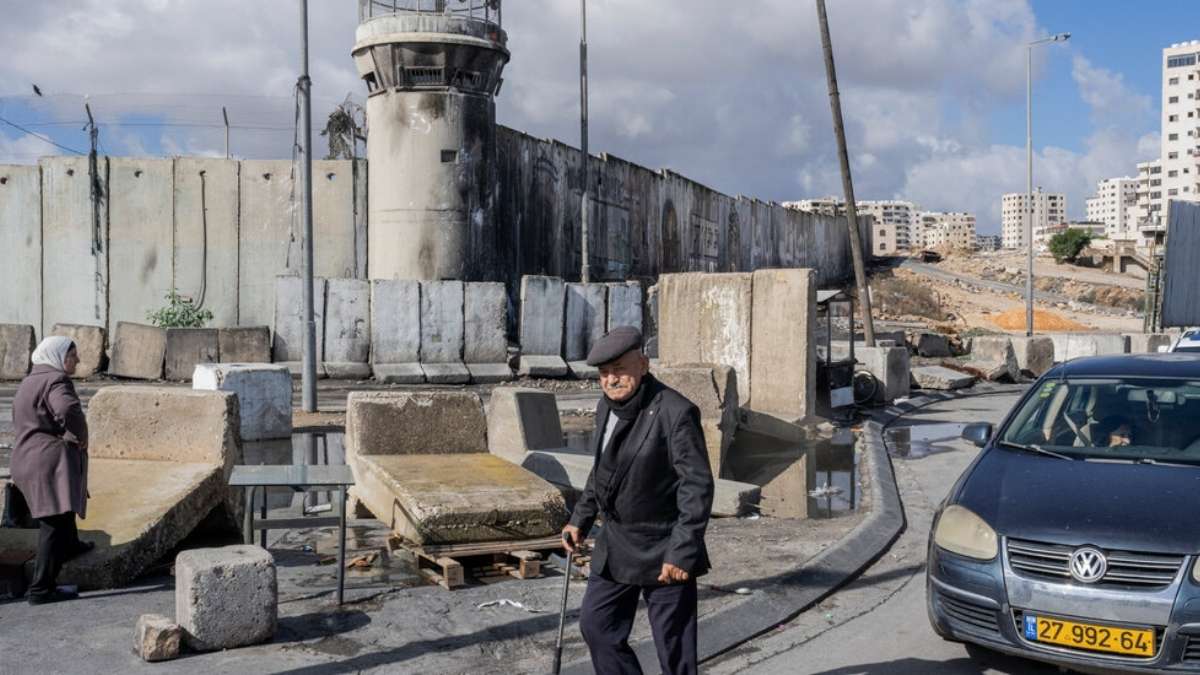
Take Jenin. Once a symbol of Palestinian resistance, its refugee camp has been depopulated, bulldozed and reoccupied by the Israeli military. The Palestinian police have vanished. City officials now request permits from Israeli officers to repair water pipes. Or consider Sinjil, a village near Ramallah, where a barbed-wire fence now traps residents inside, under the justification of preventing stone-throwing at a nearby highway. In Area A—meant to be under full Palestinian control under Oslo—Israeli soldiers patrol freely.
This is a deliberate reversal of the Oslo framework. And unlike Gaza, where Israel’s stated goal of eliminating Hamas has drawn fierce military and diplomatic resistance, the dismantling of the PA unfolds in slow motion and with little international pushback.
Yet the implications are far-reaching. Shrinking the Palestinian economy is not without spillover. The West Bank has lost roughly a third of its GDP since Hamas’s 7th October attack last year, according to local economists. Some of that is due to lost remittances from Palestinian workers banned from entering Israel. Much of the rest stems from a cash crunch in the banking sector and weakened business confidence, among others.
Real estate transactions, once smoothly processed through Palestinian banks, are now increasingly denominated in Jordanian dinars or US dollars, and conducted in cash—if they happen at all. Banks are sitting on roughly $3.5bn worth of excess shekel notes that the Bank of Israel refuses to convert into electronic deposits.
The outcome is a dual economy: one part stalled by design, the other slipping into informality. A black market is growing and so is disillusionment. “If the PA cannot pay salaries, it cannot govern,” says Ghassan Khatib, a former Palestinian cabinet minister and Oslo negotiator. “And if it cannot govern, it cannot exist.”
International donors, long the financial supporters of the PA, now face a dilemma. Propping up a moribund authority may feel like throwing good money after bad. But letting it collapse may hand Smotrich precisely what he wants: a political vacuum in which the idea of Palestinian statehood is erased.
To some onlookers, the PA’s demise may seem like a consequence of corruption and public discontent. These factors are real but they are not sufficient. Even the most inept government can survive if it controls its tax base, currency and border. The PA controls none of these. Its economic life support has been pulled not from within but without.
What distinguishes Smotrich’s strategy is its technocratic sheen. No declarations of annexation (yet), no dramatic military operations—just fiscal pressure.
For now that approach is working. Israel pays little diplomatic price for the incremental collapse of the PA. Western leaders continue to offer rhetorical support for a two-state solution even as the institutional foundation of one disintegrates.
But such quiet victories may bring louder consequences. A failed PA risks security chaos, not just for Palestinians but for Israel too. If the formal structures disappear, Hamas or other factions may fill the void. Already youth in places like Jenin and Nablus look to armed militias or to emigration.
Smotrich may not last in office—polls suggest his party could lose ground—but the machinery he has activated may outlast him. A state is not undone in one blow. It frays, weakens, is priced out of existence. The question now is not if Oslo is dead, but if anyone still remembers what it was supposed to be. ■