IMAGE: ALAMY LIVE NEWS
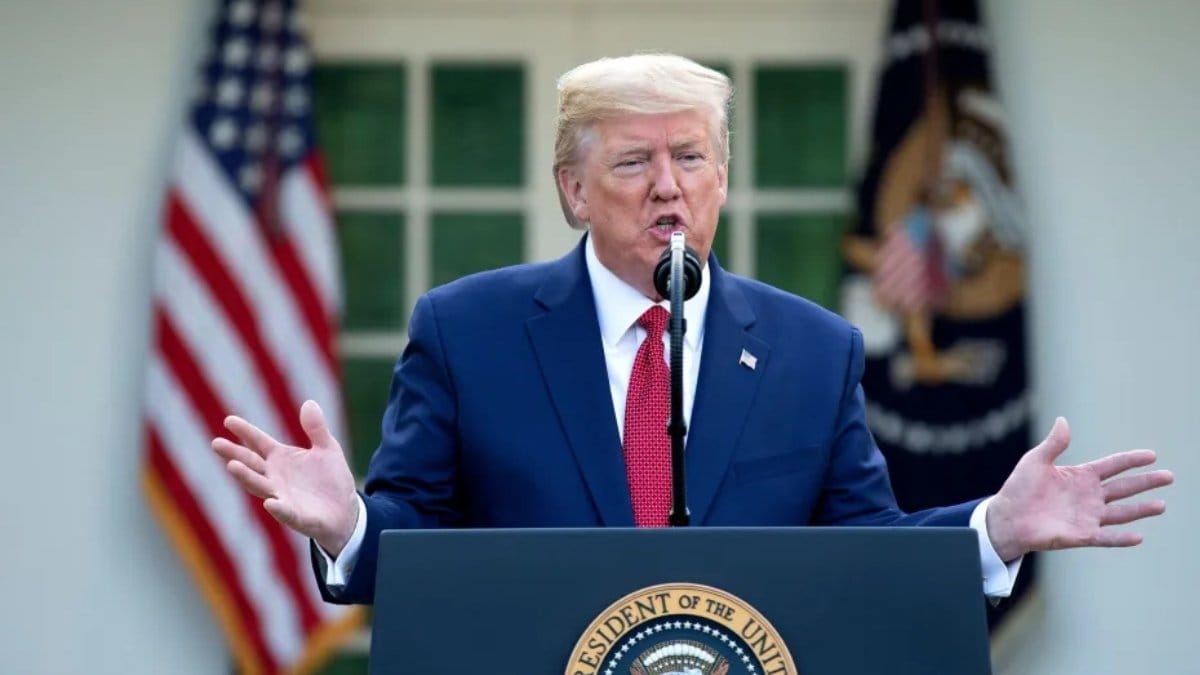
In the late 1980s America fretted about losing its technological edge to Japan. Its answer was not to bar foreign brains but to import them. The H-1B visa, launched in 1990, opened the door for firms to hire skilled foreigners when local talent was scarce. Thirty-five years on, that same programme is now the target of America’s protectionist turn. On September 20th Donald Trump announced a new $100,000 fee for fresh H-1B applications, a sum large enough to alter global labour markets.
The H-1B scheme has been a cornerstone of America’s tech industry. Each year 85,000 slots are allocated by lottery—65,000 for degree-holders and 20,000 for those with advanced qualifications from American universities. Although universities and research institutions are exempt, competition is fierce. Around three-quarters of recipients are Indian, many employed by the IT giants of Bengaluru and Hyderabad. These workers form the backbone of on-site projects for American clients, from banks to retailers. The visa may last only six years, but for many it has served as a stepping stone to permanent residence and a Silicon Valley salary.
The new levy lands hardest on India’s IT services exporters. Shares in Tata Consultancy Services, Infosys, HCLTech and Wipro all sank when markets opened in Mumbai the Monday after the announcement. The Nifty IT index fell 2.7%. Indian firms generate about $283bn a year in revenues, much of it tied to American contracts. Around 20–30% of their U.S. staff are H-1B holders. An extra $100,000 per new worker could wipe out the thin margins on some projects, forcing a rethink on staffing models.
Indian industry leaders voiced alarm. Nasscom, the sector’s trade body, warned of “business disruption” and stressed that firms had already been trimming reliance on visas by expanding local hiring in Texas, Ohio and North Carolina. The immediate effect may be to accelerate “nearshoring” of work back to India or to hubs in Mexico and Canada. In the longer term, the rule could nudge companies to recruit more American graduates. But that assumes the skills exist domestically at scale. Tech firms insist they do not: Amazon, Microsoft and Google are among the largest sponsors of H-1B visas.
Critics of the scheme disagree. They argue that firms exploit it to import cheaper labour. Evidence supports the claim that pay tends to be below local norms: in 2019 about 60% of H-1B positions were classed as “below median wage”, according to the Economic Policy Institute. High-profile cases, such as Disney’s replacement of American staff with H-1B contractors a decade ago, still sting. The Trump administration has seized on these anecdotes, claiming the fee will push firms to “train Americans instead of importing foreigners”.
Yet the economics is less straightforward. Training a graduate into a machine-learning specialist takes years; demand is immediate. The fee is unlikely to conjure new coders in Nebraska. Instead the cost will fall on firms that must either absorb the levy or pass it to clients. For Indian outsourcers, with margins already squeezed by automation and global competition, the blow is sharper. For U.S. firms, it may mean more offshoring of work to India rather than more jobs in Indiana.
Diplomatic ripples are also inevitable. India’s government has already warned of the “humanitarian consequences” for families of visa-holders and hinted that the move could strain relations. Tensions were already rising after Mr Trump’s imposition of 50% tariffs on Indian goods linked to Russian oil trade. With Indian nationals making up more than 70% of H-1B holders, this is as much a bilateral issue as a domestic labour policy.
Legal challenges may still derail the plan. Immigration lawyers note that a president’s authority to impose such fees is murky, and courts may view the sum as punitive rather than administrative. The White House, scrambling to calm confusion, clarified that the fee is a one-off payment applied only to new applications from February 2026, not to renewals. Even so, the uncertainty has already rattled investors and workers alike. Some visa-holders reportedly rushed back to America to avoid being caught in limbo.
The bigger question is what this signals about America’s openness to talent. Countries from Canada to Australia court skilled migrants with fast-track residency. Singapore boasts of being a “global hub for talent”. By raising barriers, America risks ceding ground in the very industries it seeks to dominate, from artificial intelligence to biotech. H-1B holders have founded firms that employ thousands of Americans; penalising them may prove self-defeating.
The H-1B programme started as a pragmatic response to a skills gap. It now sits at the intersection of populist politics and corporate demand. A $100,000 fee may look like a quick fix to protect American jobs. More likely, it will shift work offshore, squeeze Indian IT exporters as well as sour relations with one of America’s closest economic partners. In trying to wall off foreign brains, America may discover that skills, like capital, tend to flow where they are welcome. ■