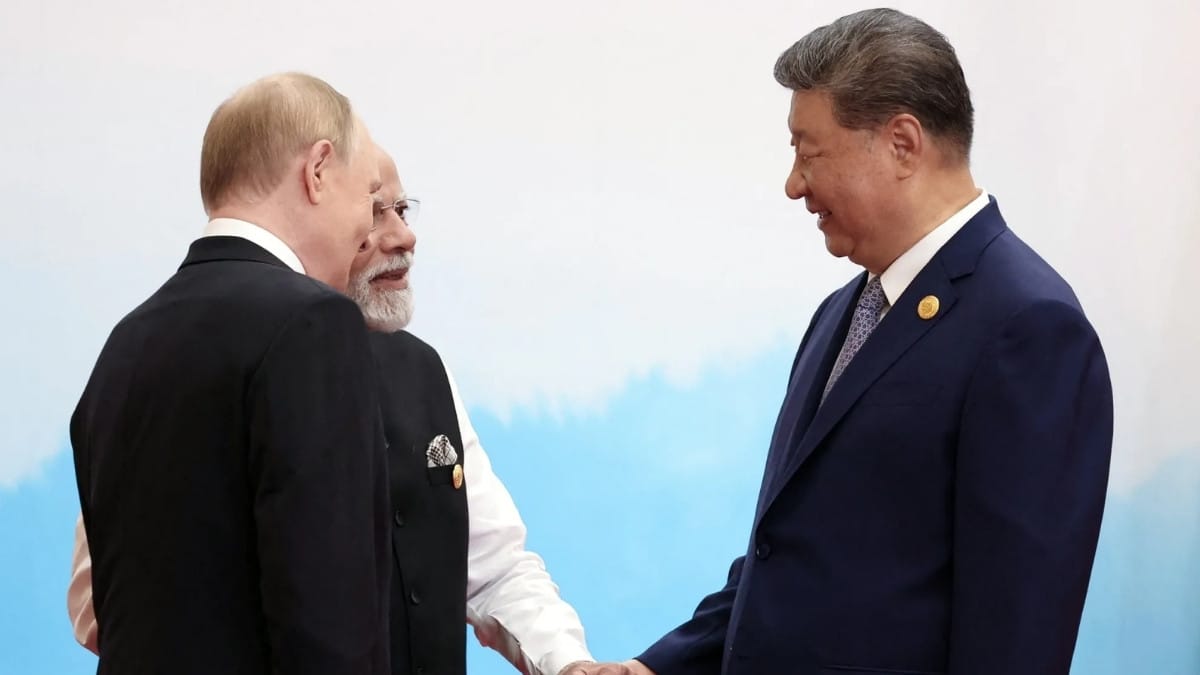
In 2020 Indian and Chinese troops brawled with clubs and stones in Ladakh, one of Asia’s most sensitive military flashpoints, leaving 20 Indian soldiers and at least four Chinese dead. Relations froze. India banned Chinese apps, blocked Huawei from its 5G rollout and tightened scrutiny of investment. Yet five years on, Narendra Modi clasped hands with Xi Jinping on August 31st in Tianjin at the Shanghai Cooperation Organization summit, laughing alongside Vladimir Putin. What changed was politics in Washington. Donald Trump’s decision this summer to slap tariffs of 50% on Indian exports while hinting at a grand bargain with Beijing has rattled Delhi into reopening the door it had tried to bolt.
The first thaw came last October at a BRICS summit, where Mr Modi and Mr Xi met for the first time since 2019 and announced troop disengagement at some flashpoints. Since then talks have resumed, visas reinstated and flights restarted. Beijing has restored Indian access to Hindu pilgrimage sites in Tibet. India meanwhile is preparing to let in more Chinese tourists and firms.
Economic pressure explains much of this pragmatism. Despite efforts to diversify, India still relies heavily on Chinese goods: in 2024 it imported $101bn worth, against just $16bn of exports. The deficit has widened even as Delhi promoted “self-reliance”. Indian industry complains that without Chinese inputs from smartphone parts to solar wafers, its manufacturing ambitions will falter. Business lobbies now see Trump’s tariffs as one more reason to restore supply chains through China, or at least to stop tightening restrictions.
China, too, has reason to engage. Growth has slowed, America and Europe are increasingly wary and the Belt and Road Initiative has lost momentum. India offers a vast market even if politically fraught. Allowing more Chinese firms back in—perhaps on the condition of joint ventures or technology transfers—could serve both sides. Yet the paradox is that Beijing’s exports could help India industrialise, but also entrench dependence on a strategic rival.
Mistrust is never far away. Troops remain massed along the border in larger numbers than before 2020. China is pushing ahead with a vast dam on the Yarlung Tsangpo (known in India as the Brahmaputra), alarming downstream neighbours. It has restricted exports of fertilisers and rare-earth magnets that India needs. More provocatively, Beijing has doubled down on its ties with Pakistan, supplying submarines and, according to Indian officials, even real-time intelligence during skirmishes earlier this year.
For India the dilemma is sharpening. The Biden administration had cast Delhi as a partner in countering China, deepening defence and technology co-operation. Mr Trump rather treats India as just another trade rival, while striking a softer tone towards Xi. That weakens the hand of Indian officials who argued that America was part of the solution to the “China problem”. Increasingly they hear critics ask: if Washington wields tariffs and threats like Beijing, why not hedge with both?
India’s response will be hedged rather than aligned. Mr Modi has stepped up naval patrols with Japan, the Philippines and Vietnam, signalling that containment of China remains a priority. He has kept distance from China’s attempts to revive trilateral meetings with Russia. Delhi continues economic and cultural engagement with Taiwan, to Beijing’s fury. The rapprochement, such as it is, remains at arm’s length.
Yet perception matters. If America persists in coercing India while courting China, the risk is that Delhi, however reluctantly, inches closer to its old foe. That would weaken America’s strategy in Asia and complicate its bid to enlist India in technology and defence supply chains. A misjudged tariff here or a photo-op there could redraw alignments in the Indo-Pacific.
For the moment, India and China are not friends, merely neighbours with reasons to avoid a fight. But Washington’s missteps may yet turn a wary truce into something more enduring and more awkward for America. ■