Image: The Kathmandu Post
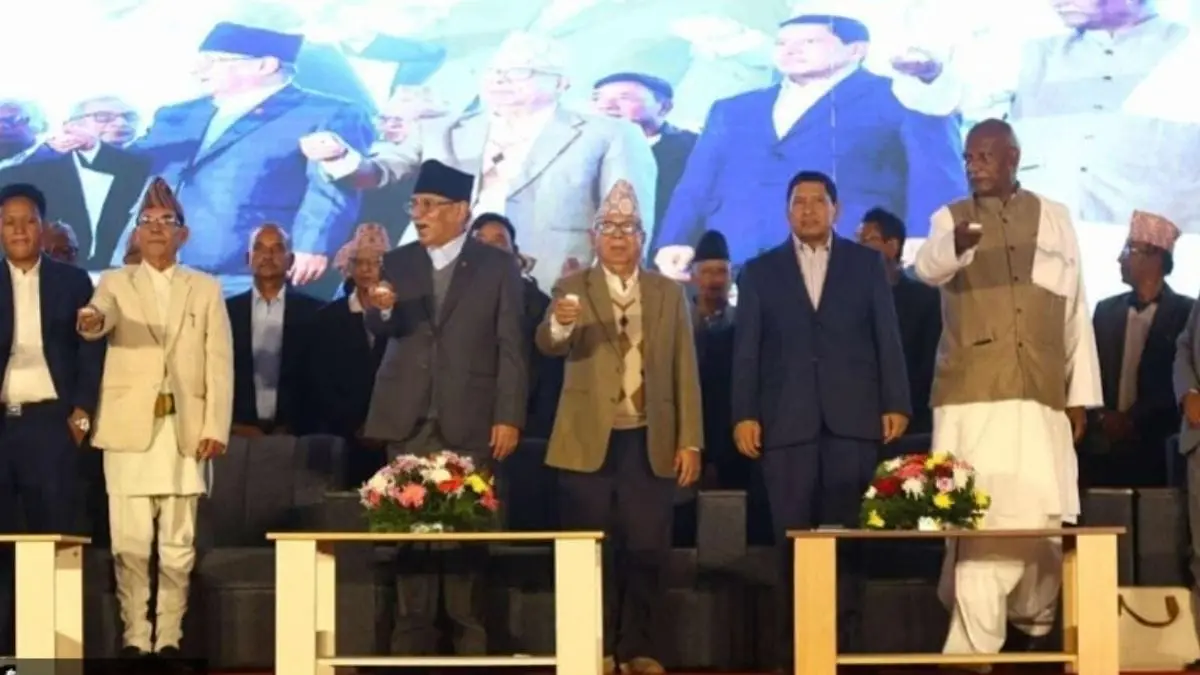
IN THE cramped world of Nepali politics, adding ten together does not always make a larger number. On November 5th ten communist and socialist parties announced they had become one, merging to form the Nepali Communist Party. The new bloc is led by Pushpa Kamal Dahal, who is better known by his nom de guerre, Prachanda, meaning “the fierce one”. He is a former prime minister and leader of a brutal Maoist insurgency. His partners include two other former prime ministers, Madhav Kumar Nepal and Jhalanath Khanal, and Mahindra Ray Yadav, a veteran politician from the Madhesi ethnic community.
On the surface this looks like a formidable gathering of political heavyweights. Yet look closer and it becomes obvious that it is a fragile coalition of ageing leaders whose new vehicle may struggle to get out of the car park.
The merger is the latest realignment in Nepal’s endlessly fissile communist movement. For decades, the country’s leftist parties have behaved like amoebas, constantly splitting and recombining. The largest constituent of the new party, Mr Dahal’s Maoist Centre, was itself born from a split in 1994. Another member, the Unified Socialist party led by Mr Nepal and Mr Khanal, was formed only in 2021 after breaking away from the country’s dominant communist force, the Communist Party of Nepal (Unified Marxist-Leninist), or CPN-UML. Many of the other, smaller groups in the new coalition were once part of the Maoist Centre. Their reunion is less a grand leftist synthesis and more a gathering of prodigal sons.
Even the new party’s name carries the ghost of past failures. It is the Nepali Communist Party, a deliberate choice to avoid the title Nepal Communist Party. That was the name given to a previous mega-merger between the Maoist Centre and the CPN-UML in 2018. That union, which briefly created a supermajority in parliament, dissolved in acrimony and was annulled by the Supreme Court in 2021. The court ruled that the name was already registered to a different, tiny party. The choice of “Nepali” this time is both a legal necessity and a nod to the naming conventions of other communist parties abroad, such as the Chinese Communist Party.
The immediate goal of this new amalgamation is electoral. Nepal is due to hold federal elections in March. The hope is that a unified party can present a credible challenge to the two main political forces: the CPN-UML, led by the canny KP Sharma Oli, and the Nepali Congress, a centrist party headed by Sher Bahadur Deuba, also former prime minister. Yet the new Nepali Communist Party faces profound obstacles. It lacks the extensive network of grassroots cadres that has propelled the CPN-UML to repeated victories. Its constituent parts are ideologically disparate, ranging from hardline Maoists to social democrats. And several prominent figures from the Unified Socialist wing, including a former finance minister, Janardan Sharma, and a firebrand young politician, Ram Kumari Jhankri, have refused to join the merger, weakening its appeal.
The most glaring weakness, however, is generational. The three top leaders—Mr Dahal, Mr Nepal and Mr Khanal—are all in their seventies. Their political careers span the fall of the monarchy, a civil war and the tumultuous birth of a federal republic. They argue, with some justification, that their experience is invaluable in a young democracy. Yet their enduring prominence highlights a chronic failure to cultivate successors. In a country where the median age is 25, the face of the new party is decidedly elderly. Mr Nepal defends the old guard by pointing to global examples of older leaders such India’s Narendra Modi and China’s authoritarian leader, arguing that capability not age should determine leadership. But this logic rings hollow to many younger Nepalis who see a political class out of touch with their aspirations.
The party’s internal culture may also hinder its progress. Mr Nepal speaks of a “discipline of consensus”, where major decisions are made collectively by a central committee. This sounds commendably democratic, but in truth it can lead to sluggishness and internal factionalism. The process of merging ten distinct party machines, each with its own interests and loyalists, will be a monumental task. The tendency for Nepali communist parties to splinter is as strong as the impulse to unite.
For all its fragility, the new party’s birth reflects a persistent dynamic in Nepali politics: the search for a viable leftist alternative to the CPN-UML. Mr Oli’s party is disciplined and powerful, but his autocratic style has alienated many. The Nepali Congress is a broad church but lacks a coherent ideological core. There is space for a strong, unified socialist party. Whether this new entity can fill that void is a question for you to decide. It is a coalition built more on the shared ambitions of its leaders than on a common vision for the country.
The formation of the Nepali Communist Party is a big event in Nepal’s fractious political landscape; yet it feels more like a chapter in an ongoing saga than its conclusion. The same veteran actors are playing new roles on a familiar stage. They promise unity and renewal, but the audience has seen this performance before. This new merger will soon face the same strains of ideology, ambition and time that have undone every union before it. For the moment Nepal’s left remains a family of quarrelsome relatives, forever arguing over the inheritance. ■