
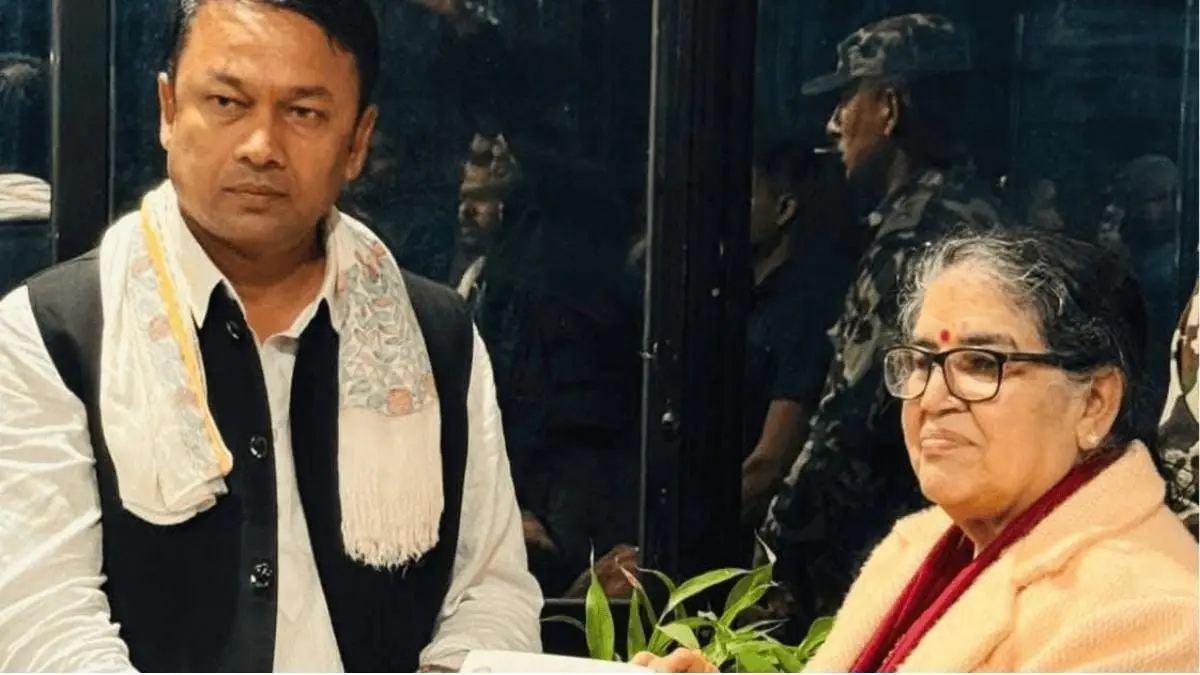
The Bardibas oath Image via Facebook
In Nepal even a hotel room can become a seat of power. In the early hours of November 10th, at a small hotel in Bardibas, Sumitra Subedi Bhandari, the head of Madhesh Province, administered the oath of office to Saroj Kumar Yadav as Chief Minister (pictured above). By dawn, protests had erupted outside the provincial secretariat in Janakpur. Opposition lawmakers denounced the ceremony as unconstitutional, claiming that Ms Bhandari had bypassed an emerging coalition majority to install her party ally. The Supreme Court has since stepped in, suspending Mr Yadav’s authority until the legality of his appointment is resolved.
It was the latest episode in a political farce that has turned Madhesh Province into a microcosm of Nepal’s wider instability. In a 107-member assembly, no party holds a majority. That makes coalition-building necessary as well as treacherous. The constitution offers two routes to forming a government. Under Article 168(2), a leader who commands the support of multiple parties may be appointed chief minister. Under Article 168(3), if no such coalition can be formed, the head of province may instead appoint the leader of the largest single party.
The opposition claims that a seven-party coalition representing 74 members had already presented itself to Ms Bhandari, making the use of Article 168(3) unnecessary. Ms Bhandari, however, appointed Mr Yadav, whose Communist Party of Nepal (Unified Marxist-Leninist), or CPN-UML, holds only 23 seats. Critics note that Ms Bhandari is a longtime affiliate of the CPN-UML and a former nominee of its leader, KP Sharma Oli, for an ambassadorship. Her decision to swear in Mr Yadav away from the provincial capital and without public notice has raised doubts about whether provincial heads intended as neutral constitutional figures can act impartially.
The Supreme Court’s interim order, calling the appointment “prima facie unconstitutional”, prevents Mr Yadav from performing his duties until the case is settled. It also restricts any long-term administrative or fiscal decisions. The move shows how the judiciary has become an arbiter of last resort, repeatedly asked to referee disputes that the political class cannot resolve. Since the adoption of the 2015 constitution, courts have been called upon to interpret nearly every clause governing government formation, often after political manoeuvres have outpaced legal clarity.
Madhesh has seen three chief ministers in two months—each undone by shifting alliances. The federal system, created to give Nepal’s diverse regions a sense of ownership, has instead imported Kathmandu’s factional culture into provincial politics. Coalition arithmetic, rather than policy, dominates governance. Assemblies spend more time counting votes than debating budgets.
The Supreme Court’s order has momentarily halted the chaos, but only that. The province still needs a functioning government, and the national parties that control its fate have little incentive to compromise. For the citizens of Madhesh, who expected federalism to bring governance closer, it has brought Kathmandu’s crises to their doorstep instead. The constitutional music has paused for now, but the chairs remain in motion. ■




