
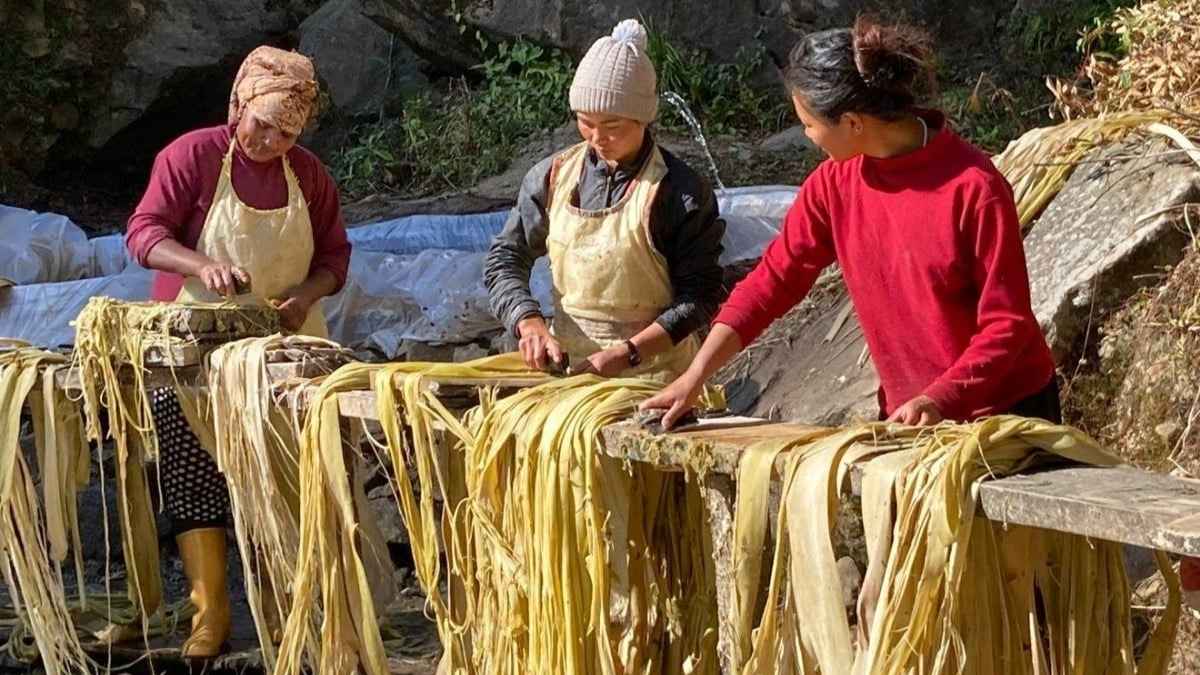
Image via South China Morning Post
TO HOLD a new 10,000-yen note, issued by the Bank of Japan, is to touch a masterpiece of anti-counterfeiting. The bill, featuring the industrialist Eiichi Shibusawa, boasts 3D holograms that rotate as the paper tilts and high-definition watermarks. Yet for all this wizardry, the note’s most distinctive feature is arguably its texture. Japanese banknotes are printed on a creamy, durable paper derived from the inner bark of the mitsumata plant. It gives the currency a heavy, sticky feel that machines and cash-handlers alike trust implicitly. But the mitsumata on which the world’s third-largest economy relies is no longer sufficiently Japanese. It is increasingly Nepalese.
The shift is a lesson in demographic destiny. For roughly a century, Japan grew its own mitsumata. But the shrubs require keen attention and the farmers who once tended them are dying out. As Japan’s rural population shrinks and ages, the domestic harvest has collapsed. To keep the printing presses running, the National Printing Bureau has turned to the Himalayan foothills. There, between 1,500 and 3,000 metres above sea level, grows Edgeworthia gardneri, known locally as argeli. It is a wilder, hardier relative of the Japanese variety, and it has become an unlikely economic lifeline for some of the poorest farmers in Asia.
Until recently, argeli was viewed by the hill tribes of Nepal as little more than a nuisance or, at best, firewood and fencing. That changed when Kanpou Incorporated, an Osaka-based agency, identified the plant as a viable substitute for the Japanese shortage. A trade has since flourished. Farmers in districts such as Ilam and Dolakha have found that the bark commands significantly higher prices than traditional staples like corn or potatoes. For a country that relies heavily on remittances from workers migrating to the Gulf, the emergence of a high-value cash crop that keeps labour at home is a rare boon.
The work, however, is punishing. Converting the shrub into a raw material suitable for high-grade currency takes precision. The stems must be steamed and stripped by hand to isolate the white inner fibres, then dried in the sun. It is a precarious stage: a cloudy day can lead to mould, ruining the batch. The bark is then bundled and sent on a tortuous journey: by truck to Kathmandu, down to the Indian port of Kolkata and finally by sea to Japan. Only there is it pulped and processed into the “washi” paper that underpins the yen.
For Japan, the reliance on Nepal highlights a stubborn attachment to physical money. Whereas neighbours like China and South Korea race toward cashless societies, Japan is still fond of paper. Cash in circulation accounts for around 20% of GDP, nearly double the average for the OECD club of mostly rich countries. This is partly cultural, a preference among the elderly, and partly pragmatic. In a land prone to earthquakes and typhoons, physical currency is a resilient backup when power grids fail. The tactility of argeli-based paper is not merely aesthetic: it is a security feature.
Yet for Nepal, the “yen rush” has limits. The country sits at the bottom of the value chain. It exports raw bark not finished paper, capturing only a fraction of the final value. Moreover, quality control is a struggle. Japanese printers demand “A-grade” product—immaculate, snow-white bark. Much of the Nepalese harvest fails to meet this standard due to inconsistent processing techniques, meaning demand from Japan—estimated at over 100 tonnes a year—often outstrips supply.
There is also a longer-term risk. The Reserve Bank of India stopped using similar plant fibers for rupee notes years ago in favour of cotton and synthetics. If the Bank of Japan eventually succumbs to the digital tide, or if material science offers a cheaper synthetic alternative that mimics the feel of mitsumata, the market for argeli could evaporate as fast as it appeared.
For the moment, however, the arrangement holds. It is an interesting example of globalisation’s reach: the economy of a G7 powerhouse, famed for robotics and high-tech exports, rests quite literally on the manual labour of Himalayan villagers stripping bark from wild bushes. Nepal’s farmers may not have many yen in their pockets, but they can take a quiet satisfaction in knowing that Japan cannot make money without them. ■





