Image: The Kathmandu Post
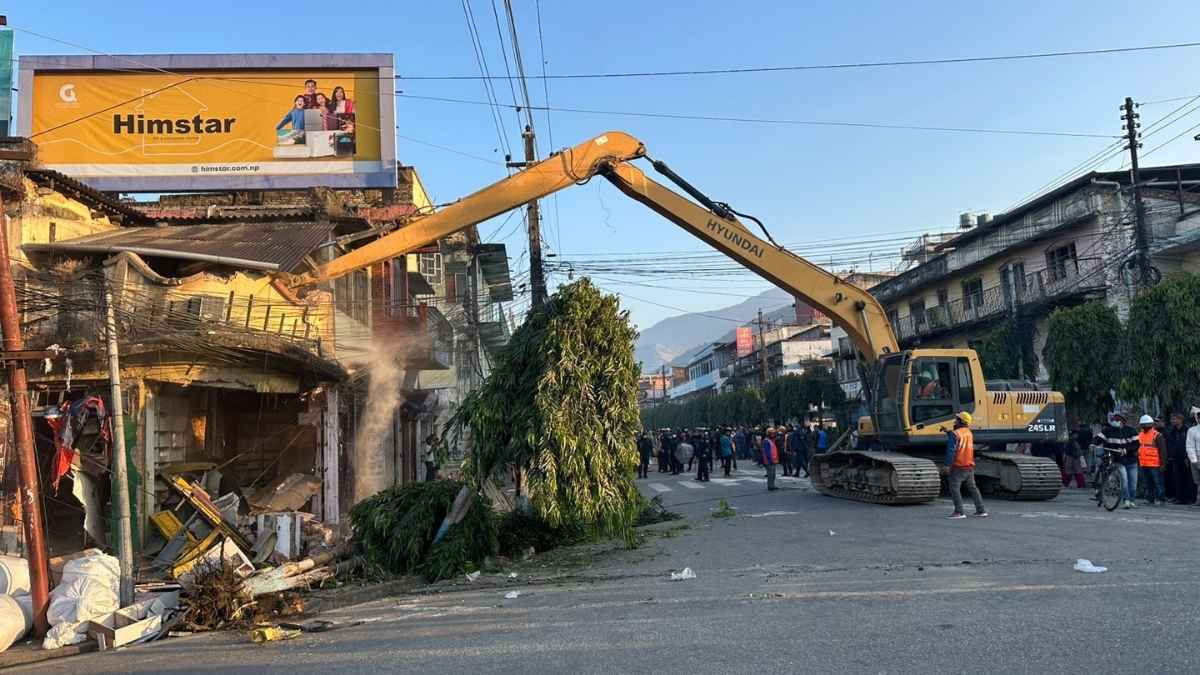
IN THE EARLY hours of Saturday, while the residents of Hetauda were mostly asleep, the Nepali state suddenly woke up. It did not wake gently. It arrived at 5:30am in the form of heavy machinery, backed by riot police, to claw down over 500 shops, homes and shutters along the East-West and Tribhuvan highways. These concrete structures for decades had stood as facts on the ground: bustling and visible. In the span of twelve hours, they were bulldozed to rubble.
To the casual observer this looks like the restoration of order. The government claims it is reclaiming public land for a vital road expansion, clearing a choke-point in a strategic economic corridor. But look closer and the dust settling over Hetauda says something far uglier: a style of governance that oscillates wildly between comatose negligence and capricious brutality. The demolition in Hetauda is not a sign of a strong state enforcing the law. In fact it is the panic of a weak state trying to look busy.
The situation is a perfect example of how poorly Nepal’s bureaucracy works. The law is clear: the road boundary extends some 75 feet from the centre line. The Supreme Court in a verdict in 2023 confirmed that structures within this zone are illegal and their owners are owed no compensation. Yet for over 20 years, the state watched as the market grew, as well as participated. It connected these “illegal” homes to the electricity grid; it piped in water; it issued business licences; and most crucially it collected taxes.
That’s the contradiction that plagues this country. The state operates on two conflicting registers. There is the de jure reality, where strict rules exist on paper, and the de facto reality, where everything is negotiable until it isn’t. By taxing illegal structures for so many years, the government made them seem legitimate. It entered into a silent social contract: you may stay, provided you pay. When the bulldozers arrived on Saturday, they did not only crush brick and mortar. They crushed the predictability that is critical for any economy to function.
The consequences of “governance by bulldozer” are ruinous. The initial losers are the shopkeepers, many of whom watched their livelihoods vanish without a rupee of compensation. But the bigger loser is the rule of law itself. The Road Division Office claimed it proceeded because it had not formally received a stay order issued by the Supreme Court just a day prior. This excuse—that the digital age has not yet reached the fax machines of Hetauda—is convenient. It suggests a government that is selectively blind: it sees the encroachment it ignored for 20 years, but it cannot see a court order urging restraint.
Economically, this approach is disastrous. Development needs the expansion of infrastructure, yes. The East-West Highway is an artery that cannot stay clogged. But development also needs secure property rights. If a government permit is valid only until a bureaucrat wakes up on the wrong side of the bed, no rational actor will invest for the long term. Instead the economy becomes short-termist and extractive. People build cheap, ugly structures to grab land while they can, knowing that the state is a sleeping giant that might one day roll over and crush them.
The government’s defenders will argue that this is the only way. They will say that in a country rife with litigious delays and political patronage, only a shock-and-awe approach can clear the path for progress. They point to the “symbolic” nature of the demolition—tearing down shutters and overhangs rather than razing entire multi-story buildings—as proof of restraint.
But that comfort is deceptive. True state capacity is not measured by the horsepower of the demolition equipment. It is measured by the ability to prevent the mess in the first place. A competent state would have enforced the 75-foot rule when the first brick was laid in 2000 not in 2025. A competent state would have updated its cadastral maps, or offered a transparent amnesty window, or negotiated a resettlement plan that acknowledged its own complicity in the error.
Rather Nepal has chosen the path of the bulldozer. It is a path that mistakes motion for progress. It is easy to destroy, it is hard to plan. The officials in Kathmandu may pat themselves on the back for “reclaiming” the highway. But they have done so by burning the very capital—trust—that they will need for the next project. ■