
NEPAL CURRENTLY finds itself in the enviable yet deeply frustrating position of a person who has won the lottery but cannot find a shop open to spend the winnings. Its foreign-exchange reserves have swelled to a record $22.13bn, sufficient to fund the nation’s imports for 18 months. In the jargon of central banking, that is a “fortress balance sheet”.
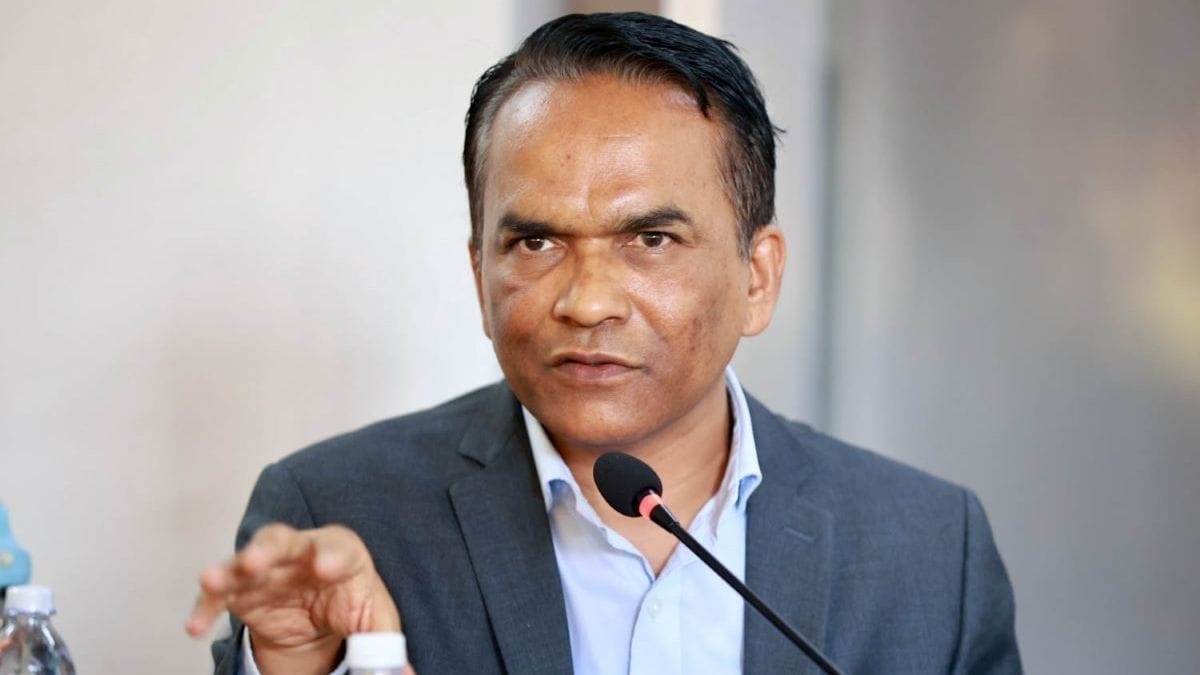
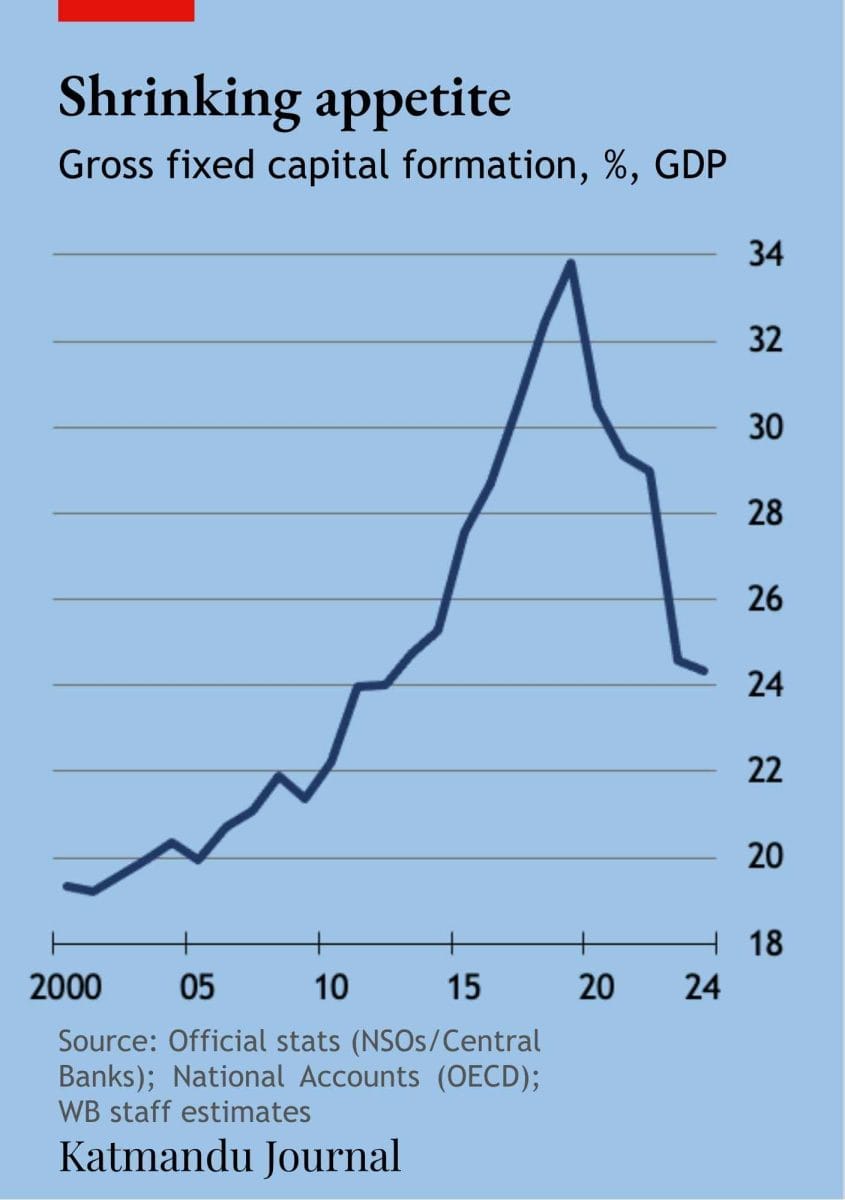
In the reality of the Kathmandu streets, it is a symptom of a troubling economic malaise. Money is pouring in through the sweat of migrant workers abroad, but at home, the engines of credit and investment are stalling (see chart below). That peculiar crisis is the inheritance of Biswo Nath Poudel, the governor of the Nepal Rastra Bank, who is currently attempting to overhaul the institution’s traditional conservatism in favour of a more muscular and technocratic activism.
The transition last May from Maha Prasad Adhikari to Mr Poudel was a change of species. Mr Adhikari was a creature of the institution, a career central banker who had spent three decades inside the NRB’s corridors. His tenure was defined by the defensive crouch. He steered the financial system through the wreckage of the pandemic and the inflationary shocks of the Ukraine war. He was a man of the “shield”, obsessed with stability, digital-payment rails and the integrity of the currency. Mr Poudel, on the other hand, is an outsider. An academic with a doctorate from Berkeley and a resume that includes the World Bank and the National Planning Commission, he embodies a more catalytic view of central banking.
The politics surrounding his appointment foreshadowed the scale of the task. For forty days, the central bank sat without a leader as the ruling coalition bickered over the future direction of the economy. The choice of Mr Poudel was a victory for those who argued that stability had become a cage. If Mr Adhikari’s legacy was the QR code—a triumph of digital plumbing—Poudel’s must be the revival of the private sector. The difficulty is that he is attempting to ignite a fire in a room where the wood is damp with uncertainty.
The first visible sign of the “Poudel Playbook” appeared in monetary policy for the 2025-26 fiscal year. In a move that signaled a clean break from the previous administration’s caution, the NRB implemented across-the-board cuts to the interest-rate corridor. The policy rate was first trimmed to 4.5%, and has since been cut further to 4.25%, the lowest in more than four years. The objective was to lower the price of money until someone, somewhere, decides to borrow it. This “cautiously accommodative” stance is a straight response to the tepid credit appetite of the private sector. While the NRB targeted a 12% growth in credit, the actual figure for the first half of the fiscal year lingered at a dismal 1.9%.
That credit stagnation is the great headache of the Poudel era. By most estimates commercial banks are sitting on roughly Rs700bn in loanable funds. This is a mountain of cash that no one seems to want to climb. The reasons are structural rather than purely monetary. Business owners, wary of political volatility and high capital costs, have adopted a “wait and watch” posture. To break that impasse, Mr Poudel has reached for more interventionist tools than his predecessor might have found palatable. He has raised the limits for share-backed loans and increased the maximum loan amount for residential housing.
Such measures are designed to “pump prime” the economy by inflating asset values. The logic is that when people feel wealthier because their stocks and homes are worth more, they will begin to spend and invest again. It is a strategy fraught with risk. Critics argue that this is merely blowing bubbles in a vacuum. Nara Bahadur Thapa, a former executive director at the bank, has noted that these are short-term fixes that may ignore the need for productive industrial investment. Yet in a scenario where domestic demand has fallen off a cliff, Mr Poudel seems to believe that a little froth is a necessary price for a lot of movement.
One of the most extraordinary departures from the old regime is the nature of the relationship between the central bank and the Ministry of Finance. Under Mr Adhikari, the NRB tended to be a fortress of independence, a stance that led to public friction and even a legal battle in the Supreme Court. Mr Poudel has opted for what he calls a “dialogue-based” approach. He and Bishnu Prasad Paudel, former finance minister, appeared to be in a state of high-level synchronicity. They pledged to align monetary instruments with the government’s ambitious 6% GDP growth target.
Yet the harmony tends to invite the old ghost of “fiscal dominance”. There is a danger that the central bank becomes a mere extension of the treasury, tailoring its policies to suit the government’s borrowing needs rather than the long-term health of the economy. For now, however, the markets seem to prefer a unified front. The stock market reacted to Mr Poudel’s appointment with a visible surge of confidence. After years of policy zig-zags, the investment community is hungry for a predictable, growth-oriented narrative.
While Mr Poudel is expansionary on interest rates, he is surprisingly hawkish on regulation. He has shifted the bank’s focus from “merely devising rules” to “scaling up supervision”. The most ambitious part of that agenda is the Asset Quality Review (AQR) of commercial banks. For years there have been whispers that the low non-performing loan (NPL) ratios reported by banks were a fairy tale, sustained by the creative restructuring of bad debt. Mr Poudel has welcomed international auditors to look under the bonnet.
That is an embarrassing but essential exercise. As the NPL ratio crept above 4% in late 2024, it became clear that the banking sector was carrying more dead weight than it admitted. The AQR is intended to force banks to clean up their balance sheets. It is a move that may depress bank profits in the short term but is vital for the long-term resilience of the system. Mr Poudel is betting that a transparently healthy banking sector will be more willing to lend than one that is hiding its bruises.
Perhaps the most ominous cloud over Mr Poudel’s desk is the “grey list” of the Financial Action Task Force (FATF). Nepal was placed on this list of countries with strategic deficiencies in anti-money laundering in early 2025. It is a stain that threatens the country’s access to global financial markets and its ability to attract foreign direct investment. Mr Poudel has made removal from this list his top priority. He has pushed for stricter oversight of “beneficial ownership” and deeper inspections of high-risk sectors like casinos and cooperatives. It is a race against time. If Nepal stays on the list for too long, the historic foreign-exchange reserves will matter little if no one wants to trade with the banks that hold them.
The macroeconomic data for late 2025 suggests an economy that is technically sound but emotionally depressed. Inflation has fallen to 1.63%. In a normal economy that would be cause for celebration. In Nepal it is a sign of a “recession-like” quietude. People are not buying goods, and therefore prices are not rising. Food inflation has even dipped into negative territory. This is the “liquidity paradox” in its purest form: record-high savings, record-low inflation and yet a sense of stagnation.
Mr Poudel’s rewriting of the playbook is an attempt to solve that riddle. He is trying to build a bridge between the wealth generated by Nepalis abroad and the opportunities for those at home. He has noted, with some candour, that “fiscal policy has more problems than monetary policy”. He knows that he can lower interest rates to zero, but he cannot force the government to build roads faster or create a manufacturing base overnight.
As the year progresses, the Poudel administration will be judged by its ability to turn “tempered optimism” into tangible growth. The Berkeley technocrat has shown he is willing to be flexible with credit and firm with supervision. He has replaced the defensive shield of his predecessor with a more active, and perhaps riskier, set of tools.
Whether that will be enough to break the cycle of remittance-dependent stagnation is the central question of the Nepali economy. For the moment Mr Poudel has successfully changed the conversation from how to survive a crisis to how to manage a recovery. In the world of central banking, that is already a big victory. ■





