IMAGE: FAZRY ISMAIL
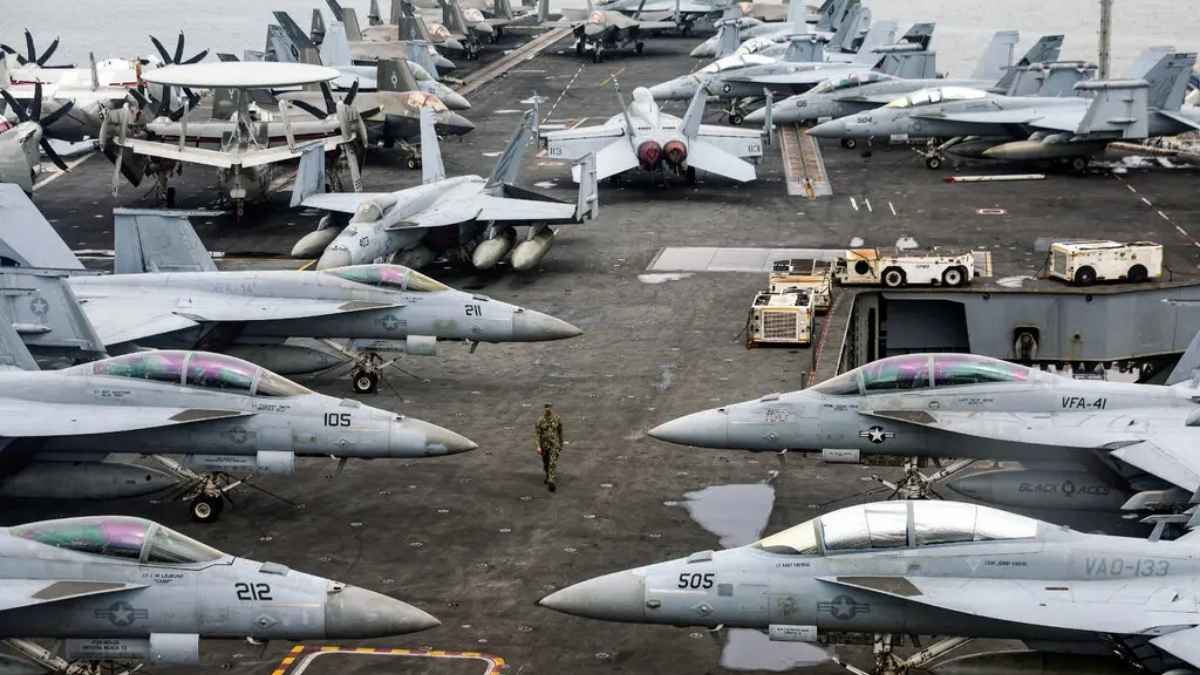
“A MASSIVE ARMADA is heading to Iran,” declared Donald Trump on January 28th, adding that the country should make a deal. “If Iran dares to strike…the response will be far worse than the last time.” The American president was referring to the American air strikes that hit three Iranian nuclear sites last June. Since then the aircraft carrier USS Abraham Lincoln and its accompanying strike group have moved within range. Satellite imagery shows new air-defence systems at America’s al-Udeid base in Qatar. Surveillance and refuelling aircraft are buzzing around the region. As Steffan Watkins, an analyst who tracks such movements, notes, the build-up has all the hallmarks of serious preparation.
Mr Trump feels emboldened. The operation that snatched Nicolás Maduro, Venezuela’s former dictator, from his bedroom in early January confirmed his belief in the power of sudden, violent shock. His administration has presented Iran with three demands: permanently end all uranium enrichment; limit its ballistic-missile arsenal; and cease support for proxy militias across the Middle East. These are not negotiating points but terms of surrender. Accepting them would strip Iran of its core strategic assets and leave it naked before its enemies. There is no indication Tehran will comply.
The stand-off is a case study in the new, volatile grammar of American power. The armada is real. Its purpose is deliberately ambiguous. It could be a blunt instrument of intimidation, a shield to defend regional allies, or the spearhead for another attack. Mr Trump enjoys the flexibility. The threat itself becomes a tool, compressing diplomacy into a binary choice between capitulation and catastrophe.
Iran’s position, however, is more brittle than it appears. The regime is still reeling from the widespread protests in December and January and their brutal suppression. Estimates of the death toll, obscured by internet blackouts, range from official figures of around 3,100 to opposition claims as high as 30,000. The economy is shattered and the currency in free-fall. The June strikes significantly degraded, though did not obliterate, the nuclear programme. Funding for proxies like the Houthis in Yemen is a strain. As one American official involved in recent back-channel exchanges noted, even Iran’s seasoned foreign minister, Abbas Araghchi, appeared constrained, needing permission to talk and relay promises through third parties.
That frailty makes the regime both more dangerous and more calculating. Mr Araghchi has warned that an “all-out confrontation” would be “messy” and “ferocious”, dragging on far longer than American war-planners imagine. Iran’s remaining strengths are its capacity for asymmetric retaliation through regional proxies and its substantial stockpile of ballistic missiles, its last deterrent against Israel. Forcing it to abandon these would be to strip it of its final cards.
America’s Secretary of State Marco Rubio has told lawmakers the build-up is “wise and prudent” defence, given the reach of Iranian drones and missiles. But he added that the force could also “preemptively act”. This duality is the point. Mr Trump’s method is to create a reality—a circling armada, a set of maximalist demands—and then see how his adversary reacts. The Venezuela operation showed that he is willing to act on his threats. The June strikes on Iran confirmed it.
Yet the parallels have limits. Toppling Venezuela’s regime required a single daring raid. Neutralising Iran’s nuclear and military capacity would be a sustained campaign, likely plunging the entire region into a wider war. America’s Gulf allies, Saudi Arabia and the United Arab Emirates, are strongly wary and have refused the use of their airspace for strikes. They remember the chaotic aftermath of America’s previous Middle Eastern wars all too well.
The most probable path is not a grand invasion but a series of punitive blows—perhaps against the Islamic Revolutionary Guard Corps or another slice of the nuclear programme. That would allow Mr Trump to claim enforcement of his red lines without committing to regime change. It is a strategy of controlled escalation, where each turn of the screw tests the opponent’s breaking point. The danger is that in a region of multiple fault lines, controlled escalation is an illusion. One miscalculation, one errant missile, and the logic of the situation takes over. The armada is a threat but also a machine for generating moments of irreversible choice. ■