
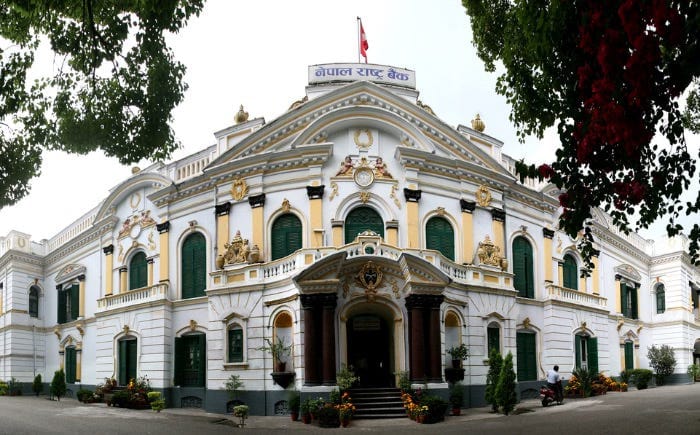
ECONOMISTS LIKE their models neat. A nation, they posit, can choose only two corners of a triangle: free capital movement, a fixed exchange rate and independent monetary policy. This “impossible trinity” has long been a textbook staple. But economies have a habit of defying textbooks. Consider Nepal. It maintains a rigid peg of its currency to India’s rupee, controls capital flows and yet still tries to run its own monetary policy. According to a new study, that arrangement does not solve the trilemma at all; it warps it into something else entirely. The country’s interest rates are not set according to domestic inflation, as standard theory would suggest, but move in perverse ways. Its experience shows how much a small economy has to bend when it ties itself to a far larger neighbour.
Nepal’s peg is a matter of necessity. Its economy is yoked to India’s. More than two-thirds of its trade is with its southern neighbour. Millions of Nepalis work there, sending home remittances equivalent to a quarter of Nepal’s GDP. Letting its currency, the rupee, float freely against India’s would invite chaos. So it is anchored at 1.6 Nepali rupees to the Indian rupee. The peg provides stability but at a cost. It forces Nepal’s central bank to shadow India’s interest rates, lest diverging yields spark destabilising capital flows across their porous border.
That much is standard trilemma thinking. Where things get peculiar is in the details of how Nepal’s monetary policy actually works. Guna Bhatta of the Nepal Rastra Bank and Rabindra Nepal of the University of Wollongong have constructed a modified “Taylor rule” for the country—an equation describing how central banks should set interest rates in response to inflation and economic growth. Their analysis, based on data from 2000 to 2020 and soon to be published in Emerging Markets Finance and Trade, reveals two key findings.
First, Nepal’s short-term interest rates are influenced more by the real effective exchange rate, a measure of its currency’s trade-weighted value adjusted for inflation, than by domestic factors. When the REER appreciates, meaning Nepal’s goods become more expensive relative to those of trading partners, interest rates rise. The effect is powerful. The coefficient linking the REER to interest rates surpasses three, the researchers find, implying that a 1% appreciation prompts more than a three-percentage-point increase in rates. In most economies, the REER might be a secondary concern. In Nepal it dominates.
Second, and more puzzling, is the relationship between interest rates and inflation expectations. In most central-bank reaction functions, higher expected inflation leads to higher rates, as policymakers try to cool the economy. In Nepal the study finds the opposite. Expected inflation is negatively correlated with interest rates. When Nepalis anticipate rising prices, rates tend to fall. That inversion of the usual mechanism suggests that domestic inflation is not the driving force behind monetary decisions. Something else is pulling the levers.
That something is the exchange-rate peg and the remittance flows that sustain it. Nepal’s REER has been on a long ascent, rising by nearly 30% between 2000 and 2020. Economists such as Chandan Sapkota, an independent analyst based in Kathmandu, attribute that largely to remittances. Migrant workers send home foreign currency, which commercial banks convert into local rupees, swelling domestic money supply. This pushes up the prices of non-tradable goods and services, such as housing and haircuts, relative to tradable ones, leading to an appreciation of the REER. The central bank then faces a dilemma. It can allow the money supply to expand, keeping interest rates low but fuelling inflation and hurting the competitiveness of exporters. Or it can try to mop up the liquidity by selling bonds, pushing up interest rates.
It does a bit of both in practice, but the effect is to tighten the tether to India. Higher interest rates in Nepal attract deposits, further strengthening the currency’s real value. This dynamic explains why the REER plays such an outsize role in rate-setting. It also explains the odd negative relationship with inflation expectations. Much of Nepal’s inflation is imported from India, owing to the peg. When Indians expect higher prices, the NRB must in effect import tighter monetary policy from India to maintain the peg, yanking up rates. But because these rate rises are a reaction to foreign, not domestic, inflation expectations, they show up as a negative correlation in a model that looks only at domestic variables.
The policy implications are sobering. Nepal has experimented with an interest-rate corridor since 2017, seeking to reduce volatility in short-term rates. But without a clear rule to guide its central bank, such efforts are ad hoc. The research by Mr Bhatta and Mr Nepal suggests that any credible rule must give heavy weight to the REER and to Indian monetary conditions. It must also acknowledge that remittances, while a lifeline for many households, act as a monetary-policy disruptor, forcing trade-offs between stability and competitiveness.
Some analysts wonder if Nepal should just adopt India’s rupee, eliminating the pretence of monetary independence. But that would mean ceding control over banking regulation and financial stability. Others, including the International Monetary Fund, have suggested moving to a more flexible exchange rate. Yet that could unleash volatility in a country where confidence in the currency is fragile. For now Nepal is stuck with its peg and its paradoxes.
Its experience holds lessons that extend past the Himalayas. Many small, poor economies face similar dilemmas: tethered to larger neighbours by trade, migration or debt, yet striving for policy autonomy. Their central banks may find that the textbooks provide no easy answers. Sometimes the trilemma is not impossible, just impossible in the way you expected. ■





