IMAGE: ATUL LOKE/NYT
IN A YEAR when other finance ministers are wielding machetes, Nirmala Sitharaman reached for a scalpel. Presenting India’s annual budget on February 1st, her speech was remarkable for what it avoided. There were neither sweeping tax cuts, nor lavish new welfare schemes, nor dramatic breaks from orthodoxy. Instead the government of Narendra Modi offered a programme of small spending increases, careful deficit targets and targeted industrial subsidies. It was a budget engineered for a dangerous world. Growth is robust—the economy is expected to expand by 7.4% this fiscal year ending in March—but the horizon is dark with protectionist clouds. India is preparing for a siege.
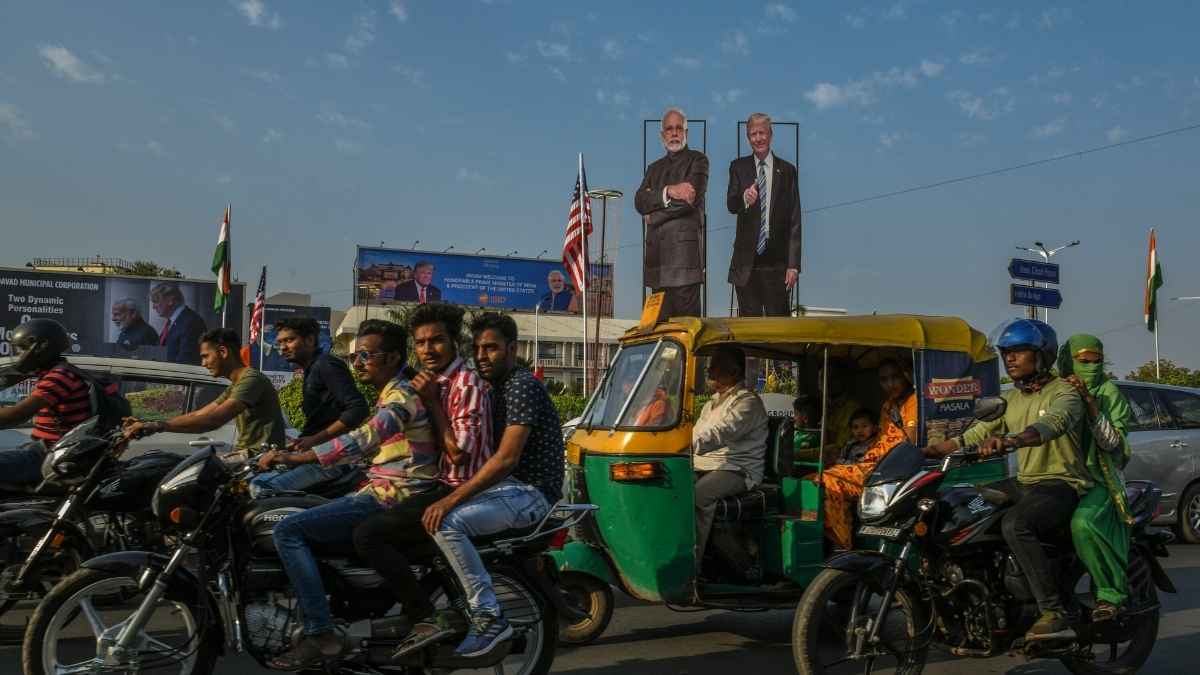
The proximate threat is America. President Donald Trump’s 50% tariffs, levied in response to India’s continued oil purchases from Russia, have made a mockery of earlier hopes for a bilateral trade deal. Exports to America, India’s largest trading partner, are stalling. The rupee has slumped to a record low. Hence the budget seeks to bolster the domestic economy and diversify trade links. Capital expenditure will rise by almost 9% to a record 12.2trn rupees ($133bn), with much of it directed at railways, roads and ports. The goal is to improve the country’s creaking logistics as well as lower costs for manufacturers and integrate India more firmly into alternative supply chains. A new trade pact with the European Union, signed just days before the budget, is part of the same strategy.
More revealing were the specific incentives sprinkled through the finance bill. Support for semiconductor manufacturing was doubled to 400bn rupees. A 100bn-rupee fund was created for biopharmaceuticals. “Mega textile parks” were promised. These are not random choices: they amount to a calculated bet on industries where India believes it can compete globally, and a buffer against sectors, like textiles, that are directly in Mr Trump’s line of fire. As one consultant in Mumbai puts it, the government is building shock absorbers.
Yet that defensiveness comes at a cost. The first tension is fiscal. Mrs Sitharaman reiterated a commitment to prune the public-debt burden, now 56.1% of GDP, over the coming years. The budget deficit is projected to inch down from 4.4% to 4.3%. Such targets are welcome. Achieving them while ramping up capital spending, however, needs some sleight of hand. The government will borrow a record 17.2trn rupees in the coming year, more than the entire capital expenditure budget. “I pray that a path is laid where one day capital expenditure will be more than the total borrowing,” says Nilesh Shah of Kotak Mahindra Asset Management. For now that prayer is unanswered. The maths works only because of strong tax revenues and a presumption of continued growth. Any stumble would force unpleasant choices between investment and discipline.
The second tension is more serious. Mr Modi has set a national goal of attaining “developed economy” status by 2047. Economists estimate this requires annual growth of 7-8% for decades. The current expansion, driven largely by domestic demand and public investment, may not be sustainable enough. Private investment remains hesitant. Foreign capital is flighty. Global funds have pulled more than $3bn from Indian stocks this year alone, wary of high valuations and American protectionism.
Here the budget offered a clever, if telling, fix. It changed the rules to allow “Persons Resident Outside India”—non-resident Indians—to own a larger share of listed companies. The ceiling for individual holdings was doubled to 10%; the aggregate limit was raised from 10% to 24%. The motive is obvious. As Vaibhav Mittal of Khaitan & Co notes, the government is seeking a “stability premium” from the diaspora. Overseas Indians are seen as a source of stickier, more patient capital than fickle global funds. The state is turning to its own people to replace retreating foreigners.
That is a precarious foundation for an economic superpower. The budget’s amalgam of infrastructure push, industrial subsidy and fiscal caution is not without logic. It seeks to keep the growth engine humming while insulating India from geopolitical winds. But true resilience would call for deeper reforms: freer land and labour markets; a more predictable regulatory environment; and a real unleashing of private enterprise. Those were absent. What remains is a capable but increasingly state-directed economy, building walls against the world while trying to sprint towards development. The pace is impressive. The trajectory, however, is beginning to look more circuitous. For a nation with its eyes on 2047, that is a risky trade-off. ■