
IMAGE: MINISTRY OF FOREIGN AFFAIRS, NEPAL
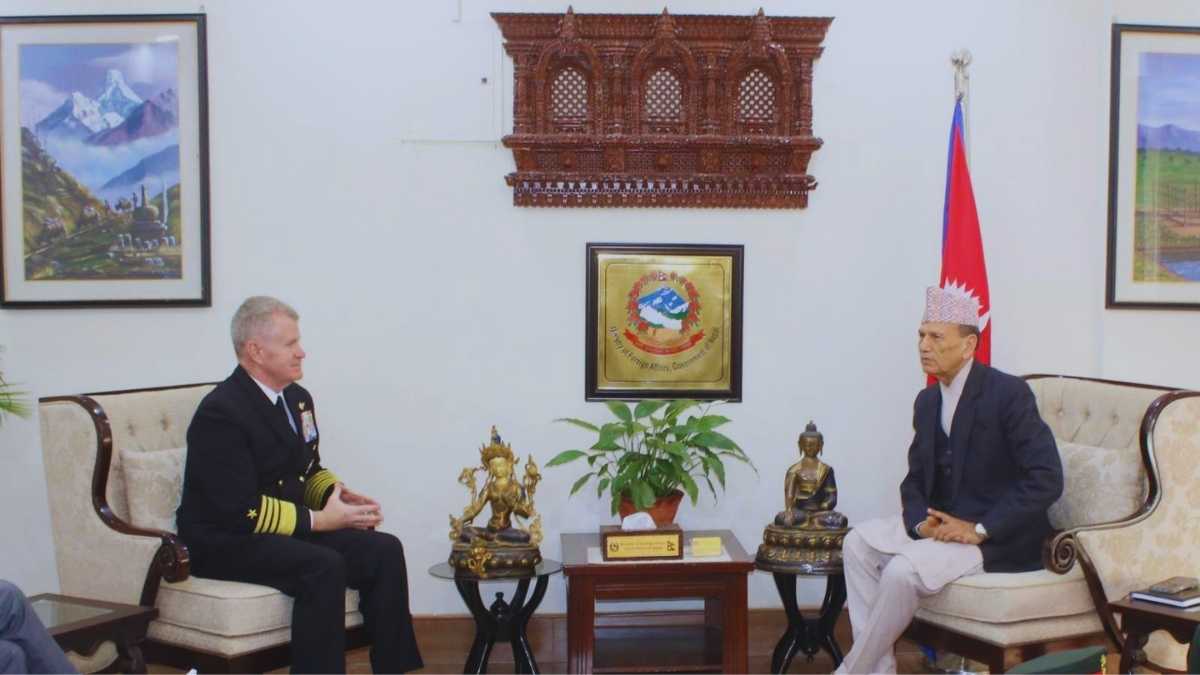
WHEN ADMIRAL SAMUEL PAPARO (pictured left), commander of United States Indo-Pacific Command, touched down in Kathmandu on February 12th for three days of meetings with Nepal Army brass, the optics were encouraging. He toured the Birendra Peace Operations Training Centre in Panchkhal, exchanged pleasantries with officers and spoke about disaster response. High-level military visits usually speak of closeness. The problem was everything else.
Nepal is three weeks from a general election, a hurried ballot born of last September’s street protests, in which thousands of young Nepalis, many raised under the republic that replaced the monarchy, took to Kathmandu having watched their counterparts in Dhaka topple Sheikh Hasina. They wanted their own corrupt leadership gone. They got it: the prime minister resigned, an interim government under Sushila Karki took over, and March 5th was fixed as polling day. A rare, real bottom-up democratic transition. Washington has said all the right things about it.
At a House Foreign Affairs subcommittee hearing the day before Admiral Paparo landed, lawmakers across party lines called it a moment of opportunity. “These major political transitions present a chance for the US to leverage our democracy assistance,” said Sydney Kamlager-Dove, the senior Democrat. Bill Huizenga, the Republican chair, described “a new chapter for engagement.” Assistant Secretary of State Paul Kapur nodded and told the committee that Washington was “prepared to work with whoever wins.”
The tools needed to act on that readiness have been largely dismantled. In December Donald Trump recalled Dean Thompson, the American ambassador to Nepal, alongside his counterpart in Sri Lanka, describing both departures as part of an efficiency drive. An ambassador is not a ceremonial fixture. He knows which civil-society groups are credible, which anti-corruption activists need cover and which emerging politicians merit attention. Six weeks of election preparation cannot substitute for that institutional knowledge.
On January 5th Prime Minister Karki met Washington’s chargé d’affaires at Singha Durbar, expressed gratitude for development aid and asked for help ensuring the vote was “free and fair.” The request was courteous but pointed: we are holding up our end.
The gap matters because Nepal’s geography does not permit passivity. The country sits between India and China, a buffer neither wishes the other to dominate. Kathmandu has long managed this by accepting Chinese infrastructure financing—roads, hydropower, telecoms—while preserving Indian goodwill and keeping Western aid flowing. That triangle has tightened. Zhang Maoming, a former deputy director in China’s foreign ministry, arrived as Beijing’s new ambassador on February 12th, replacing Chen Song after a three-year posting. His American counterpart has yet to be nominated.
Some argue the Pentagon’s continued engagement covers the gap. Counterterrorism co-operation persists. Nepal contributes reliably to UN peacekeeping. Perhaps that suffices. Yet democratic transitions in small, landlocked states carry their own logic, and America’s record on sustained commitment is fresh in Kathmandu’s memory. At his confirmation hearing, Dr Kapur admitted he could not confirm how many recipients of payments made for voluntary return to Taliban-controlled Afghanistan remained alive. That admission travels. Nepal’s democrats heard it.
The contrast with American trade diplomacy sharpens the picture further. Days before Admiral Paparo’s visit, Washington finalised a deal with India cutting tariffs to 18% and securing commitments to purchase $500bn in American energy and technology. A reciprocal arrangement with Bangladesh followed, offering duty-free access for garments sewn from US cotton. Commercial interests bring follow-through. Elections in Himalayan republics apparently bring optimism.
A new ambassador, when he eventually arrives, will find a government freshly elected and a public that watched who showed up during the campaign. Presence is its own argument. Absence makes a different one. ■




