IMAGE: FAZRY ISMAIL
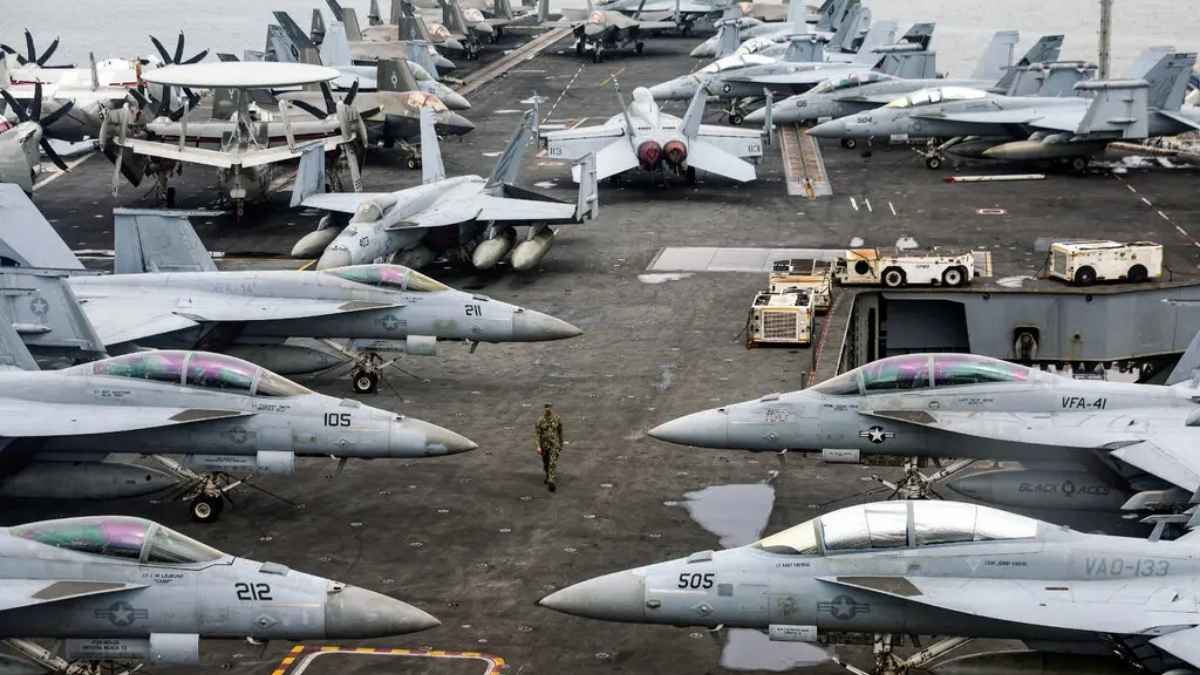
FOR A MAN who likes to deal, Donald Trump has boxed himself in. On February 19th he gave Iran a public ultimatum: strike a nuclear deal within 15 days, or else “bad things will happen”. The phrase was vintage Trump—vague, menacing, lifted from the lexicon of a mob boss. Yet the military build-up behind it is anything but vague. Twelve American warships, two aircraft carriers, dozens of fighter jets and a stream of tanker aircraft have moved into position. The Pentagon has not assembled this much firepower in the region since the invasion of Iraq in 2003. The clock is now ticking. And both sides face a problem.
Mr Trump’s deadline landed days after indirect talks in Geneva, where American and Iranian envoys reported “progress” but remained far apart. The administration says it wants limits on Iran’s nuclear programme, perhaps its missile arsenal too. The supreme leader, Ali Khamenei, has shown no appetite for the sort of sweeping concessions that would satisfy Mr Trump’s more hawkish allies. Instead Iran’s negotiators appear to be playing for time—talking just enough to keep the bombs at bay while reconstruction proceeds at Natanz and Isfahan, the nuclear sites hit by American strikes last June.
That may prove a miscalculation. The military build-up is not a bluff that can be sustained indefinitely. The USS Gerald R Ford, America’s newest and largest carrier, has already been at sea for nearly eight months. A typical deployment lasts nine. Its sister ship, the Abraham Lincoln, is needed back in the Pacific, where Chinese carriers now sail without American competition. Becca Wasser of the Center for a New American Security says: this is either the prelude to an attack or one of the costliest bluffs in American history.
The costs are not just financial. Mr Trump came to office promising to end America’s “forever wars”. A prolonged air campaign would test that pledge. Even a limited strike, targeted at nuclear facilities or Revolutionary Guard positions, risks escalation. Iran has practiced closing the Strait of Hormuz, through which a fifth of the world’s oil passes. Brent crude hit $71 a barrel this week, its highest in six months. Traders are betting on disruption.
Congress is restless too. Elizabeth Warren, a Democratic senator, reminded Mr Trump this week that the constitution requires lawmakers’ approval for new wars. The White House disagrees. But the memory of Iraq’s faulty intelligence and open-ended occupation haunts any discussion of Middle East intervention. Mr Trump’s own vice-president, J.D. Vance, sounded gloomy after the Geneva talks, noting that Iran had yet to acknowledge the president’s “red lines”.
What happens when the 15 days expire? One option is an assassination campaign against Iran’s political and military leadership—destabilising, but unlikely to topple the regime. Another is a repeat of last June’s strikes, only larger, targeting nuclear sites and missile batteries. Neither guarantees lasting results. Iran’s nuclear programme is dispersed and hardened. The regime has survived decades of isolation, sanctions and sabotage. It may calculate that it can absorb a blow and rebuild, as it has before.
Mr Trump has left himself room to manoeuvre. His public comments swing between maximalist demands—regime change, missile limits—and a narrower focus on the bomb. On February 19th he said the world would know “over the next, probably, ten days” how the standoff ends. That suggests flexibility. It also suggests impatience.
Mr Trump likes to say that peace through strength works. He may soon discover that strength, once assembled, demands to be used. The countdown has begun. ■