IMAGE: REUTERS
IN A Kathmandu teashop the morning after the election, a man in his twenties explained why he had not voted. His registration was in a village in the far west, a two-day bus journey away. He had work, he had rent to pay and he had watched the campaign on his phone. He knew who he wanted to win. He just could not get home in time. Across Nepal, millions made the same calculation. The result was the lowest turnout in the country’s democratic history, and the most emphatic mandate any party has ever received.
When the votes from the March 5th election were counted, the Rastriya Swatantra Party (RSP) had won 124 of the 165 directly elected seats, with a handful of remote constituencies still to report. Its leader, Balendra Shah—Balen to the nation, a former rapper and Kathmandu’s mayor—had crushed four-time prime minister K.P. Sharma Oli in Oli’s own constituency of Jhapa-5 by nearly 50,000 votes. The Nepali Congress, the party that led the 1990 democracy movement, was reduced to 17 seats. The CPN-UML, once the country’s dominant communist force, scraped eight. An entire political generation was wiped out in a single afternoon.
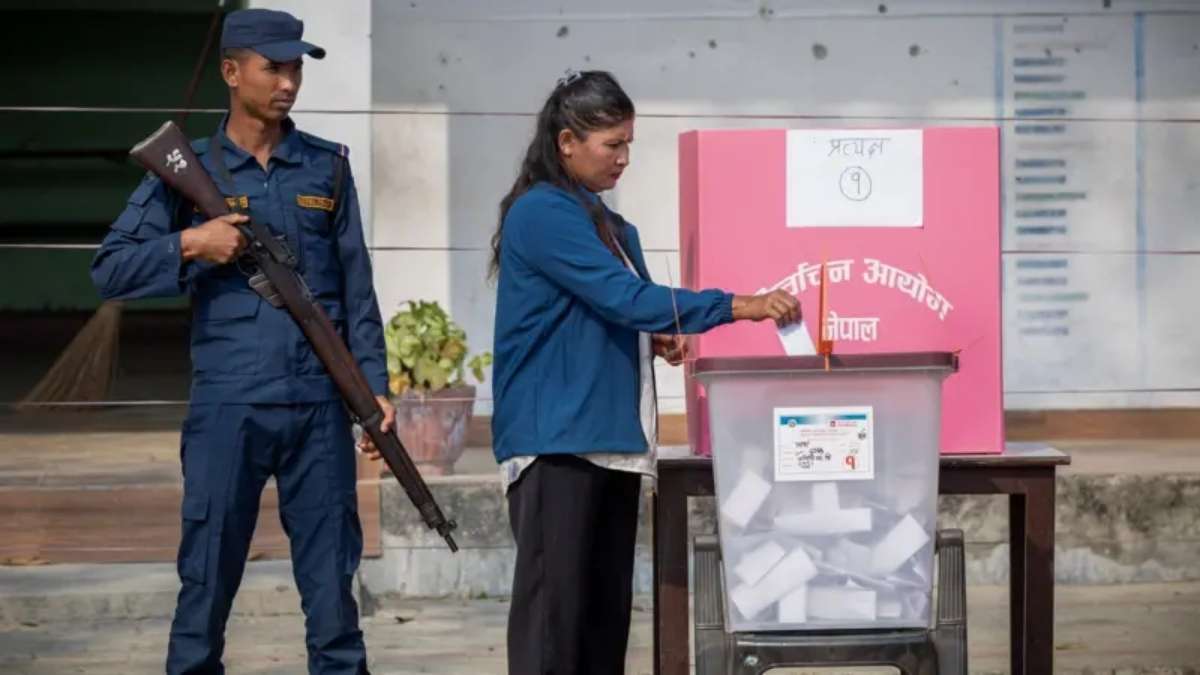
The scale of the victory is all the more striking for the emptiness of the polling stations. Only 58% of registered voters cast ballots, the lowest figure since multi-party politics resumed in 1991. That number may edge up to 60% when the last mountain ballots are counted, but the trend is clear. In 2013, when the country was exhausted by constitutional deadlock, turnout hit 78%. In 2022 it was 61%. Now it has fallen again, even as the electorate expanded by nearly a million young people registered after the Gen Z protests of September 2025.
Those protests matter. They began as a reaction to a government ban on social media and became a movement against the “NepoBabies”—the entrenched dynasties that have traded power among themselves for decades. At least 77 protesters, most of them students, were killed in clashes with police. President Ramchandra Paudel dissolved parliament, installed a caretaker government under Sushila Karki, a Supreme Court justice, and called an election. The young people who had filled the streets registered to vote in huge numbers. Then they stayed away.
The Election Commission offers four explanations. The first is geography: Nepal’s voter registration system ties citizens to their home district. A man from Sindhupalchok who works in Kathmandu must travel overnight to cast his ballot. Many cannot afford the fare or the lost wages. The second is emigration: 4-5m Nepalis work abroad, mostly in the Gulf, Malaysia, Japan and South Korea. They remain on the roll, but Nepal has no overseas voting. They are counted in the denominator but cannot reach a polling booth.
The third is the quality of the roll itself. Deceased voters are not always removed. Duplicate registrations survived the transition to a national ID system. The true number of eligible voters who are actually present in the country is lower than the official 18.9m, meaning the real turnout is higher than 58%. But by how much, nobody knows. The commission will audit the list after the election, a classic case of closing the stable door.
The fourth cause is the most significant. Nepal’s established parties have historically relied on dense local networks to haul voters to the polls: party offices in every village, affiliated unions, patronage channels and candidate-funded transport. In 2026, that machinery barely moved. Reports from across the country describe Nepali Congress and UML booth committees that just did not function. Even loyal supporters stayed home. The protests had not only delegitimised the parties in the eyes of the public: they had demoralised the activists who did the grinding work of getting out the vote.
The RSP, by contrast, built something new. Its campaign was run by a 660-strong social media operation, pumping content into the phones of young Nepalis who could not attend rallies because they were in the wrong district. It raised money from the diaspora, particularly in America, where the largest overseas Nepali community watched the election from afar. And it had Balen Shah, whose song “Nepal Haseko” (Nepal Smiling) had accumulated 10m YouTube views during the protests, making him a cultural symbol before he became a political candidate.
The result is a paradox: the lowest turnout in history and the clearest mandate in history. Voters who participated made a clear choice. Voters who stayed home did so because the old parties could not persuade them to travel, and because the new party did not need them to. The RSP’s support was concentrated among settled, home-district residents who could vote easily. The Gen Z protesters, mobile and often resident in Kathmandu or abroad, contributed to the low turnout figure while driving the cultural moment that produced the landslide.
That landslide gives Balen Shah the numbers to govern alone. He is set to become prime minister within weeks, the first person of Madhesi heritage to hold the office, and the youngest by far. His party’s manifesto—a “Citizen Contract” with legally binding commitments—promises to investigate the assets of every public official since 1990; to abolish party-affiliated student and trade unions; and to push for $30bn in IT exports. It also pledges to review the Nepali rupee’s peg to the Indian rupee, a step with big implications for trade and inflation.
The old parties face an existential question. Their mobilisation networks, built over decades, have collapsed. The generation that should staff them has explicitly rejected the institutions. Gagan Thapa, elected president of the Nepali Congress only in January, lost his seat. So did most of his senior colleagues. The CPN-UML is reduced to a rump. Both parties now confront the possibility that their decline is permanent.
The teashop voter who could not get home will be registered in his home district for the next election too. If the new government introduces overseas voting, as it has promised, or cleans the voter roll, the turnout figure will rise. But that will be a statistical artefact. The real story of 2026 is that Nepal’s young people, who could not vote, nevertheless flipped the ountry’s politics on its head. The man on the motorcycle, skipping past the customs post, was the truer measure of the economy. The man who stayed in Kathmandu, watching the results on his phone, was the truer measure of the election. ■