
IMAGE VIA THE KATHMANDU POST
WHEN A party founded to resist a king finds itself reduced to 18 directly elected seats in a parliament of 275, it is tempting to reach for the word “humiliation”. Tempting, but insufficient. The Nepali Congress did not only lose the March 5th general election. It collapsed—shedding 39 of the 57 seats it had won in 2022, watching its newly elected president defeated in his own constituency by nearly 13,000 votes, and seeing every single officer elected at its January convention fail to win a parliamentary seat. Nepal’s oldest democratic party has survived a Maoist insurgency, royal coups and multiple splits. It has never looked quite like this.
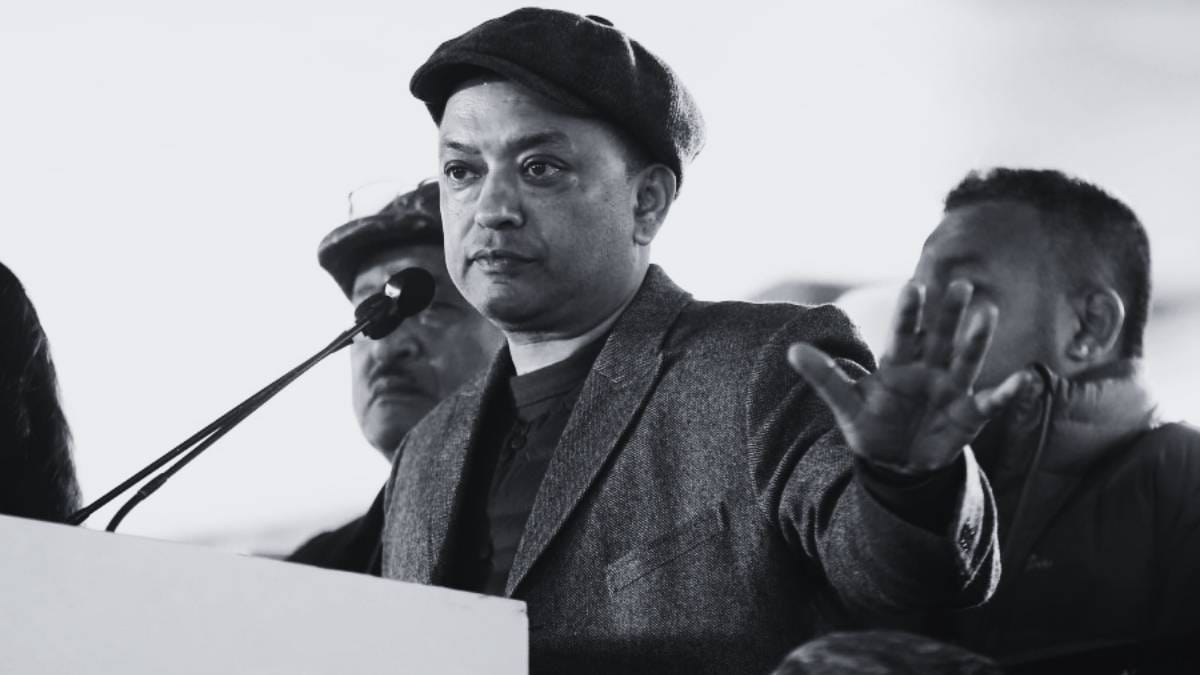
The man at the centre of the wreckage is Gagan Kumar Thapa, 49, who spent two decades demanding that Nepal’s senior leaders accept responsibility for failure. Now, with the bodies still being counted, those leaders—including Mr Thapa himself—and a growing chorus of analysts are asking whether he should apply that standard to himself.
The case for resignation writes itself. Mr Thapa gambled his personal credibility on contesting Sarlahi-4, a constituency in the Terai plains rather than his safe home seat of Kathmandu-4, where he had won three consecutive elections. The gamble was meant to signal a new Congress, reaching across ethnic and geographical lines. Instead a local academic named Amaresh Kumar Singh, running on Balen Shah’s Rastriya Swatantra Party ticket, won by a margin so big it constituted a verdict. Mr Thapa has spent fifteen years calling on his elders to resign after electoral disasters. His political identity is built on accountability. His critics say staying would tear that down.
But the case against resignation is, on closer inspection, the stronger one—at least for now. The new leadership committee was elected at a special convention on January 15th. Candidate nominations closed five days later. The election was 50 days after that. No party in any functioning democracy expects a leadership installed mid-crisis, with a split caucus and a hostile faction running passive sabotage operations, to reverse a multi-year accumulation of damage in seven weeks.
The September 2025 protests, in which the Oli government—with Congress as coalition partner—killed an estimated 77 demonstrators, had already poisoned the well long before Mr Thapa took the chairmanship. Home Minister Ramesh Lekhak was a Congress man. The blood was bipartisan.
The RSP wave that swept Nepal’s cities and young voters did not merely prefer Balen Shah’s party to Mr Thapa’s Congress: it treated both legacy parties as equally responsible for the political culture that produced the killings. First-time voters, of whom there were more than 800,000 following the protest registration surge, had no institutional loyalty to Congress to overcome. They were not abandoning the party so much as ignoring it.
That context does not clear Mr Thapa of responsibility. But it does make the question of accountability more complicated. The deeper issue is whether his resignation would solve the problem or make it worse. The honest answer is that it would make it worse.
No credible successor is positioned to unite the party without risking another split. The Deuba faction, whose passive resistance during the campaign contributed to the defeat, is the most organised group ready to fill any leadership vacuum. A Deuba restoration would reinforce the RSP’s central claim—that the old parties cannot reform themselves—and could hand it an easy decade in power. Nepal’s democracy already faces enough risks without its main opposition party turning into a museum piece.
The proportional representation count offers a slender lifeline. Congress has so far received 1.7m votes under the PR system, the second-largest share after RSP’s 5m. Under Nepal’s Webster allocation method, that could deliver an additional 19 seats, lifting the party’s total to perhaps 37—still the smallest parliamentary group in its modern history, but enough to qualify for formal opposition status and committee representation. From that platform, a disciplined Congress could force legislative debate; surface contradictions in RSP’s governing agenda; and remind Nepal’s voters that populist enthusiasm does not automatically convert into institutional competence. The RSP has never governed. The learning curve can be steep.
None of this is an argument for complacency. Mr Thapa’s continuation is only defensible if it comes with conditions. A public acknowledgment of collective failure. A faction-inclusive review of the campaign and the split. A full General Convention—not another special convention dominated by one tendency. And an explicit commitment that if the party has not achieved unity by the time that convention meets, he will not contest the chairmanship.
Nepal’s democratic tradition is fragile but real, and Congress built most of what exists. The party’s local government networks—mayors, ward chairs, councillors across the country—form a national infrastructure that the RSP cannot replicate below the federal tier. The foundations for recovery are there. Whether Mr Thapa or anyone else can use them depends less on any single resignation than on whether Congress can, for the first time in memory, put the survival of the party above factional interests. That has always been the party’s hardest problem. It has not become easier. ■




