IMAGE: REUTERS
THE REPORT landed on the interim prime minister’s desk three weeks ago. It weighs nearly three kilos. Its 907 pages catalogue 76 deaths, 2,522 injuries, 14,554 prisoners freed from their cells and 1,342 service weapons looted from police stations. It names former ministers, the former inspector-general of police, the chief of army staff and a former prime minister. It asks a question that Nepal’s new government would rather not answer: who gave the order to shoot?
The Gen-Z report, as it has come to be known after the protests that shook Kathmandu last September, is the most damning official document ever produced about the conduct of a Nepali government. Its conclusions are clinical. The decision to ban 26 social-media platforms on September 4th was taken without risk assessment and served as the primary trigger.
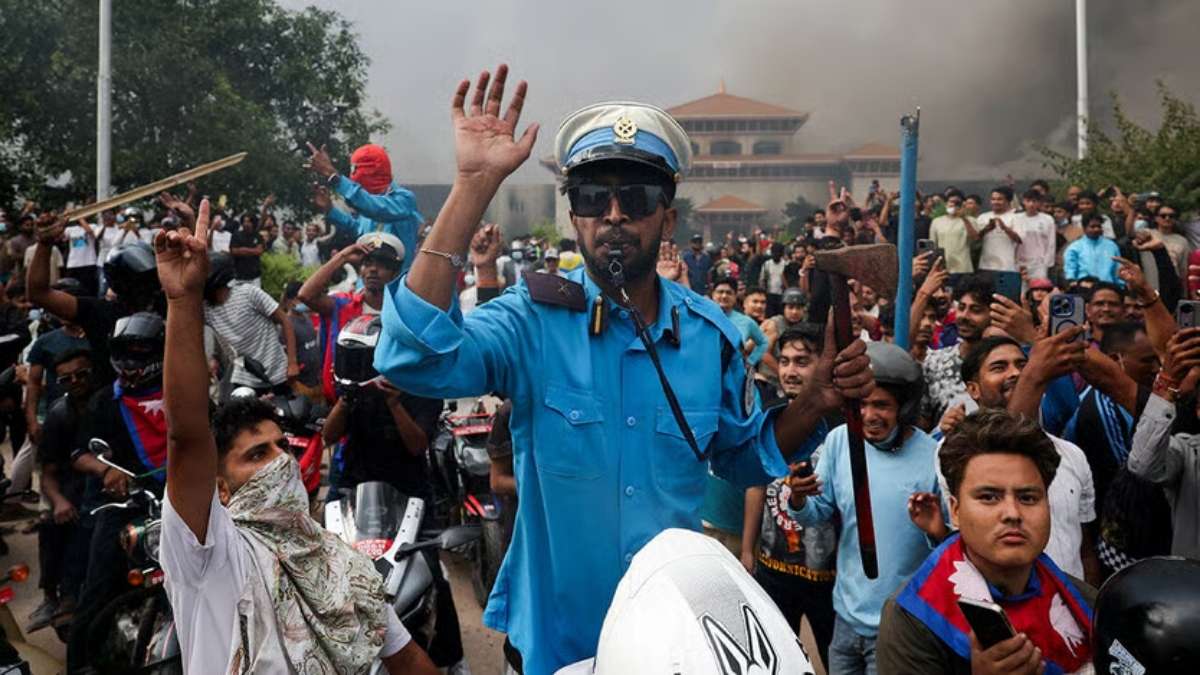
When protests swelled on September 8th, police ran out of tear gas, their barriers collapsed and field commanders resorted to live fire. The commission found the force used was “disproportionate and indiscriminate”. Seventeen protesters died that day. Twelve more later succumbed to wounds.
That would be a sufficient indictment of any government. The report’s second section is more troubling still. When news of the killings spread, the government imposed a curfew that came too late. On September 9th crowds overran police posts across the country. Armed mobs set fire to Singha Durbar, the government secretariat, the Supreme Court, the President’s Office and the prime minister’s residence. The Nepal Army, deployed nearby, did not intervene in time to prevent the attacks. The commission found the army’s role “passive and ineffective”, its stated principle of “life over property” used to justify inaction. Three police officers were killed. Nearly 120,000 rounds of ammunition were stolen.
The report does not stop at describing failure. It assigns responsibility. The then home minister, Ramesh Lekhak, is faulted for failing to order a ceasefire during four hours of confrontation at the parliament building. The then inspector-general of police, Chandra Kuber Khapung, is criticised for ordering the use of “necessary force” without defining what that meant, and for failing to maintain ballistic records that would identify which officers fired which weapons. The former chief of the National Investigation Department, Hutraj Thapa, is held responsible for an intelligence assessment that predicted 5,000 protesters when 20,000 appeared. The commission recommends criminal proceedings against each.
This poses a problem for the new prime minister, Balendra “Balen” Shah, whose Rastriya Swatantra Party won 182 seats on a platform of systemic change. Mr Shah ran against the old order. The old order, in this case, includes the man he defeated in the March 5th election, K.P. Sharma Oli, who was prime minister during the September violence.
The report suggests Mr Oli’s inaction contributed to the escalation: aware of the crisis, he did not coordinate security agencies; and delays in deciding to deploy the army meant much of the destruction occurred before any effective response.
For Mr Shah, the report is both a political inheritance and a trap. His party campaigned on investigating every public official since 1990. Voters who handed him a near-supermajority expect heads to roll. But the officials the commission wants prosecuted are men with networks, lawyers and the institutional memory of a bureaucracy that has spent decades learning to resist reform. Pursuing them would invite resistance from a civil service capable of slowing and diluting implementation, even if it cannot block it outright. The greater constraint lies in the legal process itself: cases must stand up in court, not just in politics. Acting risks friction across the state; letting them off would betray the mandate that put him in office.
There is a precedent for delay. Nepal has produced dozens of investigative commissions whose recommendations gathered dust. The difference this time is the scale of the violence and the clarity of the evidence. The commission obtained ballistic reports confirming the bullets came from weapons issued to security forces. It tracked planning on Discord servers where participants shared instructions for Molotov cocktails. It identified the moments when command broke down: the orders to withdraw from police stations that created a security vacuum; the failure to secure armoury rooms before retreating; and the absence of any coordinated response between the police, armed police and army.
That evidence has already shaped the political landscape. The RSP’s victory was built in part on the 76 people who died in September and the thousands who survived but watched their capital burn. A government that does nothing with the report risks becoming indistinguishable from the governments it replaced. A government that does everything risks grinding to a halt before it has begun.
Mr Shah has three options. He can let the report sit, hoping its weight alone will satisfy public anger. He can pursue the individuals it names, risking a confrontation with the state apparatus he needs to govern. Or he can use it as leverage: a document so damning that it gives him the authority to demand co-operation from a bureaucracy that knows, for once, that its own immunity is not assured.
The last option carries its own risks. In Nepal, even a revolution has a shelf life. The report’s 907 pages have already outlasted the government that caused the violence. If they outlast the government now charged with acting on them will determine if this commission joins the archives or becomes the rare document that changes how a state polices its own citizens. ■
This article has been amended.